Map of Germany showing where the Ewig arms are recorded
The Ewig arms were recorded in Germany, c. 1765.
Arms such as these were typically recorded in Bavaria.
Bavaria was a country of old landed families and walled market towns. Estates passed down the same line for centuries, and both the landowners and the leading townsmen kept arms, which is why so many Bavarian names sit in the registers.
This is where the arms were entered in the register. Families often moved to other parts of the country, so the same name can turn up in more than one region.
The body that granted and recorded arms in Germany in this period.
Francis I, Holy Roman Emperor
Sovereign of the period
Francis I, Holy Roman Emperor
1745–1765
Reigning in Germany when the Ewig arms are first recorded.
How Arms Worked in Germany
In the Holy Roman Empire, coats of arms were often granted to individuals by the Emperor or his representatives. These arms were then passed down through the generations to all legitimate descendants of the original holder. Younger branches of a family usually kept the same shield design without needing to change it, as the arms belonged to the entire lineage.
Granting authority
The Holy Roman Emperor held the sole power to grant new coats of arms throughout his vast imperial territories.
How they got arms
Families typically obtained their coats of arms through a formal imperial grant or by proving their noble status to the authorities.
Where arms were recorded
These grants were officially recorded in the Imperial Chancery registers, which began keeping formal records of such honors during the Middle Ages.
The family's standing
Recorded among the armigerous families of Germany.
Origin & History of the Ewig Family in Germany
The family name Ewig is rooted in the German language, where the word *ewig* translates to "eternal" or "everlasting." Historically, such names often began as descriptive nicknames or occupational identifiers in medieval German society. By the mid-eighteenth century, records confirm that members of the Ewig family were established in the region of Bavaria. During this era, Bavaria was a collection of territories governed by the House of Wittelsbach, and life for families like the Ewigs was centered around agrarian work and local village communities. Because the name carries a sense of permanence, it may have originally been given to someone who was known for their patience or perhaps someone who lived in a location associated with a long-standing landmark. As the family grew in the 1760s, they became part of the social fabric of the Bavarian countryside, contributing to the local culture and economy of the Holy Roman Empire.
Coat of Arms & Family Crest Details
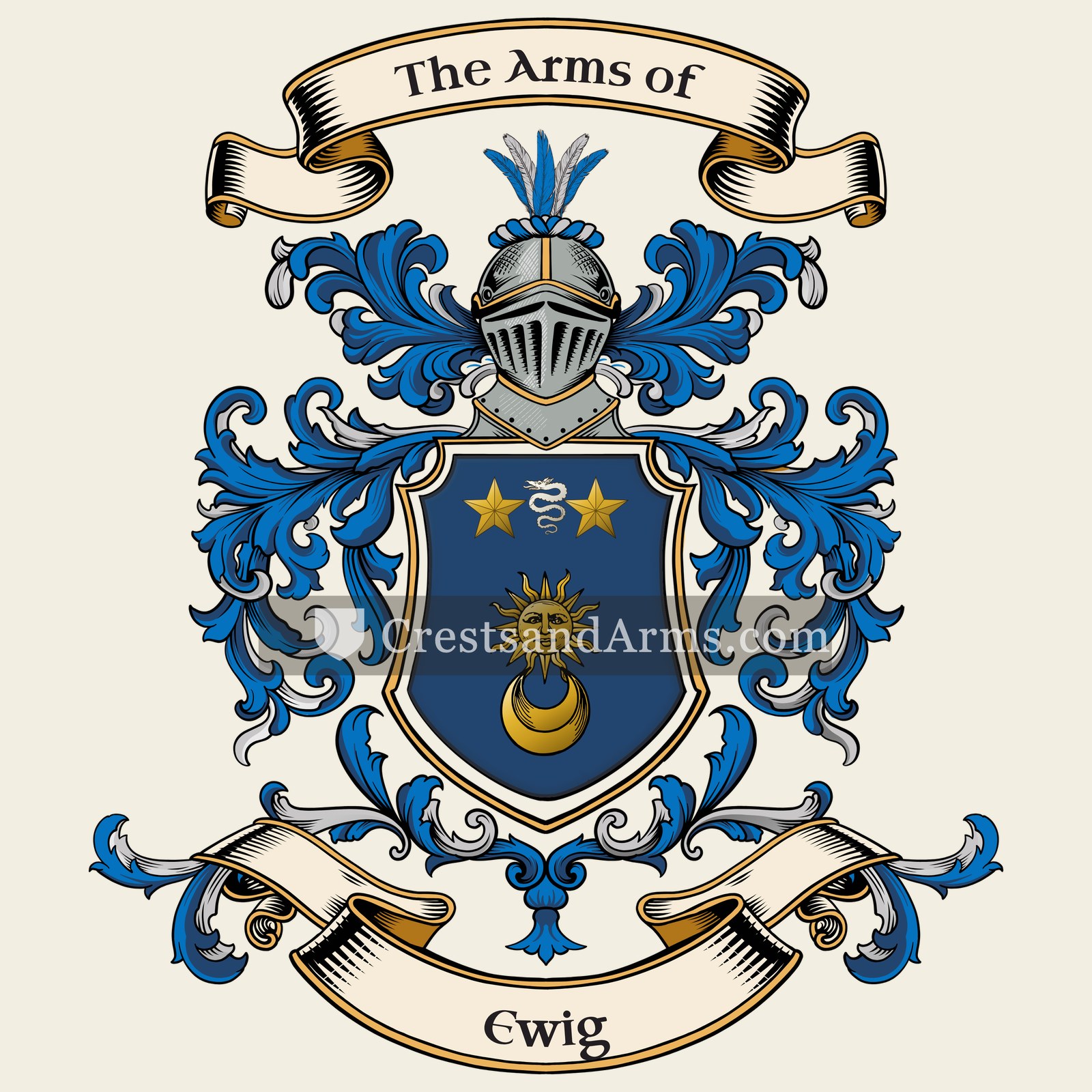
Symbols on this shield
sunGlory, splendour and the source of life
serpentWisdom, healing and prudence
mulletThe third son, and a divine quality from above
crescentHonour by the sovereign, and the second son
Colours
Blue (Azure)Means: Loyalty and truth
Gold (Or)Means: Generosity
Silver (Argent)Means: Peace and sincerity
Historical info
Source
J. B. Rietstap, Armorial Général, Gouda: G. B. van Goor Zonen, 1884–87
Blazon (the actual original written record)
“D'azur à un soleil d'or, entouré d'un serpent d'arg., plié en rond, se mordant la queue; le tout acc. en chef de deux étoiles d'or et en p. d'un croiss. figuré montant du même. Cq. cour. C.: une étoile d'or, soutenue d'un croiss. figuré montant du même.”
SwitzerlandBâle, c. 1745
Digital archive packCoat of arms PNG, gold border print PDF, vector SVG and the certificate of authenticity. Sent to your email in minutes.
Map of Switzerland showing where the Ewig arms are recorded
The Ewig arms were recorded in Bâle, c. 1745.
This is where the arms were entered in the register. Families often moved to other parts of the country, so the same name can turn up in more than one region.
The body that granted and recorded arms in Switzerland in this period.
How Arms Worked in Switzerland
In Switzerland, coats of arms were not restricted to the nobility and were often adopted by common citizens and families. These symbols were passed down through generations to show family identity. When branches of a family grew, they often changed small details of the design to distinguish their own line from the original group.
Granting authority
Cantonal and civic authorities managed the use of coats of arms within their specific regions and local jurisdictions.
How they got arms
Families typically assumed their own coats of arms based on local custom rather than receiving them from a central monarch.
Where arms were recorded
Arms were recorded in various cantonal and civic registers starting from the fourteenth century throughout the Swiss region.
The family's standing
Recorded among the armigerous families of Switzerland.
Origin & History of the Ewig Family in Switzerland
The surname Ewig carries deep roots in the German-speaking regions of Switzerland, where it first appeared in historical records as early as the mid-18th century. By 1745, members of the Ewig family were established residents of Basel, a city that served as a vital hub for trade and craftsmanship along the Rhine River. During this period, the family likely integrated into the local guild system, which was the primary way for citizens to participate in the political and economic life of the city. Because the name Ewig translates to "eternal" or "everlasting" in German, it may have originated as a descriptive nickname for a person with a steady temperament or a long-standing family presence in a specific village. As these early ancestors navigated the social landscape of Basel, they contributed to the urban development of the region, leaving behind a legacy that is preserved in the city’s meticulous baptismal and civil registries.
Ewig Meaning & Related Branches
Root word
ewig
German adjective meaning eternal or everlasting.
This name
EwigA descriptive surname originally used to describe a person who was constant or long-lived.
also spelled
Ewigg
Ewige
Evig
Documented Sources
J. B. Rietstap, Armorial Général, Gouda: G. B. van Goor Zonen, 1884–87


 leafHappiness and abundance
 leafHappiness and abundance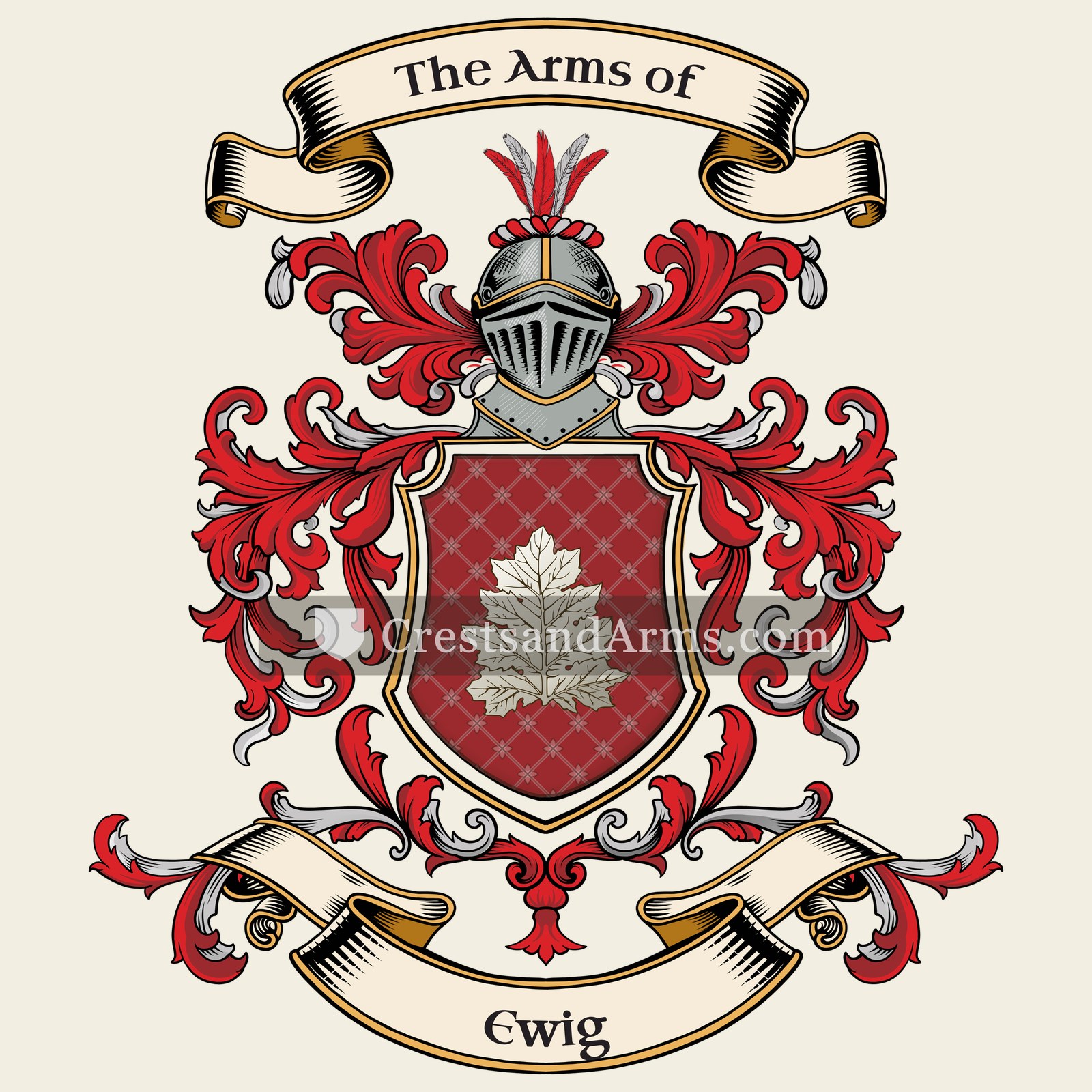


 sunGlory, splendour and the source of life
 serpentWisdom, healing and prudence
 mulletThe third son, and a divine quality from above
 crescentHonour by the sovereign, and the second son