A record of documented arms, meaning and origin, researched for the Eyre family lines. Documented in 3 countries.
Reg. 3912 · Britain, D–F
Coat of Arms & Family Crest Details
Symbols on this shield
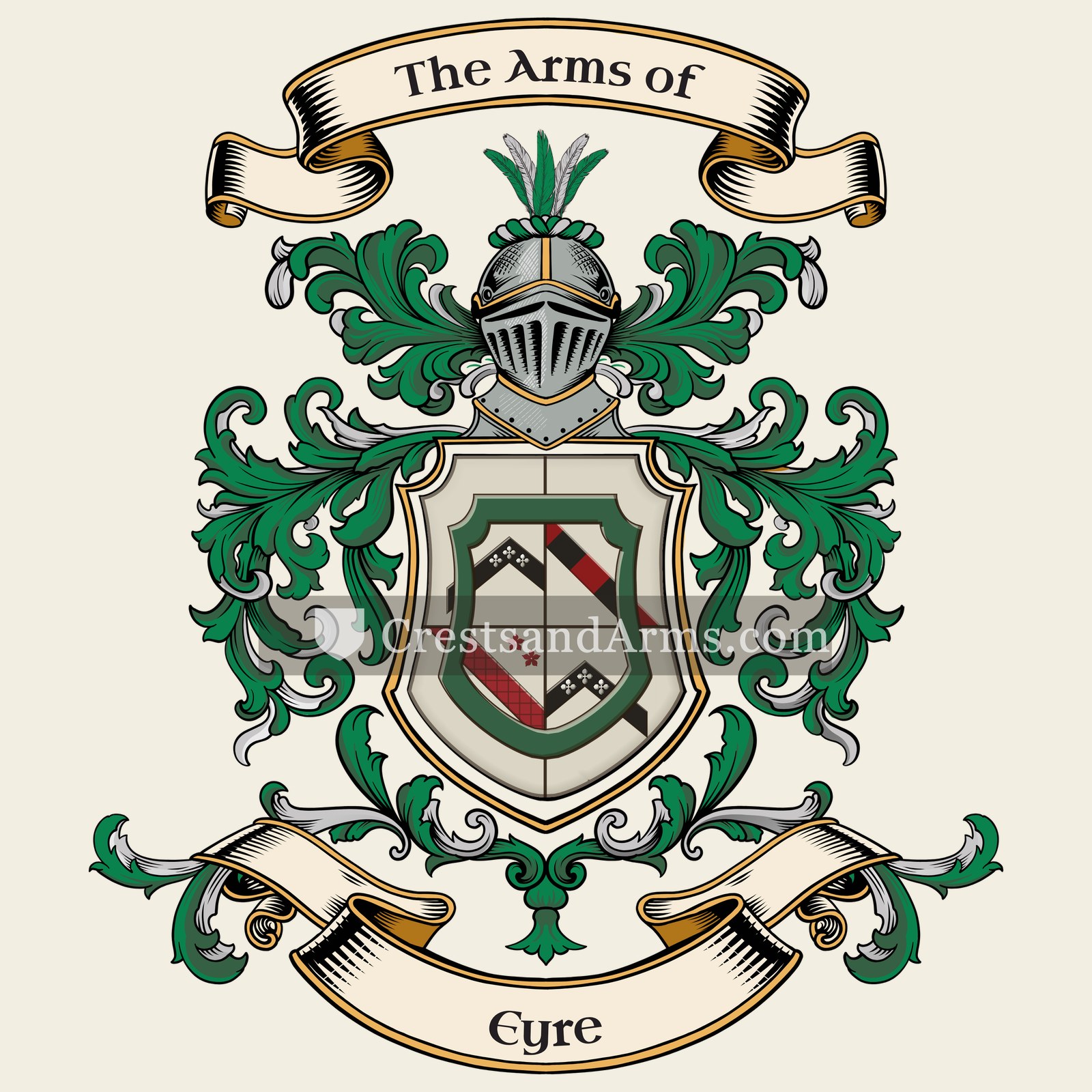
chevronProtection, and faithful service completed
bendDefence, and the scarf of a commander
plant quatrefoilGood fortune and the fourfold gospel
cinquefoilHope and joy
Colours
Silver (Argent)Means: Peace and sincerity
Green (Vert)Means: Hope
Black (Sable)Means: Constancy
Red (Gules)Means: Military strength
Historical info
Source
J. B. Rietstap, Armorial Général, Gouda: G. B. van Goor Zonen, 1884–87
Blazon (the actual original written record)
“Ec.: aux 1 et 4 d'arg. au chev. de sa., ch. de trois quartefeuilles du champ (Eyre); au 2 d'arg. à la bande engr. de sa. (Radcliffe); au 3 d'arg. à la bande de gu., acc. de trois quintefeuilles du même et ch. d'un ancre du champ; le tout enclos dans un double trècheur fleur. et c.-fleur. de sin. (Livingstone). C.: une jambe arm., partie d'arg. et de sa., arr. de gu., éperonnée d'or. T.: à dextre un sauvage de carn., ceint et cour. de lierre; à sen. un cheval d'arg., bridé de gu. D.: SI JE PUIS.”
Britainc. 1647
Digital archive packCoat of arms PNG, gold border print PDF, vector SVG and the certificate of authenticity. Sent to your email in minutes.
Map of Britain showing where the Eyre arms are recorded
The Eyre arms were recorded in Britain, c. 1647.
Arms such as these were typically recorded in Kent.
Kent sits between London and the short crossing to Europe, and the trade passing through made it wealthy. Merchant families bought land with that money, and it was landowners who took coats of arms.
This is where the arms were entered in the register. Families often moved to other parts of the country, so the same name can turn up in more than one region.
The body that granted and recorded arms in Britain in this period.
Charles I of England
Sovereign of the period
Charles I of England
1625–1649
Reigning in Britain when the Eyre arms are first recorded.
How Arms Worked in Britain
English heraldry allowed arms to be shared by all legitimate descendants of the original owner. These symbols were treated as personal property that moved through the generations to all children. While the eldest son kept the original design, other family members could use the same shield without needing to change it or register their own unique versions.
Granting authority
The College of Arms in London has regulated the use of coats of arms throughout England and Wales since 1484.
How they got arms
Families typically obtained their coats of arms through a formal grant from the Crown or by proving their ancient right to them.
Where arms were recorded
All official coats of arms are recorded in the registers kept at the College of Arms, which date back to the fifteenth century.
The family's standing
Recorded among the armigerous families of Britain.
Origin & History of the Eyre Family in Britain
The surname Eyre is believed to have originated as a descriptive nickname for a person who was known for being an heir or a person of high standing in their community. While the name has roots in various parts of England, historical records confirm that members of the Eyre family were well established in the county of Kent by the mid-seventeenth century. During this period, families with this name often worked as landowners or local officials who played active roles in the social and economic life of their parishes. As the family grew, they became deeply connected to the local landscape and the changing political climate of the British Isles. By settling in Kent, these early ancestors helped build the foundation for the family name to persist through generations of English history.
Coat of Arms & Family Crest Details
Symbols on this shield
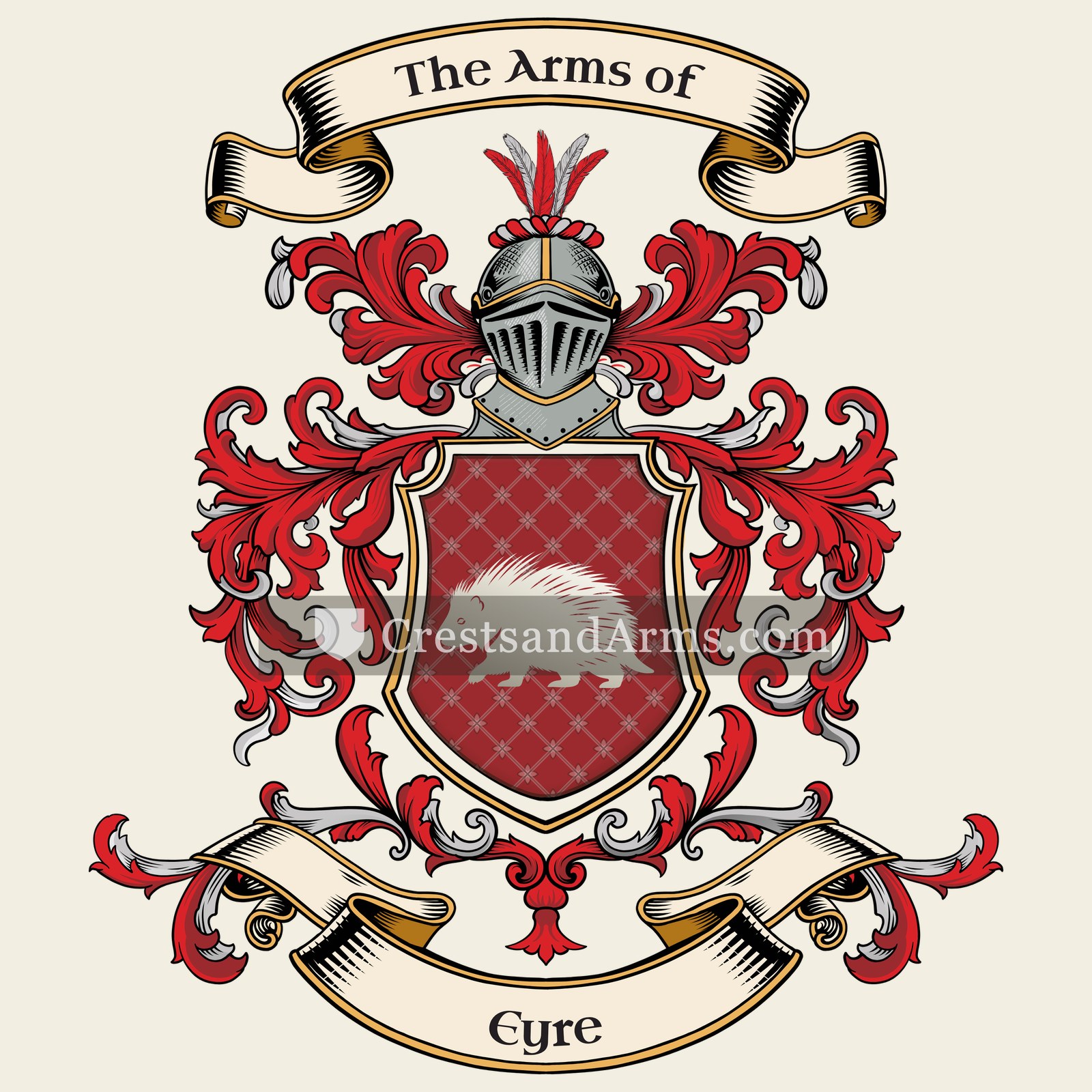
hedgehogA provident provider
Colours
Red (Gules)Means: Military strength
Silver (Argent)Means: Peace and sincerity
Historical info
Source
Sir Bernard Burke, The General Armory of England, Scotland, Ireland and Wales, London: Harrison & Sons, 1884
Blazon (the actual original written record)
“Gu. a porcupine salient ar. quilled and chained or”
EnglandLondon, c. 1445
Digital archive packCoat of arms PNG, gold border print PDF, vector SVG and the certificate of authenticity. Sent to your email in minutes.
Map of England showing where the Eyre arms are recorded
The Eyre arms were recorded in London, c. 1445.
This is where the arms were entered in the register. Families often moved to other parts of the country, so the same name can turn up in more than one region.
The body that granted and recorded arms in England in this period.
Henry VI of England
Sovereign of the period
Henry VI of England
1422–1461
Reigning in Britain when the Eyre arms are first recorded.
How Arms Worked in England
English heraldry allowed arms to be shared by all legitimate descendants of the original owner. These symbols were treated as personal property that moved through the generations to all children. While the eldest son kept the original design, other family members could use the same shield without needing to change it or register their own unique versions.
Granting authority
The College of Arms in London has regulated the use of coats of arms throughout England and Wales since 1484.
How they got arms
Families typically obtained their coats of arms through a formal grant from the Crown or by proving their ancient right to them.
Where arms were recorded
All official coats of arms are recorded in the registers kept at the College of Arms, which date back to the fifteenth century.
The family's standing
Recorded among the armigerous families of England.
Origin & History of the Eyre Family in England
The family name Eyre has deep roots in English history, emerging as a surname during the Middle Ages when people began adopting descriptive names based on their occupations or personal traits. The name is often associated with the Old French word for an heir, suggesting that early ancestors may have held a notable position or inherited property. By the year 1445, records confirm that members of the Eyre family were well-established in London, where they participated in the city’s growing commercial and civic life. During this period, the family became part of the urban middle class, contributing to the development of London as a major center of trade and government. Their presence in the capital during the fifteenth century highlights how the family successfully integrated into the social fabric of England, moving from regional origins to the heart of the nation’s political and economic activity.
Coat of Arms & Family Crest Details
Symbols on this shield
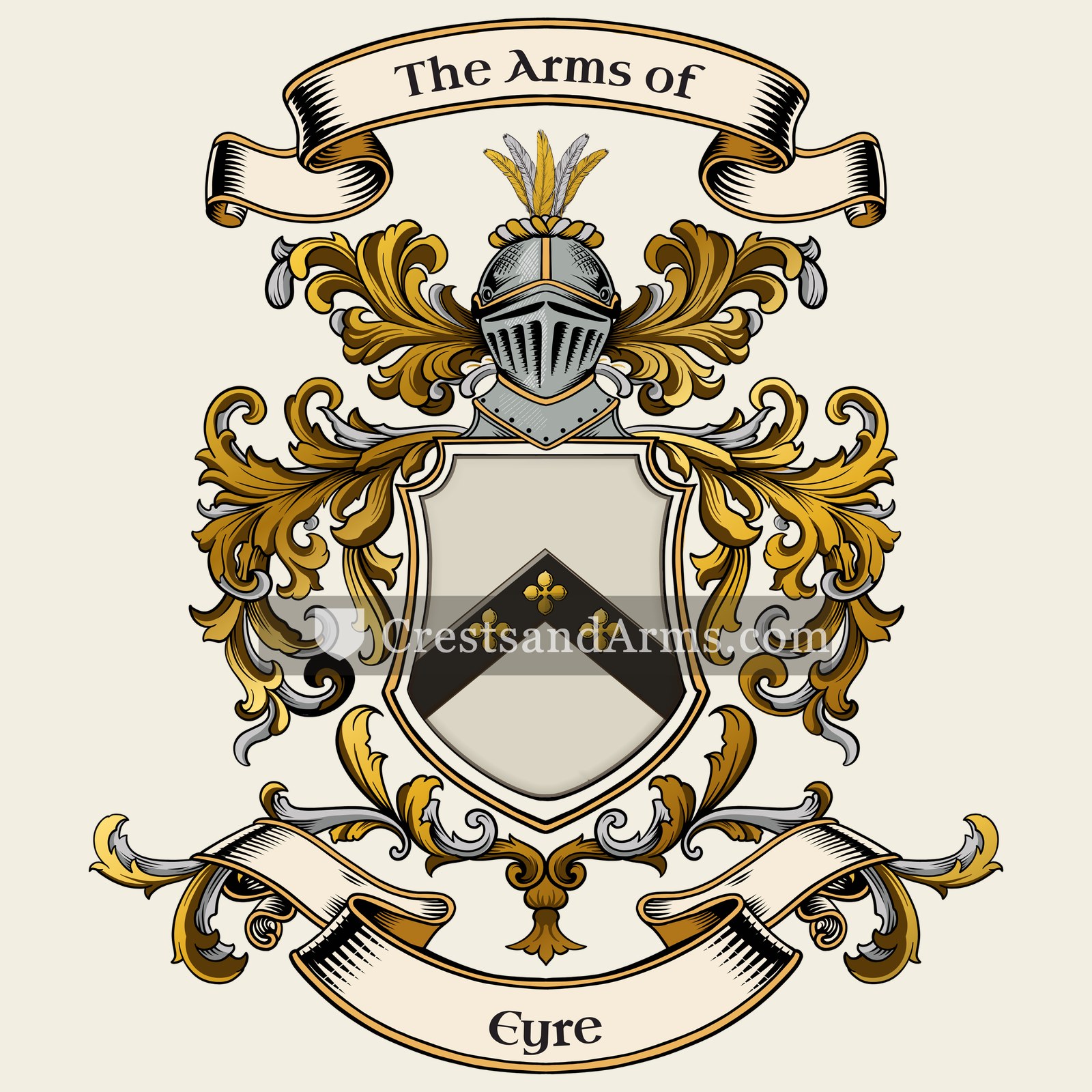
chevronProtection, and faithful service completed
plant quatrefoilGood fortune and the fourfold gospel
Colours
Silver (Argent)Means: Peace and sincerity
Black (Sable)Means: Constancy
Gold (Or)Means: Generosity
Historical info
Source
Sir Bernard Burke, The General Armory of England, Scotland, Ireland and Wales, London: Harrison & Sons, 1884
Blazon (the actual original written record)
“Ar. on a chev. sa. three quatrefoils or”
GalwayEyre Court · Galway, c. 1683
Digital archive packCoat of arms PNG, gold border print PDF, vector SVG and the certificate of authenticity. Sent to your email in minutes.
Map of Ireland showing where the Eyre arms are recorded
The Eyre arms were recorded in Galway, c. 1683.
Galway was western Irish country of poor land and a rich port. A small group of merchant families ran the town for centuries and held estates around it, and both kinds of property carried arms.
This is where the arms were entered in the register. Families often moved to other parts of the country, so the same name can turn up in more than one region.
The body that granted and recorded arms in Ireland in this period.
Charles II of England
Sovereign of the period
Charles II of England
1660–1685
Reigning in Britain when the Eyre arms are first recorded.
How Arms Worked in Ireland
The Ulster King of Arms granted coats of arms to individuals who proved their social standing and good character. These symbols were typically inherited by all legitimate descendants of the original holder. If a family branch wanted a unique look, they could apply for a specific change to their design through the office to ensure their identity remained distinct.
Granting authority
The Ulster King of Arms acted as the official body that regulated and issued all coats of arms throughout Ireland.
How they got arms
Families obtained their arms through formal grants issued by the office after proving their eligibility and paying the required fees.
Where arms were recorded
All official grants were recorded in the registers held by the Ulster King of Arms starting from the year 1552.
The family's standing
Recorded among the armigerous families of Galway.
Origin & History of the Eyre Family in Ireland
The Eyre family established a significant presence in Ireland during the seventeenth century, most notably settling in County Galway by 1683. While the name itself has roots in medieval England, the Irish branch became deeply integrated into the social and political landscape of the west of Ireland following the Cromwellian period. Members of the family rose to prominence as landowners and civic leaders, often serving in administrative roles that helped shape the development of Galway city. Their influence grew through strategic marriages and the acquisition of large estates, which allowed them to maintain a position of authority for several generations. By embedding themselves in the local governance and economic life of the region, the Eyres transitioned from newcomers to a central part of the Anglo-Irish establishment during a time of great transition in Irish history.
Eyre Meaning & Related Branches
Root word
Eir
Old Norse word for mercy or peace
This name
EyreAn occupational name for an heir or a topographic name for someone living near a gravelly bank
also spelled
Eire
Air
Eyer
Eyers
Related arms
Ayervariant spelling
Eyervariant spelling
Eyersvariant spelling
Bistonrecorded with Eyre, same area
Documented Sources
J. B. Rietstap, Armorial Général, Gouda: G. B. van Goor Zonen, 1884–87
Reaney, P.H., A Dictionary of English Surnames, 1958
Lower, Mark Antony, Patronymica Britannica: A Dictionary of the Family Names of the United Kingdom, 1860
The National Archives, Prerogative Court of Canterbury and related Probate Jurisdictions: Will Registers, 1647
Digital archive packCoat of arms PNG, gold border print PDF, vector SVG and the certificate of authenticity. Sent to your email in minutes.


 chevronProtection, and faithful service completed
 bendDefence, and the scarf of a commander
 plant quatrefoilGood fortune and the fourfold gospel
 cinquefoilHope and joy
 chevronProtection, and faithful service completed
 bendDefence, and the scarf of a commander
 plant quatrefoilGood fortune and the fourfold gospel
 cinquefoilHope and joy


 hedgehogA provident provider