Map of Netherlands showing where the Fabricius arms are recorded
The Fabricius arms were recorded in Netherlands, c. 1815.
Arms such as these were typically recorded in Friesland.
Friesland was low, wet country on the northern coast of the Netherlands, farmed by families who had held the same land for centuries. Free landholders were unusually common there, and a free landholder could carry arms.
This is where the arms were entered in the register. Families often moved to other parts of the country, so the same name can turn up in more than one region.
Region
Friesland
First recorded
1815
Granting Authority for the Fabricius Arms
Hoge Raad van Adel
Photograph made by me · CC BY-SA 3.0
The body that granted and recorded arms in Netherlands in this period.
William I of the Netherlands
Sovereign of the period
William I of the Netherlands
1815–1840
Reigning in Netherlands when the Fabricius arms are first recorded.
How Arms Worked in Netherlands
In the Netherlands, coats of arms were often used by noble families and those who held specific public offices. These arms were passed down through the generations to legitimate descendants. Younger branches of a family usually kept the original design without needing to add special marks. This system ensured that the family identity remained clear and consistent over many years.
Granting authority
The Hoge Raad van Adel is the official body that regulates and manages noble titles and coats of arms in the Netherlands.
How they got arms
Families typically obtained their coats of arms through official royal grants or by proving their long-standing historical use of the symbols.
Where arms were recorded
Coats of arms are officially recorded in the registers held by the Hoge Raad van Adel, which began its work in 1814.
The family's standing
Recorded among the armigerous families of Netherlands.
Origin & History of the Fabricius Family in Netherlands
The name Fabricius originates from the Latin word for a craftsman or smith, often serving as a professional surname for those who worked with metal. By the time the family became established in the province of Friesland in the early nineteenth century, the name had already been used for generations across Europe as a way to honor classical traditions. In the Netherlands, families adopting this name often held positions of importance within their local communities, frequently working as scholars, ministers, or skilled tradespeople. When the family appeared in Frisian civil records around 1815, they were part of a broader trend where Dutch citizens officially registered their surnames during the Napoleonic era. This period of formal documentation helped solidify the family identity within the region, linking their history to the unique cultural and social landscape of northern Dutch life.
Coat of Arms & Family Crest Details
Symbols on this shield
mountThe ground held, and steadfastness upon it
keyGuardianship, and the office of a steward
swordJustice, and military honour
palm treeVictory, and righteousness that flourishes
Colours
Gold (Or)Means: Generosity
Silver (Argent)Means: Peace and sincerity
Green (Vert)Means: Hope
Blue (Azure)Means: Loyalty and truth
Historical info
Source
J. B. Rietstap, Armorial Général, Gouda: G. B. van Goor Zonen, 1884–87
Blazon (the actual original written record)
“Coupé: au 1 d'or à une clé en bande et une épée br. en barre, passées en saut., le panneton de la clé tourné vers le chef, le tout d'azur; au 2 d'arg. à un palmier de sin., terrassé du même. C.: le palmier. L. d'or et d'azur.”
GermanyAltdorf Bav, c. 1765
Digital archive packCoat of arms PNG, gold border print PDF, vector SVG and the certificate of authenticity. Sent to your email in minutes.
Map of Germany showing where the Fabricius arms are recorded
The Fabricius arms were recorded in Altdorf Bav, c. 1765.
This is where the arms were entered in the register. Families often moved to other parts of the country, so the same name can turn up in more than one region.
The body that granted and recorded arms in Germany in this period.
Francis I, Holy Roman Emperor
Sovereign of the period
Francis I, Holy Roman Emperor
1745–1765
Reigning in Netherlands when the Fabricius arms are first recorded.
How Arms Worked in Germany
In the Holy Roman Empire, coats of arms were often granted to individuals by the Emperor or his representatives. These arms were then passed down through the generations to all legitimate descendants of the original holder. Younger branches of a family usually kept the same shield design without needing to change it, as the arms belonged to the entire lineage.
Granting authority
The Holy Roman Emperor held the sole power to grant new coats of arms throughout his vast imperial territories.
How they got arms
Families typically obtained their coats of arms through a formal imperial grant or by proving their noble status to the authorities.
Where arms were recorded
These grants were officially recorded in the Imperial Chancery registers, which began keeping formal records of such honors during the Middle Ages.
The family's standing
Recorded among the armigerous families of Germany.
Origin & History of the Fabricius Family in Germany
The surname Fabricius carries a deep connection to the intellectual and professional landscape of Germany, as it is the Latinized form of the German name Schmidt, meaning blacksmith. During the Renaissance and the Enlightenment, it was common for scholars, clergy, and educated professionals to translate their surnames into Latin to signal their academic standing. By the time the family was firmly established in the university town of Altdorf by 1765, the name had become a marker of a family deeply integrated into the German middle class. Altdorf was a significant center for learning due to its famous university, and families like the Fabricius line often served as teachers, lawyers, or administrators who helped shape the local community. This transition from a trade-based name to a Latinized scholarly identity reflects the broader movement of German families seeking to align themselves with the prestige of classical education and public service during the eighteenth century.
Coat of Arms & Family Crest Details
Symbols on this shield
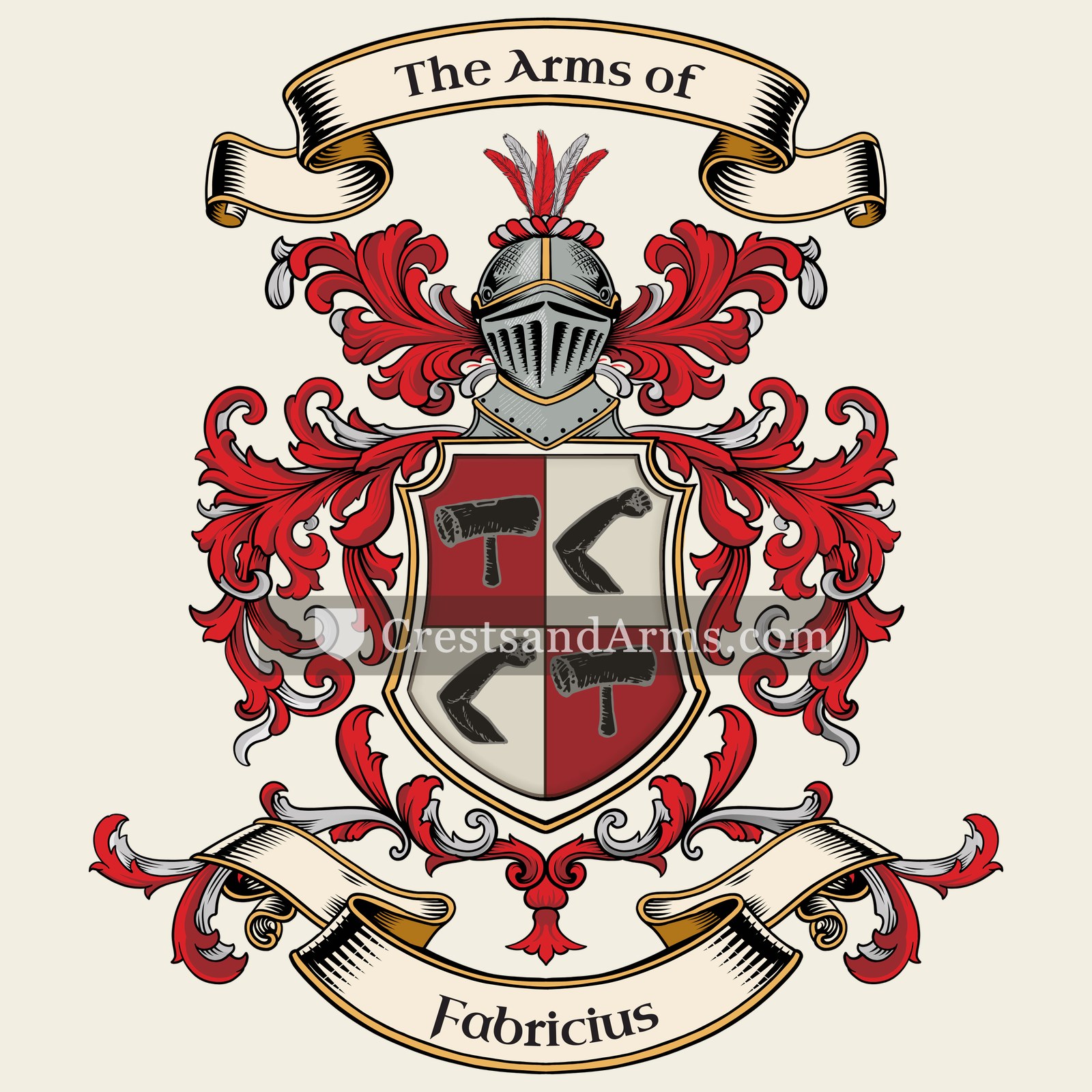
hammerHonest labour, and the smith's craft
armA person of action, industrious and laborious
Colours
Red (Gules)Means: Military strength
Silver (Argent)Means: Peace and sincerity
Black (Sable)Means: Constancy
Historical info
Source
J. B. Rietstap, Armorial Général, Gouda: G. B. van Goor Zonen, 1884–87
Blazon (the actual original written record)
“Ec.: aux 1 et 4 de gu. à une enclume de sa.; au 2 d'arg. à un senestrochère, paré de sa., rebr. d'arg., mouv. du flanc, la main de carn. empoignant un marteau de sa., emm. d'or; au 3 d'arg. au dextrochère mouv. du flanc, paré et tenant un marteau comme le senestrochère du 2. Cq. cour. C.: le bras, posé en pal, entre un vol coupé, à dextre de sa. sur arg., à sen. d'arg. sur gu. L.: à dextre d'or et de sa., à sen. d'arg. et de gu.”
Francec. 1774
Digital archive packCoat of arms PNG, gold border print PDF, vector SVG and the certificate of authenticity. Sent to your email in minutes.
Map of France showing where the Fabricius arms are recorded
The Fabricius arms were recorded in France, c. 1774.
Arms such as these were typically recorded in Bretagne.
More families held coats of arms in Bretagne than anywhere else in France. The land was divided into many small estates rather than a few large ones, so far more households counted as gentry, and each needed a shield of its own to be told apart.
This is where the arms were entered in the register. Families often moved to other parts of the country, so the same name can turn up in more than one region.
The body that granted and recorded arms in France in this period.
Louis XV of France
Sovereign of the period
Louis XV of France
1715–1774
Reigning in Netherlands when the Fabricius arms are first recorded.
How Arms Worked in France
In France, a coat of arms was a mark of honor that passed down through the male line to all legitimate descendants. Families often used the same shield without changes to show their shared heritage. If a branch wanted to stand out, they could add a small mark to their shield to show their specific place in the family tree.
Granting authority
The Juge d'armes de France acted as the official authority that regulated and verified coats of arms across the country.
How they got arms
Families typically inherited their arms from ancestors, though they could also receive them through royal grants or by proving their noble status.
Where arms were recorded
Coats of arms were officially recorded in the Armorial Général de France, which began its main collection in the year 1696.
The family's standing
Recorded among the armigerous families of France.
Origin & History of the Fabricius Family in France
The name Fabricius finds its roots in the Latin word for a craftsman or a smith, which suggests that the earliest ancestors of the family likely held roles as skilled metalworkers or builders. While the name is often associated with broader European history, records confirm that the family was firmly established in the Brittany region of France by 1774. During this period, families with this name were often integrated into the professional and administrative classes of French society. Because the name carries a classical Latin origin, it was frequently adopted by scholars, clergy, and intellectuals who wished to honor their trade or their academic pursuits. By the late eighteenth century, the Fabricius family in Brittany lived through a time of significant social change, as the region transitioned from traditional provincial life toward the upheaval of the French Revolution. This history reflects a lineage that valued both practical craftsmanship and the intellectual prestige associated with their distinctive, Latin-based surname.
Fabricius Meaning & Related Branches
Root word
faber
A Latin term referring to a craftsman, smith, or maker.
This name
FabriciusDerived from the Latin word for a blacksmith or artisan, indicating a family of metalworkers.
also spelled
Fabrishius
Related arms
Felwingerrecorded with Fabricius, same area
Glatzrecorded with Fabricius, same area
Meviusrecorded with Fabricius, same area
Odontiusrecorded with Fabricius, same area
Documented Sources
J. B. Rietstap, Armorial Général, Gouda: G. B. van Goor Zonen, 1884–87
Meertens, P.J., De betekenis van de Nederlandse familienamen, 1950
Tresoar (Frisian Historical and Literary Center), Burgerlijke Stand van Friesland (Civil Registry of Friesland) 1811-1950
Van der Schaar, J., Woordenboek van voornamen, 1964
Digital archive packCoat of arms PNG, gold border print PDF, vector SVG and the certificate of authenticity. Sent to your email in minutes.


 fessThe military belt, and readiness to serve
 swanGrace, light and the poet's art
 fessThe military belt, and readiness to serve
 swanGrace, light and the poet's art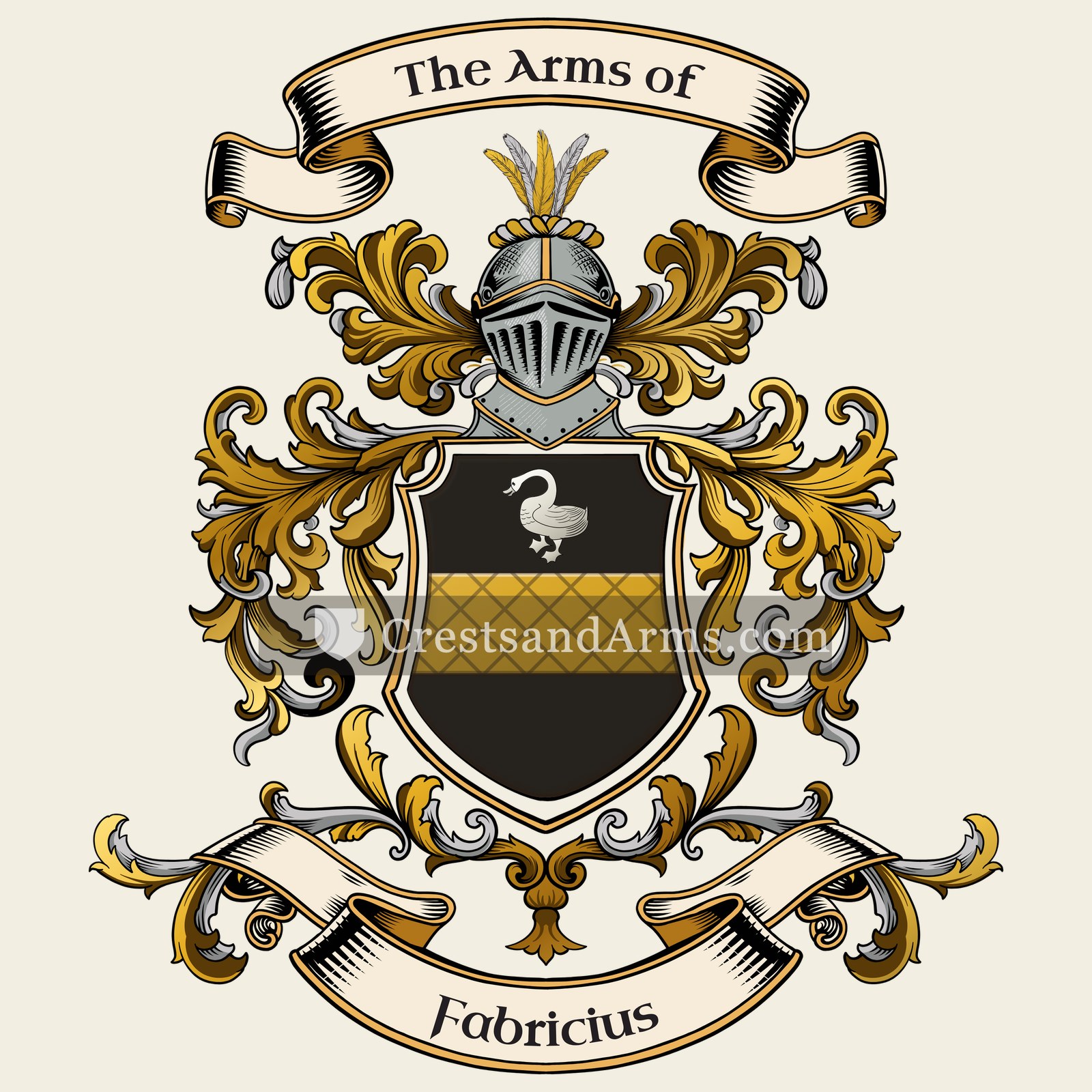


 mountThe ground held, and steadfastness upon it
 keyGuardianship, and the office of a steward
 swordJustice, and military honour
 palm treeVictory, and righteousness that flourishes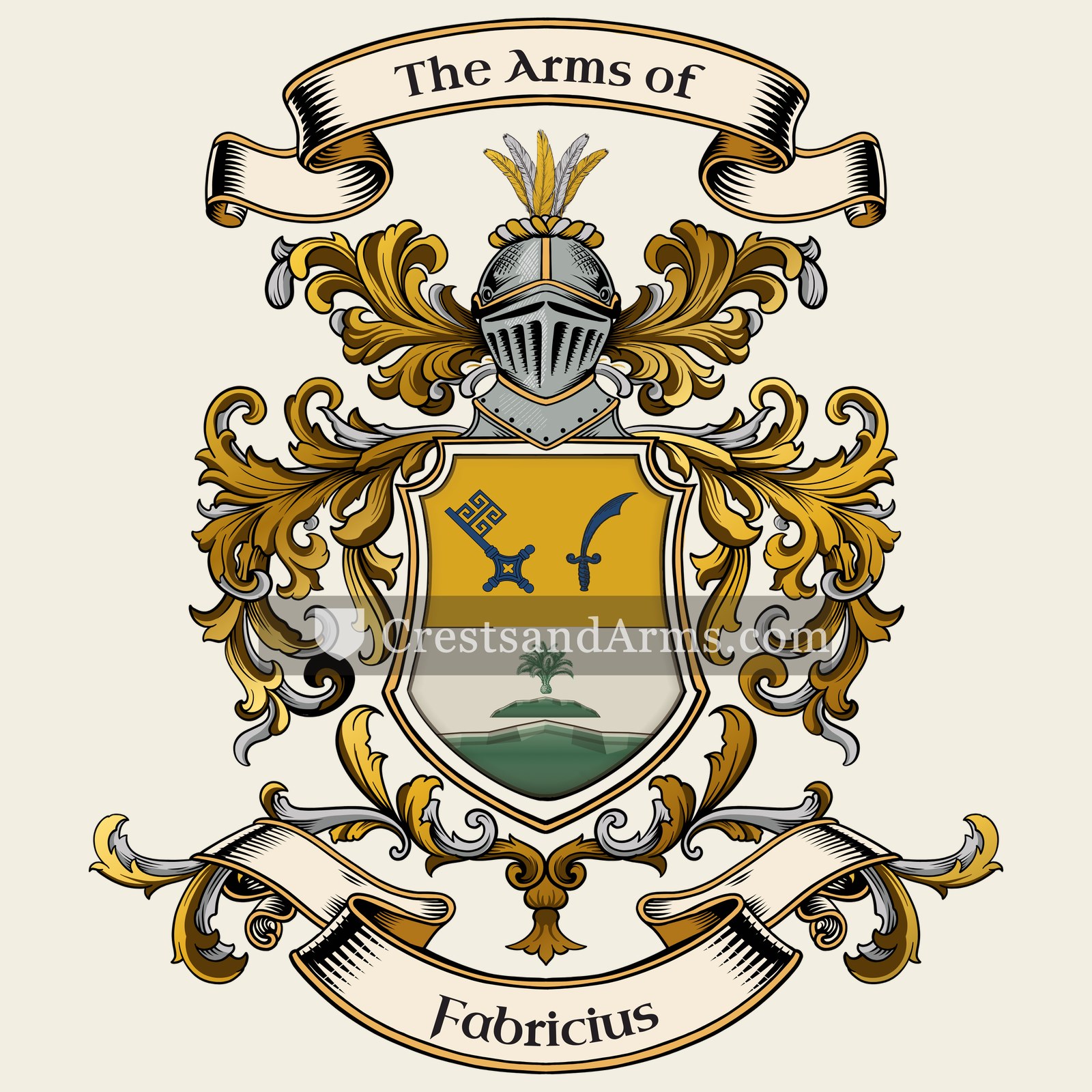


 hammerHonest labour, and the smith's craft
 armA person of action, industrious and laborious