A record of documented arms, meaning and origin, researched for the Fabris family lines. Documented in 2 countries.
Reg. 9813 · German, D–F
Coat of Arms & Family Crest Details
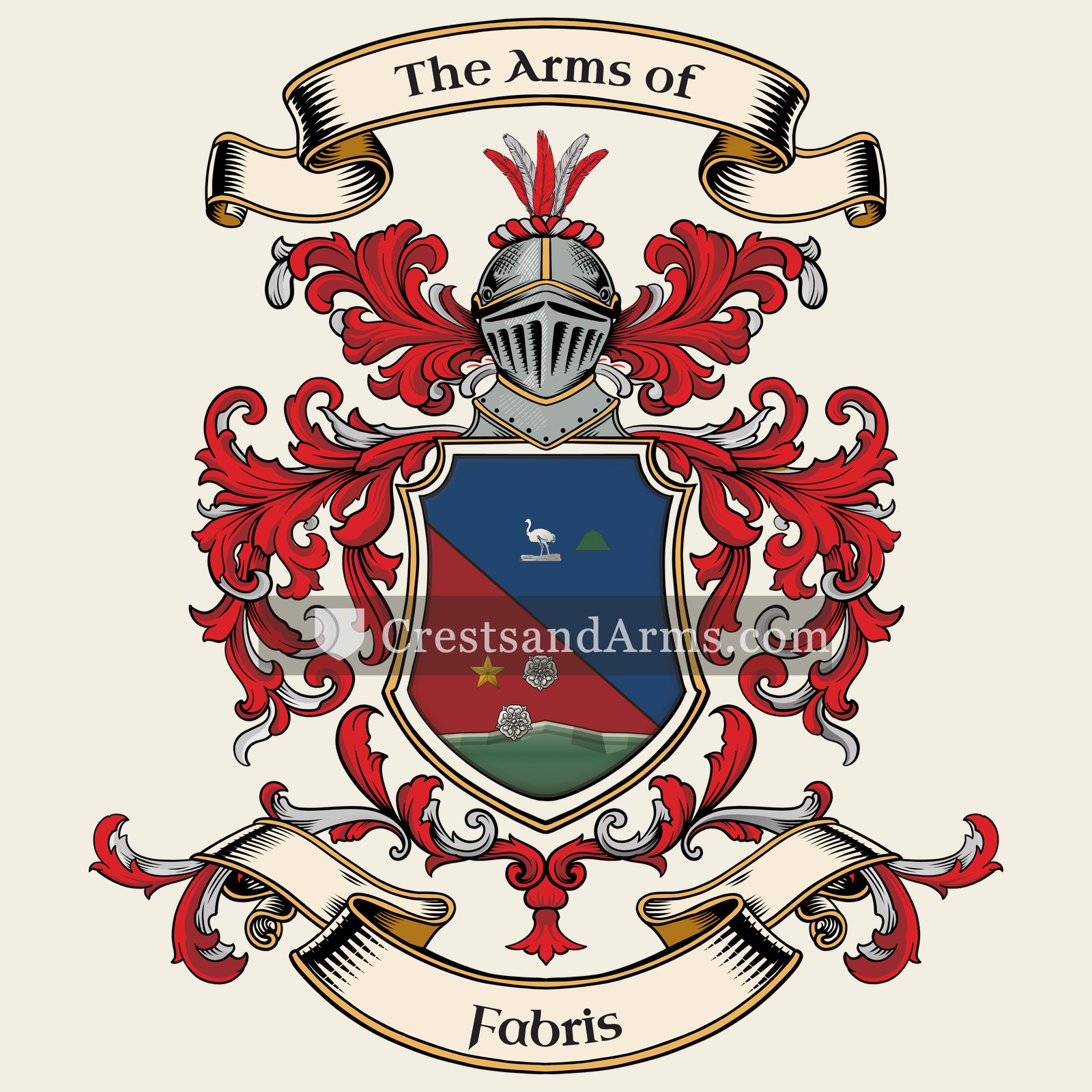
Symbols on this shield
mountThe ground held, and steadfastness upon it
mulletThe third son, and a divine quality from above
roseThe seventh son, and beauty with grace
ostrichWilling obedience and serious thought
Colours
Red (Gules)Means: Military strength
Blue (Azure)Means: Loyalty and truth
Green (Vert)Means: Hope
Gold (Or)Means: Generosity
Silver (Argent)Means: Peace and sincerity
Historical info
Source
J. B. Rietstap, Armorial Général, Gouda: G. B. van Goor Zonen, 1884–87
Blazon (the actual original written record)
“Tranché: au 1 de gu. à une étoile d'or, entre deux roses d'arg., rangées en bande; au 2 d'azur à une autruche au nat., posée sur une terrasse de sin., tenant en son bec un fer-à-cheval de sa. A la bande d'arg., br. sur le tranché et ch. de trois fers-à-cheval de sa., les bouts en bas. Cq. cour. C.: l'autruche.”
BavariaBavaria, c. 1876
Digital archive packCoat of arms PNG, gold border print PDF, vector SVG and the certificate of authenticity. Sent to your email in minutes.
Map of Germany showing where the Fabris arms are recorded
The Fabris arms were recorded in Bavaria, c. 1876.
Bavaria was a country of old landed families and walled market towns. Estates passed down the same line for centuries, and both the landowners and the leading townsmen kept arms, which is why so many Bavarian names sit in the registers.
This is where the arms were entered in the register. Families often moved to other parts of the country, so the same name can turn up in more than one region.
The body that granted and recorded arms in Germany in this period.
Wilhelm I
Sovereign of the period
Wilhelm I
1861–1888
Reigning in Germany when the Fabris arms are first recorded.
How Arms Worked in Germany
Prussian heraldry was strictly tied to social rank and noble status rather than being a free choice for every citizen. These symbols were treated as permanent family property that moved through the generations to all legitimate heirs. If a family branch wanted to change their design to stand out, they had to apply for official permission to alter their specific version of the shield.
Granting authority
The Prussian Heroldsamt acted as the central state office that managed and strictly controlled all noble titles and coats of arms.
How they got arms
Families usually obtained their arms through formal royal grants or by proving their long-standing noble status to the state authorities.
Where arms were recorded
All official coats of arms were kept in the rolls of the Prussian Heroldsamt, which functioned from 1706 until 1918.
The family's standing
Recorded among the armigerous families of Bavaria.
Origin & History of the Fabris Family in Germany
The family name Fabris has deep roots in the craftsmanship of pre-industrial Europe, originating from the Latin word faber, which refers to a skilled worker or smith. While the name is often associated with regions further south, historical records confirm that members of the Fabris family were firmly established in the Bavarian region of Germany by 1876. During this period, Bavaria was undergoing significant social and economic shifts as it transitioned into the German Empire. Families carrying this name were likely integrated into the local trades, as the surname historically identified those who worked with metal, wood, or stone. By the late 19th century, these individuals were part of a growing class of skilled laborers who helped shape the infrastructure and industrial growth of southern Germany. Their presence in Bavaria suggests a history of migration and professional mobility, as families often moved across borders to find work that matched their specialized technical skills.
Coat of Arms & Family Crest Details
Symbols on this shield
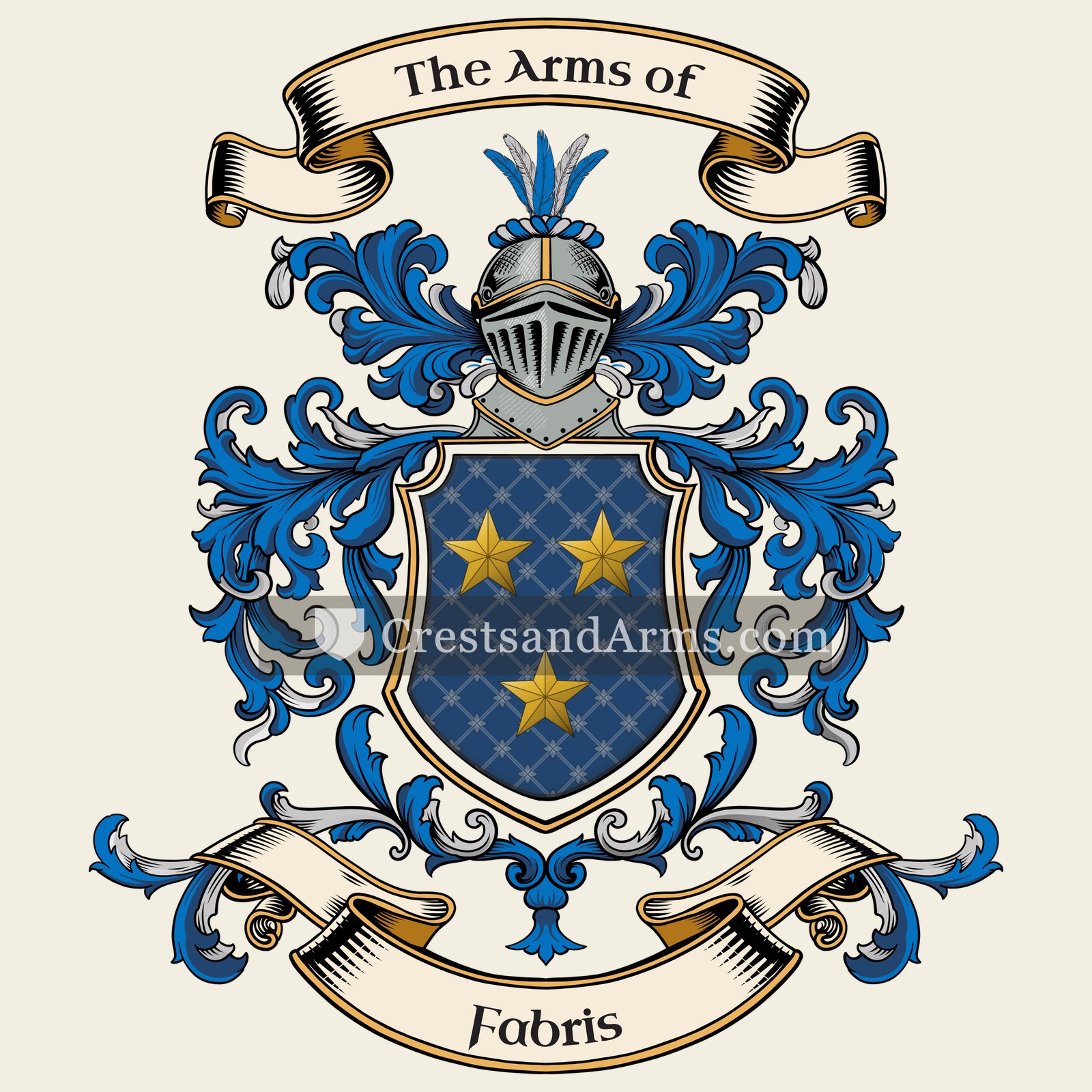
mulletThe third son, and a divine quality from above
Colours
Blue (Azure)Means: Loyalty and truth
Gold (Or)Means: Generosity
Red (Gules)Means: Military strength
Historical info
Source
J. B. Rietstap, Armorial Général, Gouda: G. B. van Goor Zonen, 1884–87
Blazon (the actual original written record)
“Tiercé en barre: d'azur, d'or et de gu., l'azur ch. de trois étoiles d'or, rangées en demi-orle. Cq. cour. C.: trois pl. d'aut.: d'azur, d'or et de gu. L.: à dextre d'or et d'azur, à sen. d'or et de gu.”
Italyc. 1775
Digital archive packCoat of arms PNG, gold border print PDF, vector SVG and the certificate of authenticity. Sent to your email in minutes.
Map of Italy showing where the Fabris arms are recorded
The Fabris arms were recorded in Italy, c. 1775.
Arms such as these were typically recorded in Venice.
Venice ran on trade, and its great families were merchants before they were anything else. The city kept a formal list of its noble houses, and a name on that list carried arms as a matter of record.
This is where the arms were entered in the register. Families often moved to other parts of the country, so the same name can turn up in more than one region.
The body that granted and recorded arms in Italy in this period.
Alvise Giovanni Mocenigo
Sovereign of the period
Alvise Giovanni Mocenigo
1763–1778
Reigning in Germany when the Fabris arms are first recorded.
How Arms Worked in Italy
In the Italian states, coats of arms were often used by noble families to show their status and history. These symbols were passed down through the generations to all legitimate male descendants. Younger branches of a family usually kept the original design but sometimes added small changes to distinguish their specific line from the main branch.
Granting authority
Various local rulers and city governments controlled the use of coats of arms across the different Italian states.
How they got arms
Families often assumed their own arms or received them as official grants from local lords, popes, or city councils.
Where arms were recorded
Arms were recorded in local city archives or private family books rather than in one single national register.
The family's standing
Recorded among the armigerous families of Italy.
Origin & History of the Fabris Family in Italy
The family name Fabris finds its roots in the Latin word faber, which translates to a craftsman or a smith. In the context of Italian history, this surname emerged as a way to identify individuals by their trade, specifically those who worked with metal, wood, or stone. By the time the family was firmly established in Venice in 1775, the name had already become a common marker of skilled laborers who contributed to the city's famous architectural and maritime success. During this period, Venice was a bustling center of trade and artistry, and families like the Fabris often played essential roles in the guilds that maintained the city's high standards for craftsmanship. As the family grew, they became deeply woven into the social fabric of the Venetian Republic, transitioning from simple artisans into a recognized part of the local community. This history reflects the broader Italian tradition where surnames served as a permanent record of a family's professional identity and their contribution to the development of their home city.
Fabris Meaning & Related Branches
Root word
Faber
Latin term for a craftsman, smith, or maker.
This name
FabrisAn occupational surname denoting a descendant of a blacksmith or metalworker.
Documented Sources
J. B. Rietstap, Armorial Général, Gouda: G. B. van Goor Zonen, 1884–87


 mountThe ground held, and steadfastness upon it
 mulletThe third son, and a divine quality from above
 roseThe seventh son, and beauty with grace
 ostrichWilling obedience and serious thought
 mountThe ground held, and steadfastness upon it
 mulletThe third son, and a divine quality from above
 roseThe seventh son, and beauty with grace
 ostrichWilling obedience and serious thought