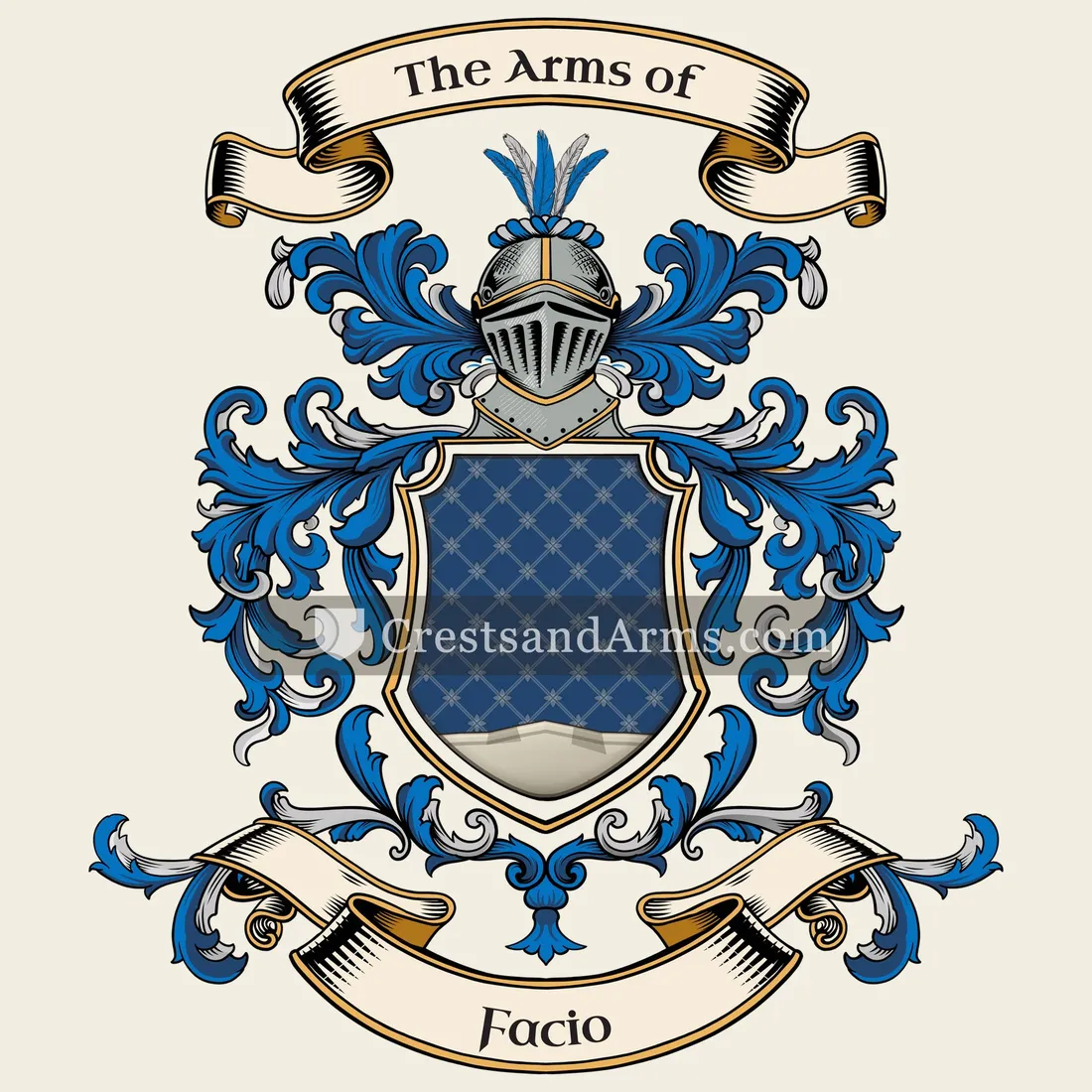
A record of documented arms, meaning and origin, researched for the Facio family of Italy.
Reg. 3520 · Italian, D–F
Meaning of the Facio family crest colors & symbols
Symbols on this shield
mountThe ground held, and steadfastness upon it
Colours
Blue (Azure)Means: Loyalty and truth
Silver (Argent)Means: Peace and sincerity
Historical info
Source
J. B. Rietstap, Armorial Général, Gouda: G. B. van Goor Zonen, 1884–87
Blazon (the actual original written record)
“D'azur à un monstre ayant le buste, les bras et la tête d'un homme, arm. d'une cuirasse et d'un casque, avec des ailes et des pattes de dragon, le tout au nat., posé sur un mont d'arg., mouv. de la p.”
PiedmontPiedmont, c. 1775
Digital archive packCoat of arms PNG, gold border print PDF, vector SVG and the certificate of authenticity. Sent to your email in minutes.
Map of Italy showing where the Facio arms are recorded
The Facio arms were recorded in Piedmont, c. 1775.
Piedmont was Alpine and river country in north-western Italy, ruled from Turin. Its noble houses were listed formally by the state, and a name on that list carried arms as a matter of record.
This is where the arms were entered in the register. Families often moved to other parts of the country, so the same name can turn up in more than one region.
The body that granted and recorded arms in Italy in this period.
Alvise Giovanni Mocenigo
Sovereign of the period
Alvise Giovanni Mocenigo
1763–1778
Reigning in Italy when the Facio arms are first recorded.
How Arms Worked in Italy
In the Italian states, coats of arms were often used by noble families to show their status and history. These symbols were passed down through the generations to all legitimate male descendants. Younger branches of a family usually kept the original design but sometimes added small changes to distinguish their specific line from the main branch.
Granting authority
Various local rulers and city governments controlled the use of coats of arms across the different Italian states.
How they got arms
Families often assumed their own arms or received them as official grants from local lords, popes, or city councils.
Where arms were recorded
Arms were recorded in local city archives or private family books rather than in one single national register.
The family's standing
Recorded among the armigerous families of Piedmont.
Origin & History of the Facio Family in Italy
The surname Facio is deeply rooted in the Piedmont region of northwestern Italy, where it emerged as a distinct family identifier long before the late eighteenth century. Etymologically, the name is often linked to the medieval Italian word "facio," which served as a variant of "faccio," meaning "I do" or "I make." This suggests that the name may have originated as a descriptive nickname for a diligent laborer, a craftsman, or someone known for their industrious nature. By the year 1775, records confirm that the Facio family was well-established within the social and agricultural fabric of Piedmont. During this era, families in the region were typically tied to the land through sharecropping or small-scale farming, and the Facio name appears in local parish registers that tracked births, marriages, and deaths. These documents highlight a lineage that was deeply connected to the local community and the evolving economic landscape of the Italian Alps.
Facio Meaning & Related Branches
Root word
Facere
Latin verb meaning to do, make, or perform.
This name
FacioDerived from a medieval personal name meaning the doer or the maker.
also spelled
Fashi
Fasi
Documented Sources
J. B. Rietstap, Armorial Général, Gouda: G. B. van Goor Zonen, 1884–87
De Felice, Emidio, Dizionario dei cognomi italiani, 1978
Archivio di Stato di Torino, Stato civile della Restaurazione (Piemonte), 1837–1865
Rossebastiano, Alda and Papa, Elena, I nomi di luogo in Piemonte, Valle d'Aosta, Liguria, Lombardia, 2011
Digital archive packCoat of arms PNG, gold border print PDF, vector SVG and the certificate of authenticity. Sent to your email in minutes.


 mountThe ground held, and steadfastness upon it
 mountThe ground held, and steadfastness upon it