Map of Britain showing where the Fairfax arms are recorded
The Fairfax arms were recorded in Britain, c. 1627.
Arms such as these were typically recorded in Kent.
Kent sits between London and the short crossing to Europe, and the trade passing through made it wealthy. Merchant families bought land with that money, and it was landowners who took coats of arms.
This is where the arms were entered in the register. Families often moved to other parts of the country, so the same name can turn up in more than one region.
The body that granted and recorded arms in Britain in this period.
Charles I of England
Sovereign of the period
Charles I of England
1625–1649
Reigning in Britain when the Fairfax arms are first recorded.
How Arms Worked in Britain
English heraldry allowed arms to be shared by all legitimate descendants of the original owner. These symbols were treated as personal property that moved through the generations to all children. While the eldest son kept the original design, other family members could use the same shield without needing to change it or register their own unique versions.
Granting authority
The College of Arms in London has regulated the use of coats of arms throughout England and Wales since 1484.
How they got arms
Families typically obtained their coats of arms through a formal grant from the Crown or by proving their ancient right to them.
Where arms were recorded
All official coats of arms are recorded in the registers kept at the College of Arms, which date back to the fifteenth century.
The family's standing
Recorded among the armigerous families of Britain.
Origin & History of the Fairfax Family in Britain
The name Fairfax is rooted in Old English, originating from the words "fayr" and "feax," which together describe someone with fair or light-colored hair. While the family name became most famous for its long-standing influence in Yorkshire, its presence in other parts of Britain, such as Kent by 1627, highlights the family’s mobility and integration into local governance during the early modern period. Historically, the Fairfaxes were members of the landed gentry who served as soldiers, lawyers, and administrators for the English Crown. Their rise in status was closely tied to their ability to manage estates and provide loyal service to the monarchy. By the time they were established in southern England, they had already cemented their reputation as a family deeply involved in the political and social shifts of the British Isles.
Coat of Arms & Family Crest Details
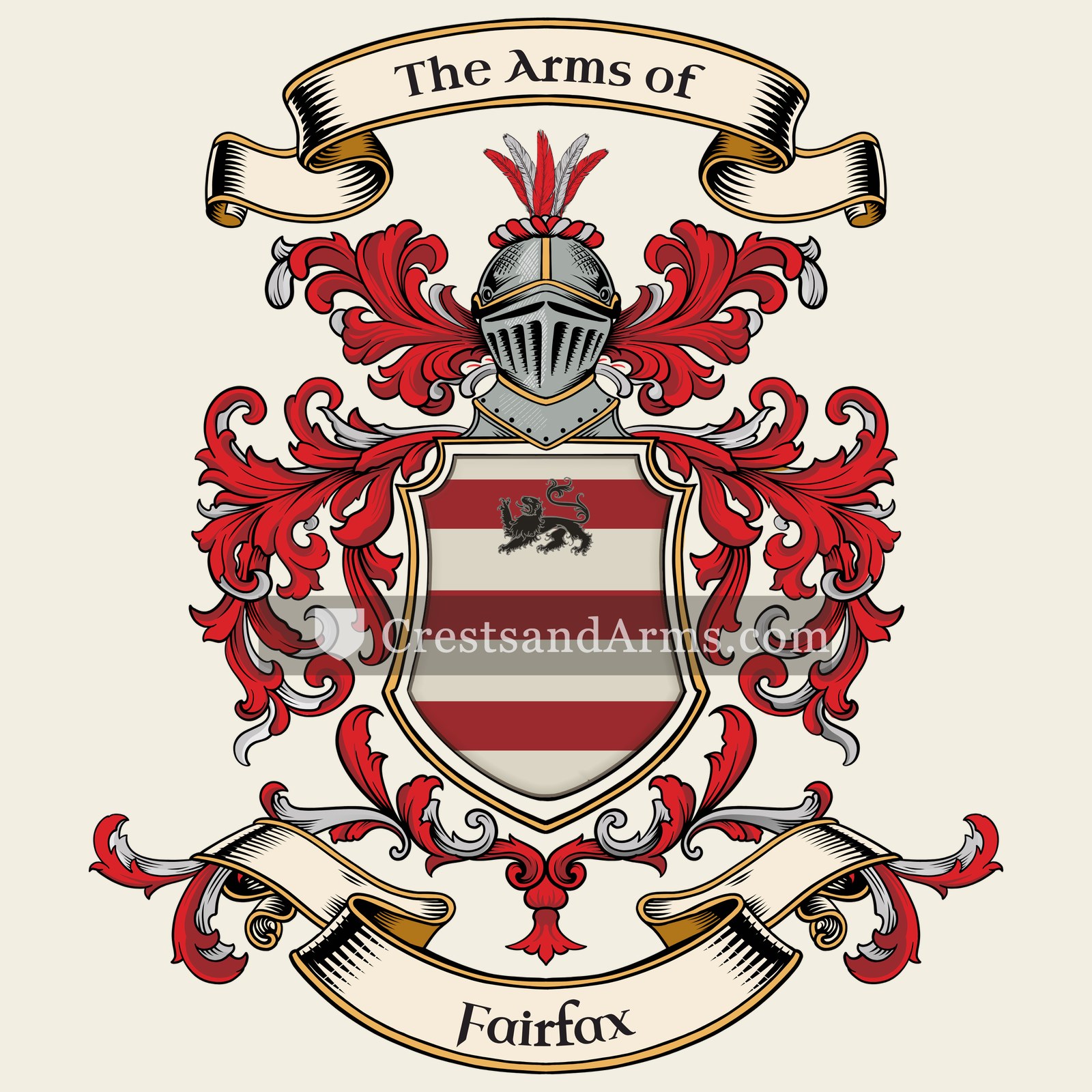
Symbols on this shield
lionCourage, strength and royalty
Colours
Silver (Argent)Means: Peace and sincerity
Red (Gules)Means: Military strength
Black (Sable)Means: Constancy
Historical info
Source
Sir Bernard Burke, The General Armory of England, Scotland, Ireland and Wales, London: Harrison & Sons, 1884
Blazon (the actual original written record)
“Ar. three bars gemelles gu. surmounted of a lion ramp. sa”
YorkWalton · York, c. 1620
Digital archive packCoat of arms PNG, gold border print PDF, vector SVG and the certificate of authenticity. Sent to your email in minutes.
Map of England showing where the Fairfax arms are recorded
The Fairfax arms were recorded in York, c. 1620.
Yorkshire is the largest of the English counties, and it held more gentry families than any other. Land there was split among a great many households rather than a few, so a great many of them carried arms.
This is where the arms were entered in the register. Families often moved to other parts of the country, so the same name can turn up in more than one region.
The body that granted and recorded arms in England in this period.
James VI and I
Sovereign of the period
James VI and I
1603–1625
Reigning in Britain when the Fairfax arms are first recorded.
How Arms Worked in England
English heraldry allowed arms to be shared by all legitimate descendants of the original owner. These symbols were treated as personal property that moved through the generations to all children. While the eldest son kept the original design, other family members could use the same shield without needing to change it or register their own unique versions.
Granting authority
The College of Arms in London has regulated the use of coats of arms throughout England and Wales since 1484.
How they got arms
Families typically obtained their coats of arms through a formal grant from the Crown or by proving their ancient right to them.
Where arms were recorded
All official coats of arms are recorded in the registers kept at the College of Arms, which date back to the fifteenth century.
The family's standing
Recorded among the armigerous families of York.
Origin & History of the Fairfax Family in England
The Fairfax family name finds its deepest roots in the northern English county of Yorkshire, where the family established a prominent presence long before the seventeenth century. The name itself is thought to be derived from the Old English words for fair and hair, likely serving as a descriptive nickname for an ancestor with light-colored locks. By the time the family became well-documented in York during the early 1600s, they had already spent generations building influence as landowners and local leaders. They were deeply connected to the social and political fabric of the region, often serving in roles that required them to manage estates and represent the interests of the North. This long-standing residency in Yorkshire allowed the family to grow in status, eventually positioning them as key figures in English history during the turbulent years of the seventeenth century.
Coat of Arms & Family Crest Details
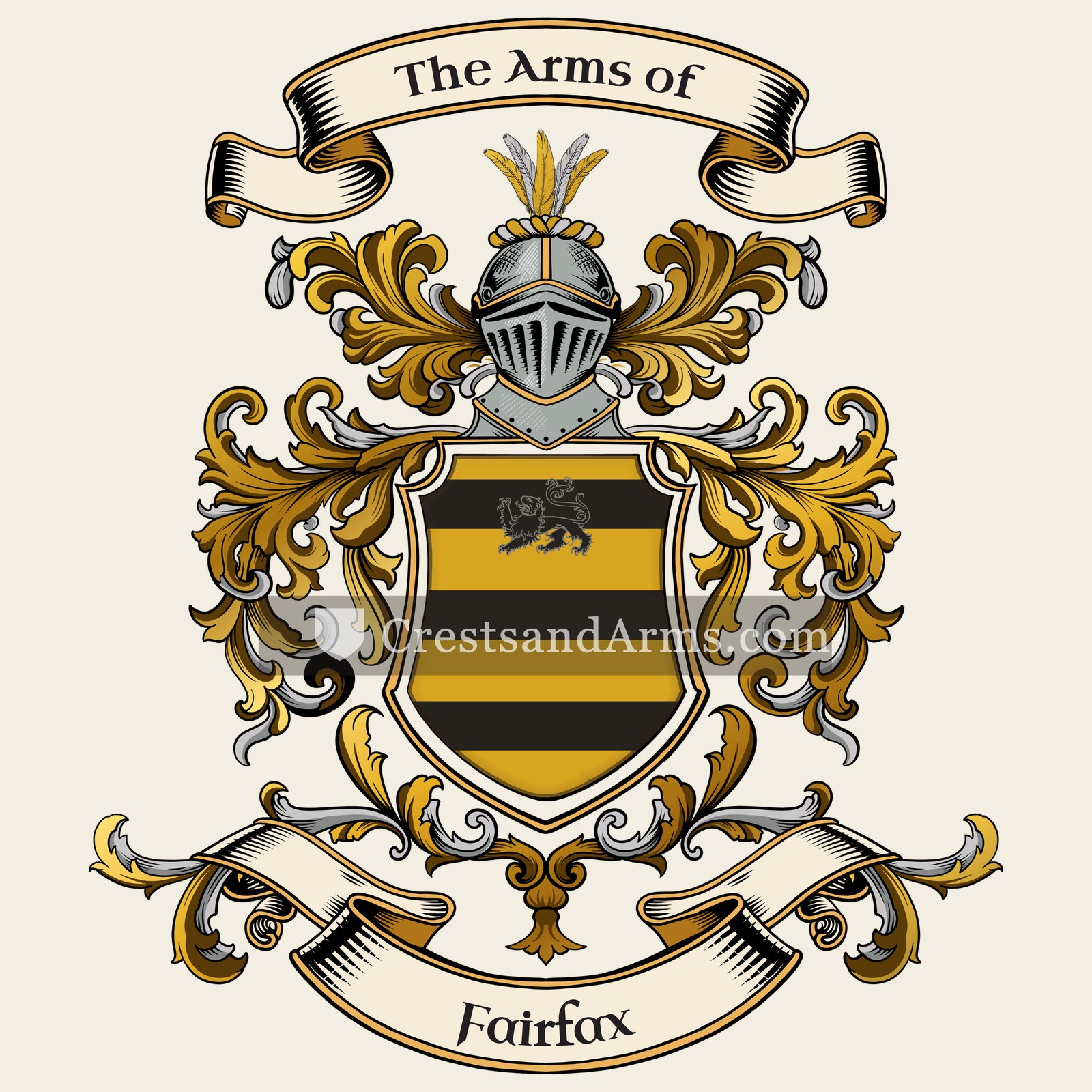
Symbols on this shield
lionCourage, strength and royalty
Colours
Gold (Or)Means: Generosity
Black (Sable)Means: Constancy
Historical info
Source
Sir Bernard Burke, The General Armory of England, Scotland, Ireland and Wales, London: Harrison & Sons, 1884
Blazon (the actual original written record)
“Or, three bars gemelles gu. surmounted of a lion ramp. sa”
YorkSteeton · York, c. 1836
Digital archive packCoat of arms PNG, gold border print PDF, vector SVG and the certificate of authenticity. Sent to your email in minutes.
Map of Scotland showing where the Fairfax arms are recorded
The Fairfax arms were recorded in York, c. 1836.
Yorkshire is the largest of the English counties, and it held more gentry families than any other. Land there was split among a great many households rather than a few, so a great many of them carried arms.
This is where the arms were entered in the register. Families often moved to other parts of the country, so the same name can turn up in more than one region.
The body that granted and recorded arms in Scotland in this period.
William IV
Sovereign of the period
William IV
1830–1837
Reigning in Britain when the Fairfax arms are first recorded.
How Arms Worked in Scotland
Scottish heraldry is unique because it treats a coat of arms as a piece of personal property protected by law. Only one person can own a specific design at any given time. When a family grows, the head keeps the original shield while other relatives must apply for their own distinct version with slight changes to prove their specific identity.
Granting authority
The Court of the Lord Lyon acts as the official body that regulates and controls all heraldic matters throughout Scotland.
How they got arms
Individuals obtain a legal right to their arms through a formal petition process that confirms their identity and family connection.
Where arms were recorded
All valid coats of arms are officially entered into the Public Register of All Arms and Bearings starting from 1672.
The family's standing
Recorded among the armigerous families of York.
Origin & History of the Fairfax Family in Scotland
The history of the Fairfax name is deeply rooted in the northern regions of England, particularly around York, where the family established a strong presence long before the nineteenth century. While the name is famously associated with Yorkshire, its origins are tied to the Old English words for fair and hair, suggesting it was originally a descriptive nickname for a person with light-colored locks. Although the family became a prominent fixture in English society, their influence occasionally brushed against the history of Scotland through border politics and military service. During the medieval period, members of the family were frequently involved in the shifting loyalties of the Anglo-Scottish borderlands, often serving as administrators or soldiers in the volatile northern territories. By the time the family was well-documented in York in 1836, they were already part of a long lineage that had navigated the complex social and political landscapes of both northern England and the Scottish frontier for hundreds of years.
Fairfax Meaning & Related Branches
Root word
fagr and feax
Old English words meaning fair or beautiful and hair.
This name
FairfaxA descriptive nickname for a person with beautiful, light-colored, or long hair.
also spelled
Fayrfax
Fayrefax
Fairfex
Fairfaks
Fairefax
Related arms
Falshawsimilar arms
van Peenensimilar arms
Wasserschlebensimilar arms
Documented Sources
J. B. Rietstap, Armorial Général, Gouda: G. B. van Goor Zonen, 1884–87
Fairfax, Thomas. Short Memorials of Thomas Lord Fairfax. 1699
Markham, Clements R. A Life of the Great Lord Fairfax, Commander-in-Chief of the Army of the Parliament of England. 1870
Reaney, P.H. and Wilson, R.M. A Dictionary of English Surnames. 1958
The National Archives, State Papers Domestic, Charles I, 1627
Borthwick Institute for Archives, Fairfax of Gilling Papers
Digital archive packCoat of arms PNG, gold border print PDF, vector SVG and the certificate of authenticity. Sent to your email in minutes.


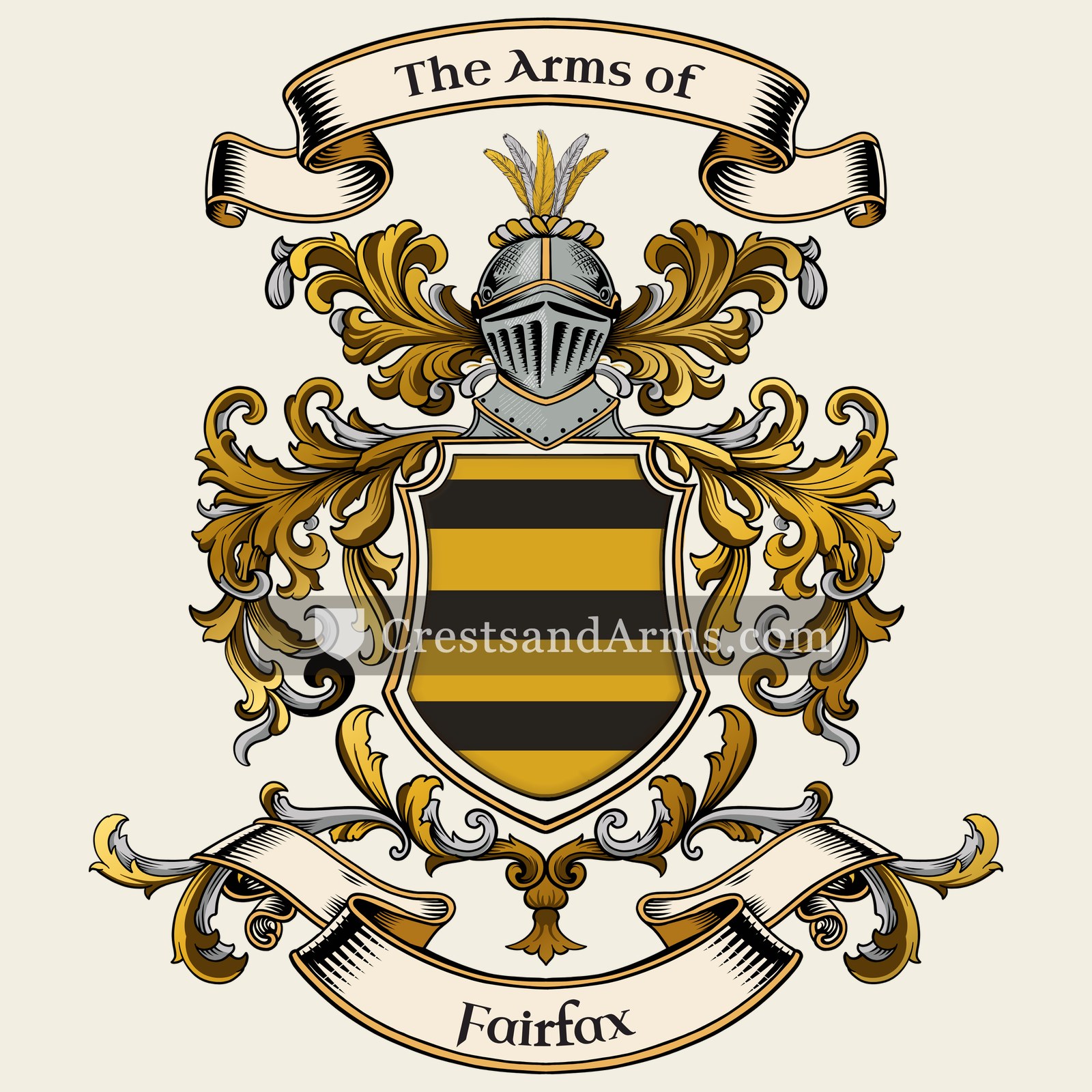


 lionCourage, strength and royalty