Map of Scotland showing where the Fairlie arms are recorded
The Fairlie arms were recorded in Scotland, c. 1748.
Arms such as these were typically recorded in Edinburgh.
Edinburgh was the seat of Scotland's government, its courts and its heralds. Families with business there settled nearby, and being close to where arms were recorded is exactly why so many of them appear.
This is where the arms were entered in the register. Families often moved to other parts of the country, so the same name can turn up in more than one region.
The body that granted and recorded arms in Scotland in this period.
George II of Great Britain
Sovereign of the period
George II of Great Britain
1727–1760
Reigning in Scotland when the Fairlie arms are first recorded.
How Arms Worked in Scotland
Scottish heraldry is unique because it treats a coat of arms as a piece of personal property protected by law. Only one person can own a specific design at any given time. When a family grows, the head keeps the original shield while other relatives must apply for their own distinct version with slight changes to prove their specific identity.
Granting authority
The Court of the Lord Lyon acts as the official body that regulates and controls all heraldic matters throughout Scotland.
How they got arms
Individuals obtain a legal right to their arms through a formal petition process that confirms their identity and family connection.
Where arms were recorded
All valid coats of arms are officially entered into the Public Register of All Arms and Bearings starting from 1672.
The family's standing
Recorded among the armigerous families of Scotland.
Origin & History of the Fairlie Family in Scotland
The surname Fairlie originates from the lands of Fairlie in the parish of Largs, located in the county of Ayrshire, Scotland. The name is topographical in nature, meaning it was likely adopted by individuals who lived near a specific local landmark or a "fair lea," which refers to a beautiful or pleasant meadow. By the mid-eighteenth century, the family had established a notable presence in Edinburgh, a city that served as a major hub for trade, law, and education during the Scottish Enlightenment. Records confirm that members of the Fairlie family were active in the capital by 1748, participating in the professional and social life of a city that was rapidly expanding beyond its medieval walls. This migration from the rural west to the urban center of Edinburgh reflects the broader movement of Scottish families seeking new opportunities in commerce and administration during this period of significant historical change.
Fairlie Meaning & Related Branches
Root word
fag-leah
Old English for a meadow or clearing associated with a sheep pasture.
This name
FairlieDerived from a place in Ayrshire, signifying a meadow belonging to a sheep farm.
also spelled
Fairly
Fairelie
Fairely
Related arms
Dickrecorded with Fairlie, same area
Documented Sources
Sir Bernard Burke, The General Armory of England, Scotland, Ireland and Wales, London: Harrison & Sons, 1884
Black, George F., The Surnames of Scotland: Their Origin, Meaning, and History, 1946
National Records of Scotland, Register of Testaments, 1748
Paterson, James, History of the County of Ayr: With a Genealogical Account of the Families of Ayrshire, 1847
Digital archive packCoat of arms PNG, gold border print PDF, vector SVG and the certificate of authenticity. Sent to your email in minutes.


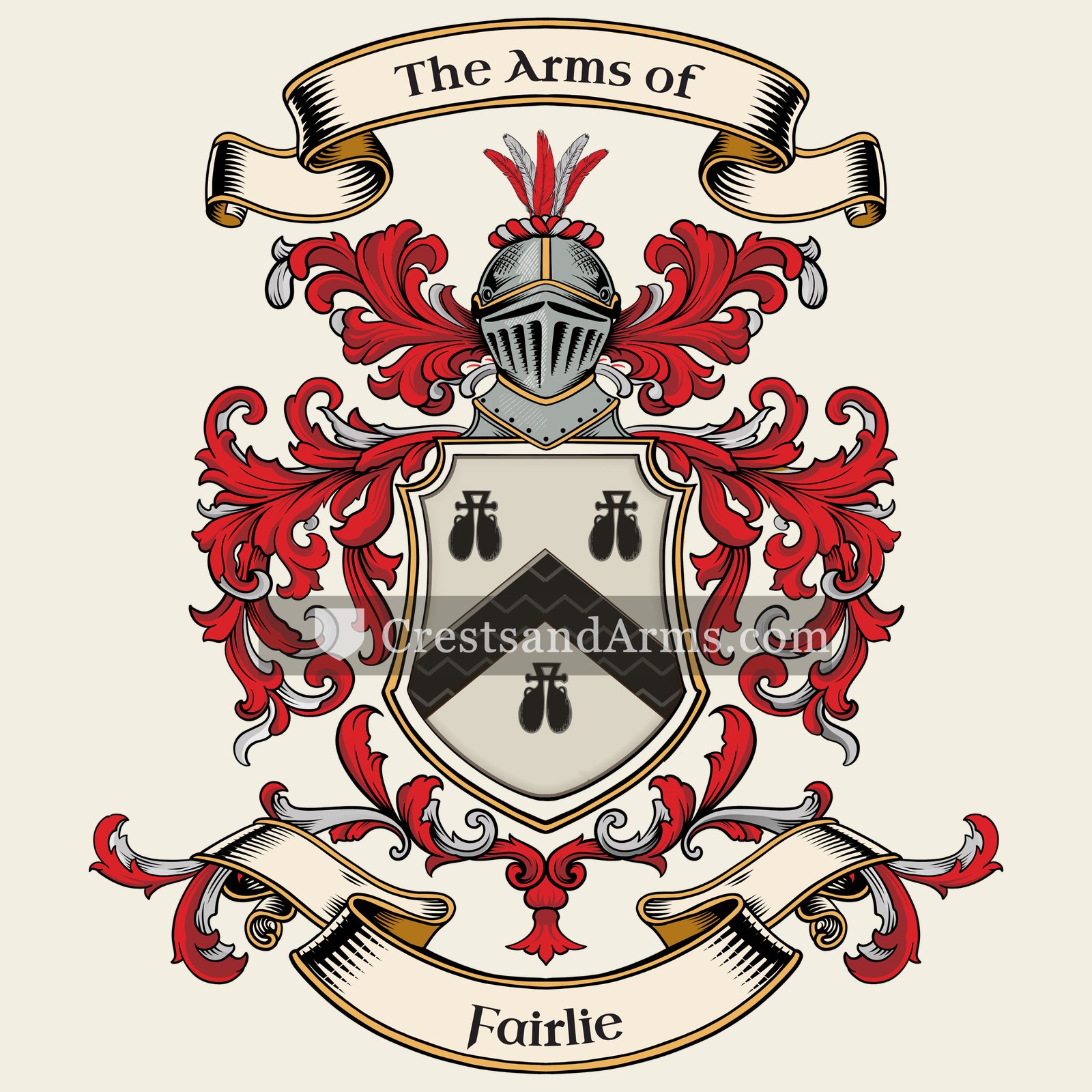
 chevronProtection, and faithful service completed
 water bougetThe crusader's water carrier, and a journey made
 chevronProtection, and faithful service completed
 water bougetThe crusader's water carrier, and a journey made