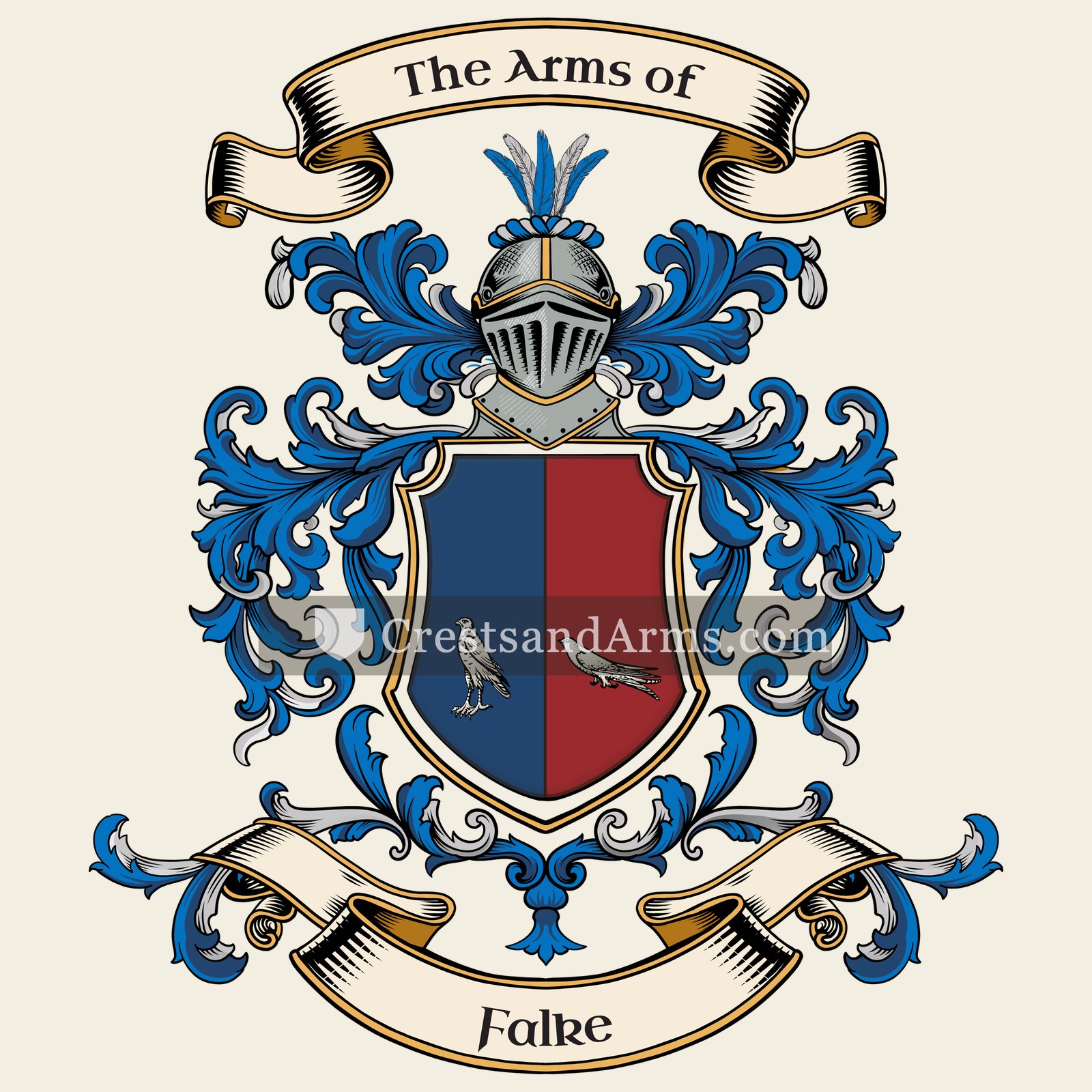
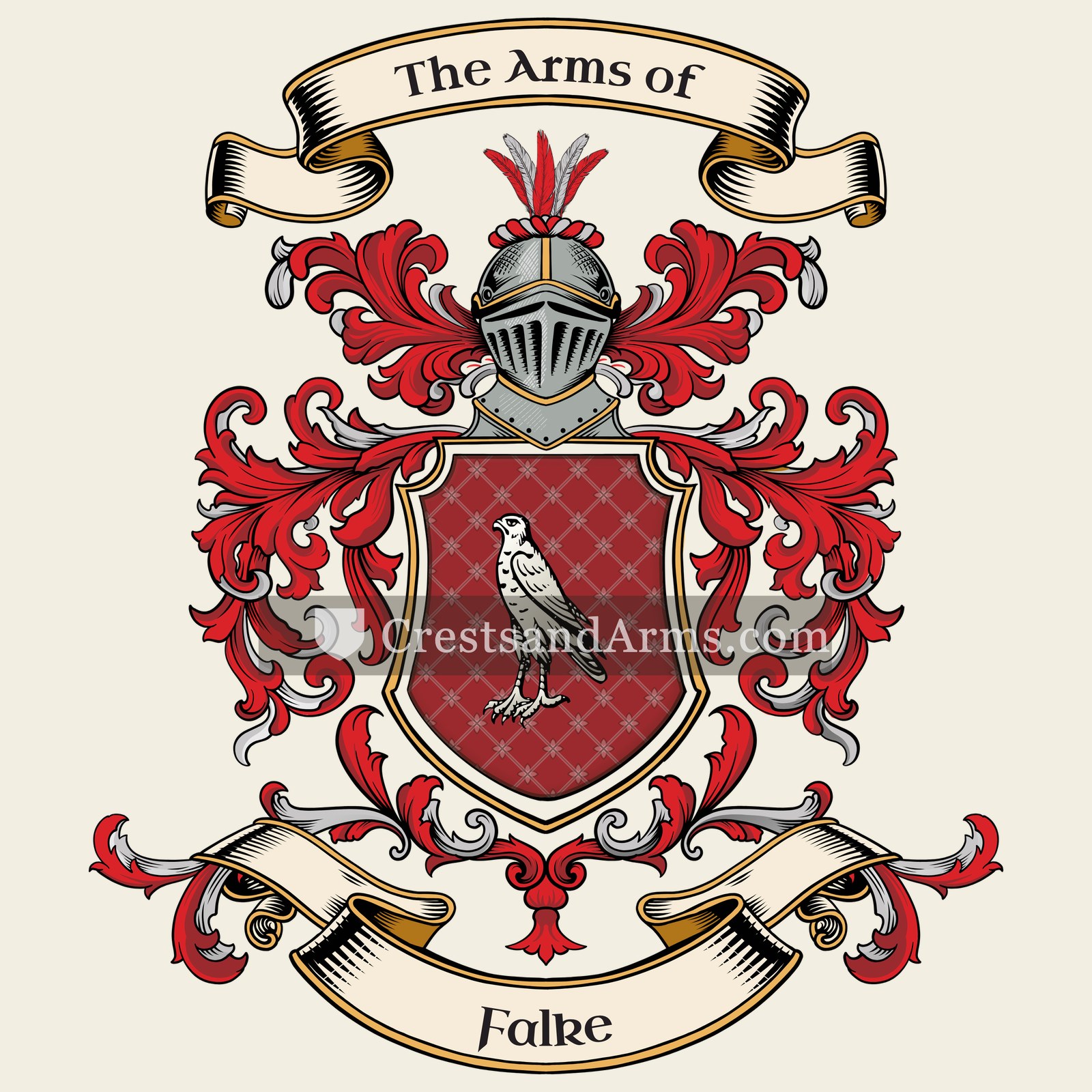
A record of documented arms, meaning and origin, researched for the Falke family lines. Documented in 2 countries.
Reg. 6911 · German, D–F
Coat of Arms & Family Crest Details
Symbols on this shield
falconOne eager and quick in pursuit
martletA younger son, who must win his own land
Colours
Blue (Azure)Means: Loyalty and truth
Red (Gules)Means: Military strength
Silver (Argent)Means: Peace and sincerity
Historical info
Source
J. B. Rietstap, Armorial Général, Gouda: G. B. van Goor Zonen, 1884–87
Blazon (the actual original written record)
“Parti d'azur et de gu.; à un faucon ess. d'arg., br. sur le parti, fondant sur un autre oiseau ess. d'arg., levant la tête pour regarder le faucon et br. aussi sur le parti. C.: un faucon au nat., chaperonné de gu., la tête sommée de trois pl. d'aut., une de gu. entre deux d'azur. L.: à dextre d'arg. et d'azur, à sen. d'arg. et de gu.”
GermanyNuremberg, c. 1765
Digital archive packCoat of arms PNG, gold border print PDF, vector SVG and the certificate of authenticity. Sent to your email in minutes.
Map of Germany showing where the Falke arms are recorded
The Falke arms were recorded in Nuremberg, c. 1765.
This is where the arms were entered in the register. Families often moved to other parts of the country, so the same name can turn up in more than one region.
The body that granted and recorded arms in Germany in this period.
Francis I, Holy Roman Emperor
Sovereign of the period
Francis I, Holy Roman Emperor
1745–1765
Reigning in Germany when the Falke arms are first recorded.
How Arms Worked in Germany
In the Holy Roman Empire, coats of arms were often granted to individuals by the Emperor or his representatives. These arms were then passed down through the generations to all legitimate descendants of the original holder. Younger branches of a family usually kept the same shield design without needing to change it, as the arms belonged to the entire lineage.
Granting authority
The Holy Roman Emperor held the sole power to grant new coats of arms throughout his vast imperial territories.
How they got arms
Families typically obtained their coats of arms through a formal imperial grant or by proving their noble status to the authorities.
Where arms were recorded
These grants were officially recorded in the Imperial Chancery registers, which began keeping formal records of such honors during the Middle Ages.
The family's standing
Recorded among the armigerous families of Germany.
Origin & History of the Falke Family in Germany
The surname Falke originates from the Middle High German word *valke*, which translates to falcon. In medieval Germany, names were often derived from a person’s occupation, a physical trait, or a notable characteristic, and this name likely identified someone who worked as a falconer or possessed the keen, sharp nature associated with the bird of prey. By the mid-18th century, the family had established a documented presence in the bustling imperial city of Nuremberg. During this era, Nuremberg served as a major hub for trade and craftsmanship, providing a stable environment for families to build their livelihoods within the city’s rigorous guild structures. The presence of the Falke name in local records from 1765 suggests that the family was well-integrated into the urban life of the Holy Roman Empire, likely contributing to the city’s reputation for skilled labor and commerce during the late Enlightenment period.
Coat of Arms & Family Crest Details
Symbols on this shield
falconOne eager and quick in pursuit
Colours
Red (Gules)Means: Military strength
Silver (Argent)Means: Peace and sincerity
Historical info
Source
J. B. Rietstap, Armorial Général, Gouda: G. B. van Goor Zonen, 1884–87
Blazon (the actual original written record)
“De gu. à un faucon d'arg., le vol ouv. et abaissé, chaperonné de sa., le chaperon bordé d'or et sommé d'un leurre de plumes de héron d'arg. Deux cq. cour. C.: 1º un lion iss. et cont. d'arg.; 2º le faucon. D.: JAGET DEM GUTEN NACH.”
Austriac. 1874
Digital archive packCoat of arms PNG, gold border print PDF, vector SVG and the certificate of authenticity. Sent to your email in minutes.
Map of Austria showing where the Falke arms are recorded
The Falke arms were recorded in Austria, c. 1874.
Arms such as these were typically recorded in Tyrol.
Tyrol was mountain country in western Austria, where the valleys were held by families who had been there a very long time. Old tenure counted for more than money, and old families carried arms.
This is where the arms were entered in the register. Families often moved to other parts of the country, so the same name can turn up in more than one region.
Region
Tyrol
First recorded
1874
Granting Authority for the Falke Arms
Imperial and Royal chancery
Sodacan · CC BY-SA 3.0
The body that granted and recorded arms in Austria in this period.
Franz Joseph I of Austria
Sovereign of the period
Franz Joseph I of Austria
1848–1916
Reigning in Germany when the Falke arms are first recorded.
How Arms Worked in Austria
Austrian coats of arms were often linked directly to noble titles granted by the Emperor. These symbols belonged to the entire family line rather than just one individual. When a family grew, new branches kept the original design without needing to change it. This system allowed all members of a noble house to share the same identity across many generations.
Granting authority
The Imperial and Royal chancery managed all heraldic matters and controlled the official granting of arms throughout the Austrian lands.
How they got arms
Families typically received their arms through a formal imperial decree that often accompanied the elevation of a person to noble status.
Where arms were recorded
Official records of these grants were kept in the Imperial Register of Nobility which began its formal documentation process in 1453.
The family's standing
Recorded among the armigerous families of Austria.
Origin & History of the Falke Family in Austria
The family name Falke carries a strong connection to the rugged landscape of the Austrian Tyrol. Derived from the Middle High German word for falcon, the name likely originated as a descriptive nickname for a person who was swift, sharp-eyed, or perhaps skilled in the noble sport of falconry. By the late 19th century, records confirm that families bearing this name were well-established within the Tyrolean region. Life in this mountainous area during the 1870s was defined by close-knit village communities and a deep reliance on the land. As the family settled into these alpine valleys, they became part of a long tradition of mountain dwellers who adapted to the challenging climate and the unique cultural identity of western Austria. This history reflects a transition from a simple descriptive title to a recognized family identity that has endured for generations in the heart of the Alps.
Falke Meaning & Related Branches
Root word
Falco
Latin term for a bird of prey or falcon.
This name
FalkeAn occupational name for a falconer or a nickname for someone with hawk-like traits.
also spelled
Falcke
Falkay
Falk
Related arms
Falckevariant spelling
Documented Sources
J. B. Rietstap, Armorial Général, Gouda: G. B. van Goor Zonen, 1884–87
Heintze, Albert. Die deutschen Familiennamen: geschichtlich, geographisch, sprachlich. 1903
Stadtarchiv Nürnberg. Bürgerbücher der Stadt Nürnberg. 1765
Digital archive packCoat of arms PNG, gold border print PDF, vector SVG and the certificate of authenticity. Sent to your email in minutes.


 falconOne eager and quick in pursuit
 martletA younger son, who must win his own land
 falconOne eager and quick in pursuit
 martletA younger son, who must win his own land