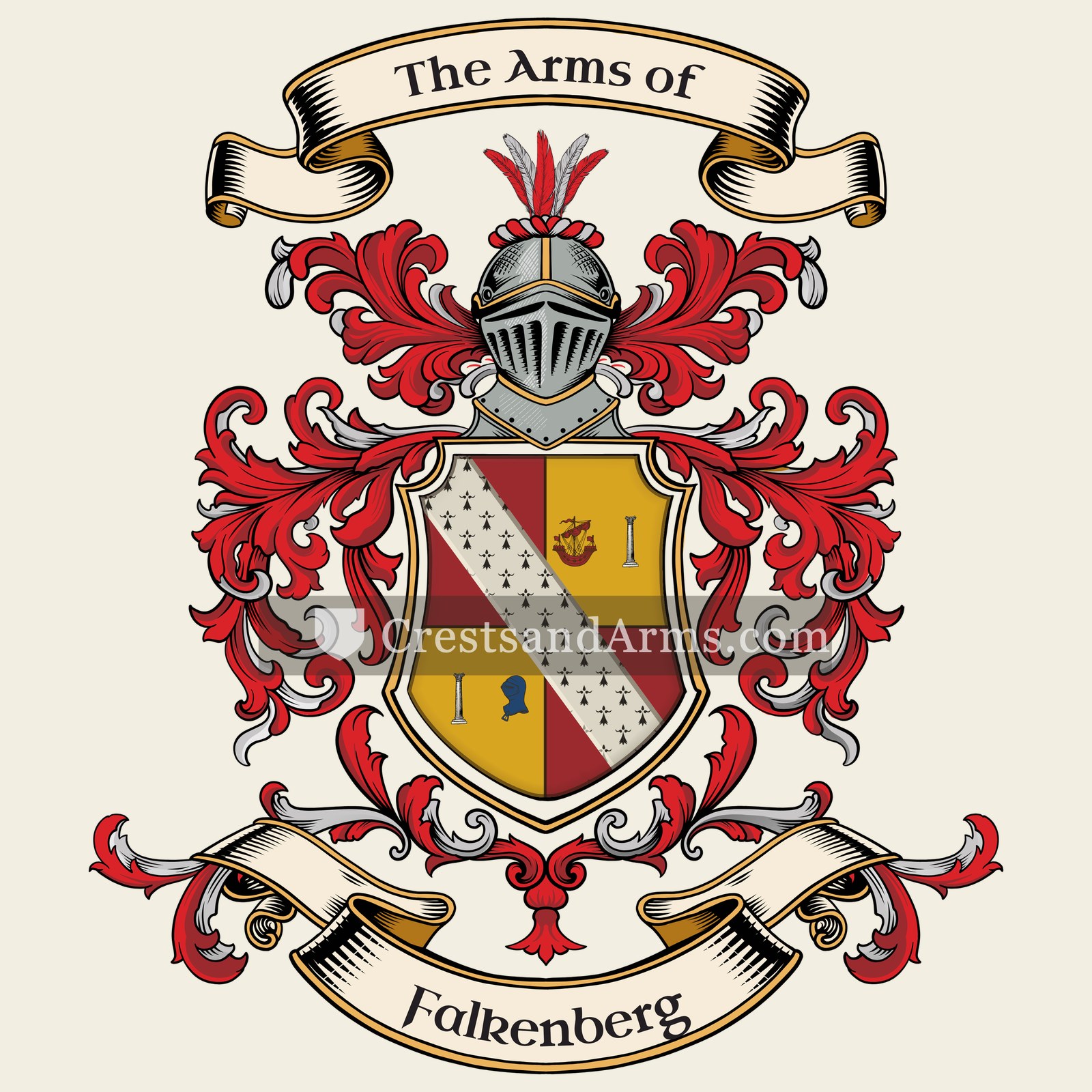
Map of Germany showing where the Falkenberg arms are recorded
The Falkenberg arms were recorded in Westphalia, c. 1765.
Westphalia was a land of small estates and fortified farmhouses in western Germany. Its families were numerous and not especially rich, but each held its own ground, and holding ground was what brought arms.
This is where the arms were entered in the register. Families often moved to other parts of the country, so the same name can turn up in more than one region.
The body that granted and recorded arms in Germany in this period.
Francis I, Holy Roman Emperor
Sovereign of the period
Francis I, Holy Roman Emperor
1745–1765
Reigning in Germany when the Falkenberg arms are first recorded.
How Arms Worked in Germany
In the Holy Roman Empire, coats of arms were often granted to individuals by the Emperor or his representatives. These arms were then passed down through the generations to all legitimate descendants of the original holder. Younger branches of a family usually kept the same shield design without needing to change it, as the arms belonged to the entire lineage.
Granting authority
The Holy Roman Emperor held the sole power to grant new coats of arms throughout his vast imperial territories.
How they got arms
Families typically obtained their coats of arms through a formal imperial grant or by proving their noble status to the authorities.
Where arms were recorded
These grants were officially recorded in the Imperial Chancery registers, which began keeping formal records of such honors during the Middle Ages.
The family's standing
Recorded among the armigerous families of Westphalia.
Origin & History of the Falkenberg Family in Germany
The family name Falkenberg is a topographic surname, which means it was originally derived from the physical features of the landscape where early ancestors lived. In the German language, the name combines the words for falcon and mountain or hill. This suggests that the first people to carry the name likely resided near a rocky cliff or a high point where falcons were commonly seen. By the mid-eighteenth century, historical records confirm that members of the family were well-established in the Westphalia region of Germany. During this period, Westphalia was a center of agricultural and trade activity, and families often stayed in the same rural districts for generations to manage local land. As the family grew, they became part of the social fabric of the region, living through the shifting political and economic changes that defined German life in the late 1700s.
Coat of Arms & Family Crest Details
Symbols on this shield
bendDefence, and the scarf of a commander
chequyConstancy, and the counting-board
shipEnterprise, and a great voyage undertaken
columnFortitude and constancy
helmetWisdom and security in defence
Colours
Red (Gules)Means: Military strength
Gold (Or)Means: Generosity
ErmineMeans: Dignity
Silver (Argent)Means: Peace and sincerity
Blue (Azure)Means: Loyalty and truth
Historical info
Source
J. B. Rietstap, Armorial Général, Gouda: G. B. van Goor Zonen, 1884–87
Blazon (the actual original written record)
“Ec.: aux 1 et 4 de gu. à la bande d'herm.; au 2 coupé: a. d'or à une nacelle de gu., la proue et la poupe sommées chacune de trois plumes de paon au nat.; b. d'azur à une colonne d'arg.; au 3 coupé: a. d'azur à une colonne d'arg.; b. d'or à un casque de tournoi d'azur, taré de trois quarts. Sur le tout échiq. d'arg. et de gu. de douze points. Deux cq. cour. C.: 1° une serre d'aigle renv. au nat., tenant un demi-vol tranché d'arg. sur un échi-”
Swedenc. 1773
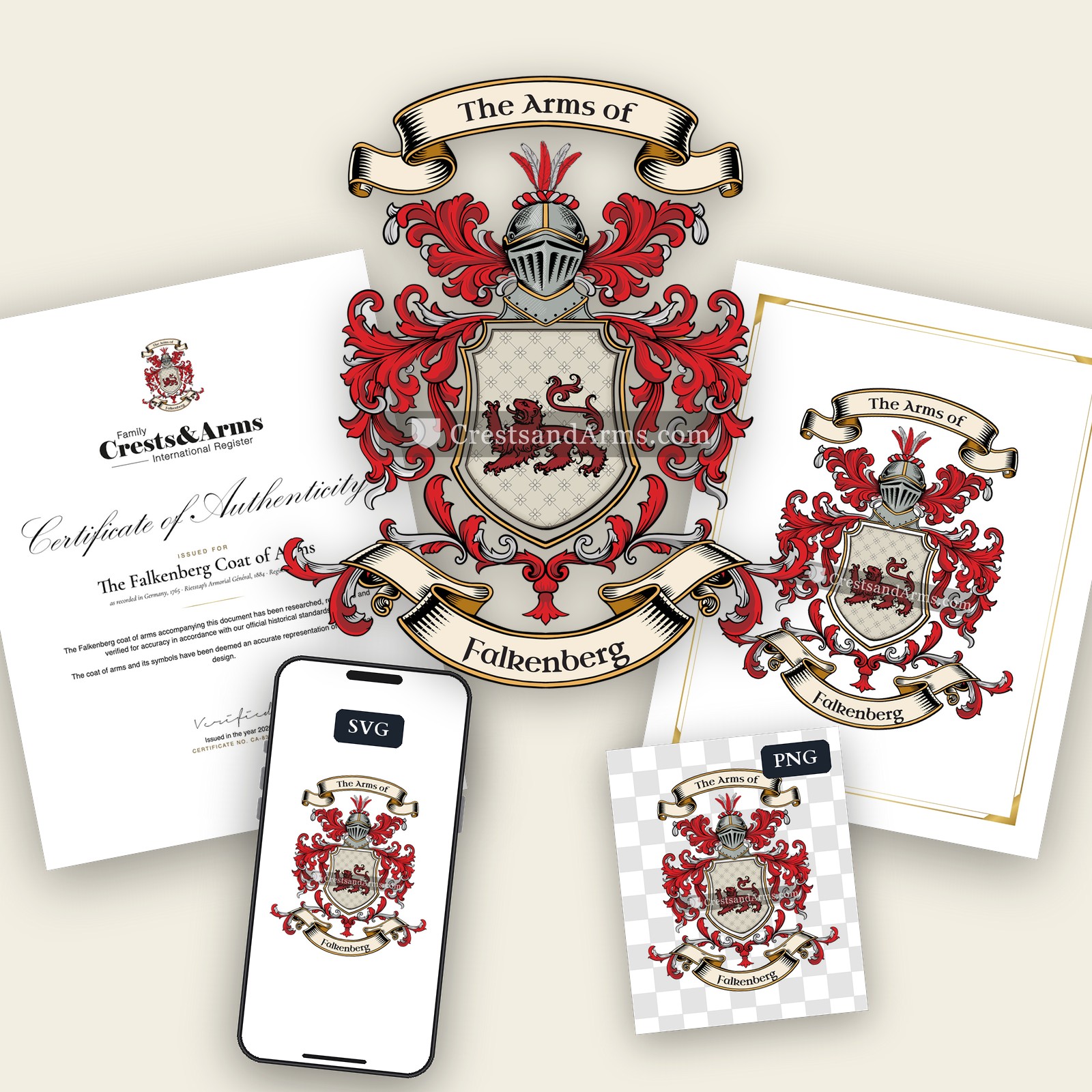
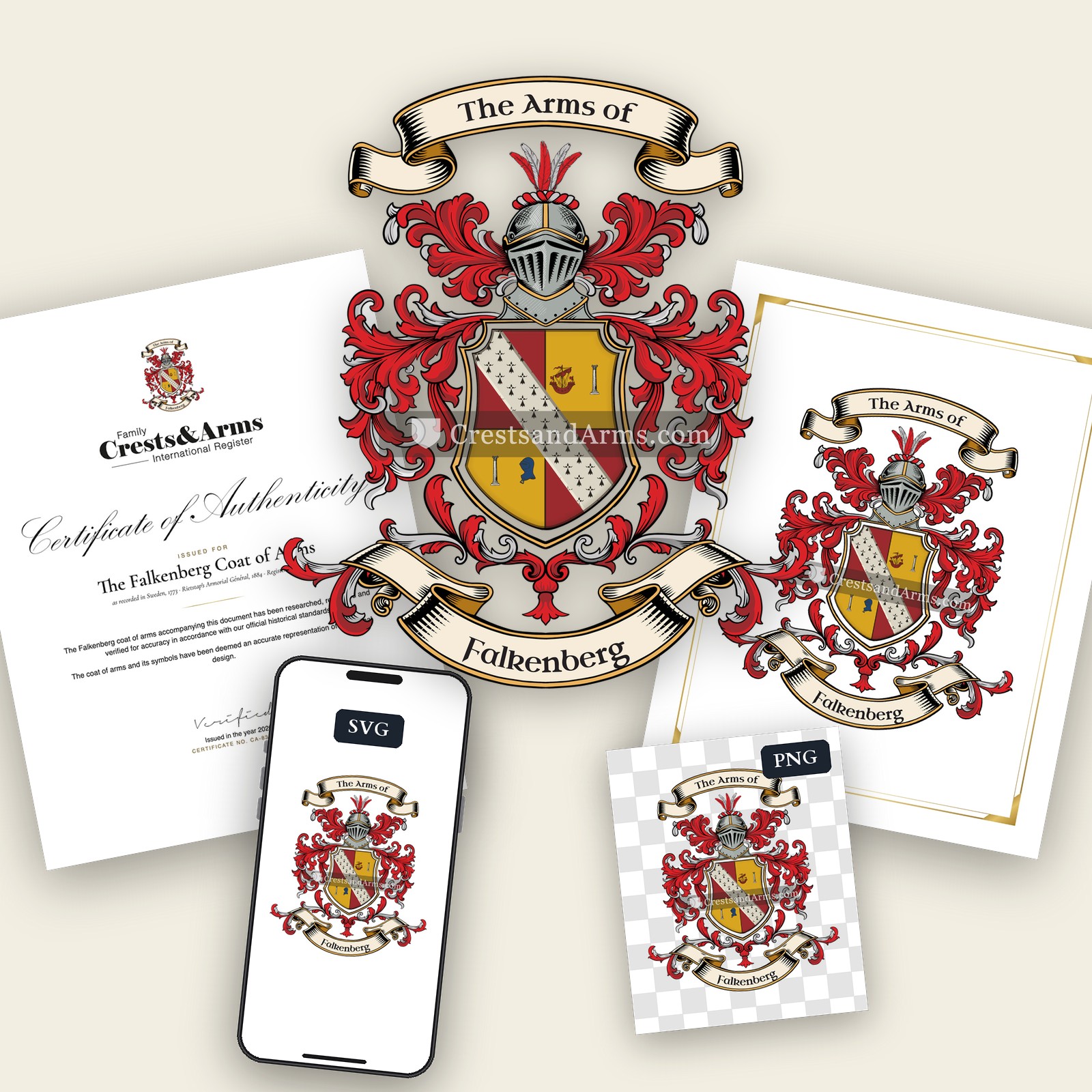
Digital archive packCoat of arms PNG, gold border print PDF, vector SVG and the certificate of authenticity. Sent to your email in minutes.
Map of Sweden showing where the Falkenberg arms are recorded
The Falkenberg arms were recorded in Sweden, c. 1773.
Arms such as these were typically recorded in Stockholm.
Stockholm held the Swedish court and the House of Nobility, where every noble family's arms were entered and kept. Families ennobled for service registered there, which is why so many are recorded around the city.
This is where the arms were entered in the register. Families often moved to other parts of the country, so the same name can turn up in more than one region.
The body that granted and recorded arms in Sweden in this period.
Gustav III of Sweden
Sovereign of the period
Gustav III of Sweden
1771–1792
Reigning in Germany when the Falkenberg arms are first recorded.
How Arms Worked in Sweden
In Sweden, a coat of arms belonged to a noble family as a whole rather than just one individual. These arms were passed down through the generations to all legitimate descendants. Younger branches of the family used the same shield without needing to change it. This system ensured that the entire lineage shared the same identity and status under the law.
Granting authority
The Riddarhuset, or House of Nobility, regulated all noble coats of arms in Sweden under royal authority.
How they got arms
Families received their coats of arms through royal grants of nobility which were then officially registered with the House.
Where arms were recorded
Coats of arms were officially recorded in the Swedish House of Nobility register starting in the year 1626.
The family's standing
Recorded among the armigerous families of Sweden.
Origin & History of the Falkenberg Family in Sweden
The Falkenberg family name has deep roots in Swedish history, reflecting the social and professional shifts of the eighteenth century. By the time members of the family were documented in Stockholm in 1773, the name was already associated with the urban development and administrative growth of the Swedish capital. During this period, Stockholm was a bustling center of trade and government service, and families like the Falkenbergs often held roles that required literacy and connection to the state bureaucracy. While the name itself carries a geographical tone, its presence in the city suggests that the family was part of the rising middle or professional class that helped shape the modern Swedish identity. Their documented residence in the capital during the late 1700s places them in the heart of a transformative era for Sweden, as the country moved toward greater industrial and social organization.
Falkenberg Meaning & Related Branches
Root word
Falke and Berg
Falcon and mountain or hill.
This name
FalkenbergA topographic name for someone living on a mountain or hill frequented by falcons.
also spelled
Falckenberg
Related arms
Lohrasimilar arms
Falckenbergvariant spelling
Documented Sources
J. B. Rietstap, Armorial Général, Gouda: G. B. van Goor Zonen, 1884–87
Bahlow, Hans, Deutsches Namenlexikon: Familien- und Vornamen nach Ursprung und Sinn erklärt, 1967
Gottschald, Max, Deutsche Namenkunde: Unsere Familiennamen, 1971
Landesarchiv Nordrhein-Westfalen, Kirchenbücher der evangelischen und katholischen Kirchengemeinden in Westfalen, 1765
Digital archive packCoat of arms PNG, gold border print PDF, vector SVG and the certificate of authenticity. Sent to your email in minutes.


 lionCourage, strength and royalty
 lionCourage, strength and royalty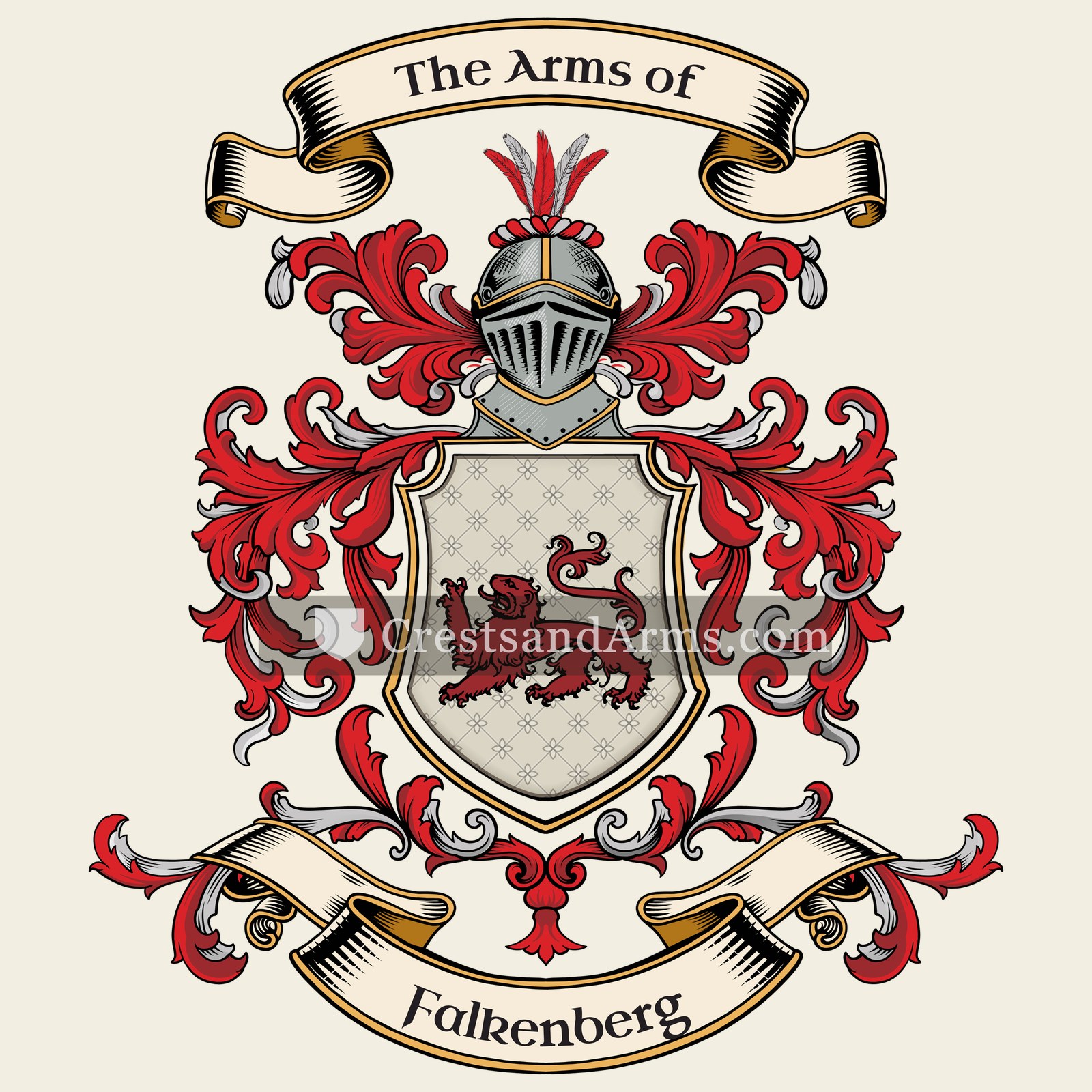


 bendDefence, and the scarf of a commander
 chequyConstancy, and the counting-board
 shipEnterprise, and a great voyage undertaken
 columnFortitude and constancy
 helmetWisdom and security in defence