A record of documented arms, meaning and origin, researched for the Falkner family lines. Documented in 3 countries.
Reg. 6144 · Swiss, D–F
Coat of Arms & Family Crest Details
Symbols on this shield
falconOne eager and quick in pursuit
handFaith, sincerity and justice
Colours
Blue (Azure)Means: Loyalty and truth
Gold (Or)Means: Generosity
Silver (Argent)Means: Peace and sincerity
Historical info
Source
J. B. Rietstap, Armorial Général, Gouda: G. B. van Goor Zonen, 1884–87
Blazon (the actual original written record)
“D'azur à un faucon ess. au nat., perché sur un chicot d'or, posé en bande, tenu par une main d'arg., en pal, mouv. de la p.; l'écu bordé d'or. Cq. cour. C.: un faucon ess., au nat. L. d'or et d'azur.”
SwitzerlandBâle, c. 1745
Digital archive packCoat of arms PNG, gold border print PDF, vector SVG and the certificate of authenticity. Sent to your email in minutes.
Map of Switzerland showing where the Falkner arms are recorded
The Falkner arms were recorded in Bâle, c. 1745.
This is where the arms were entered in the register. Families often moved to other parts of the country, so the same name can turn up in more than one region.
The body that granted and recorded arms in Switzerland in this period.
How Arms Worked in Switzerland
In Switzerland, coats of arms were not restricted to the nobility and were often adopted by common citizens and families. These symbols were passed down through generations to show family identity. When branches of a family grew, they often changed small details of the design to distinguish their own line from the original group.
Granting authority
Cantonal and civic authorities managed the use of coats of arms within their specific regions and local jurisdictions.
How they got arms
Families typically assumed their own coats of arms based on local custom rather than receiving them from a central monarch.
Where arms were recorded
Arms were recorded in various cantonal and civic registers starting from the fourteenth century throughout the Swiss region.
The family's standing
Recorded among the armigerous families of Switzerland.
Origin & History of the Falkner Family in Switzerland
The family name Falkner has deep roots in the Swiss city of Bâle, where records confirm members of the family were well-established by the year 1745. The name itself is occupational in origin, likely derived from the Middle High German word for a falconer, which suggests that early ancestors were skilled in the training and handling of birds of prey for hunting. During the eighteenth century, the Falkners in Bâle were part of a vibrant urban society that placed great value on trade, craftsmanship, and civic participation. As the city served as a major crossroads for European commerce and intellectual exchange, families like the Falkners often occupied roles that required literacy and specialized knowledge. By settling in this region, they became part of a long tradition of Swiss families who helped shape the local economy and social structure through their professional contributions. Their presence in Bâle during this era reflects a period of stability and growth for the family as they integrated into the professional life of one of Switzerland's most important historical centers.
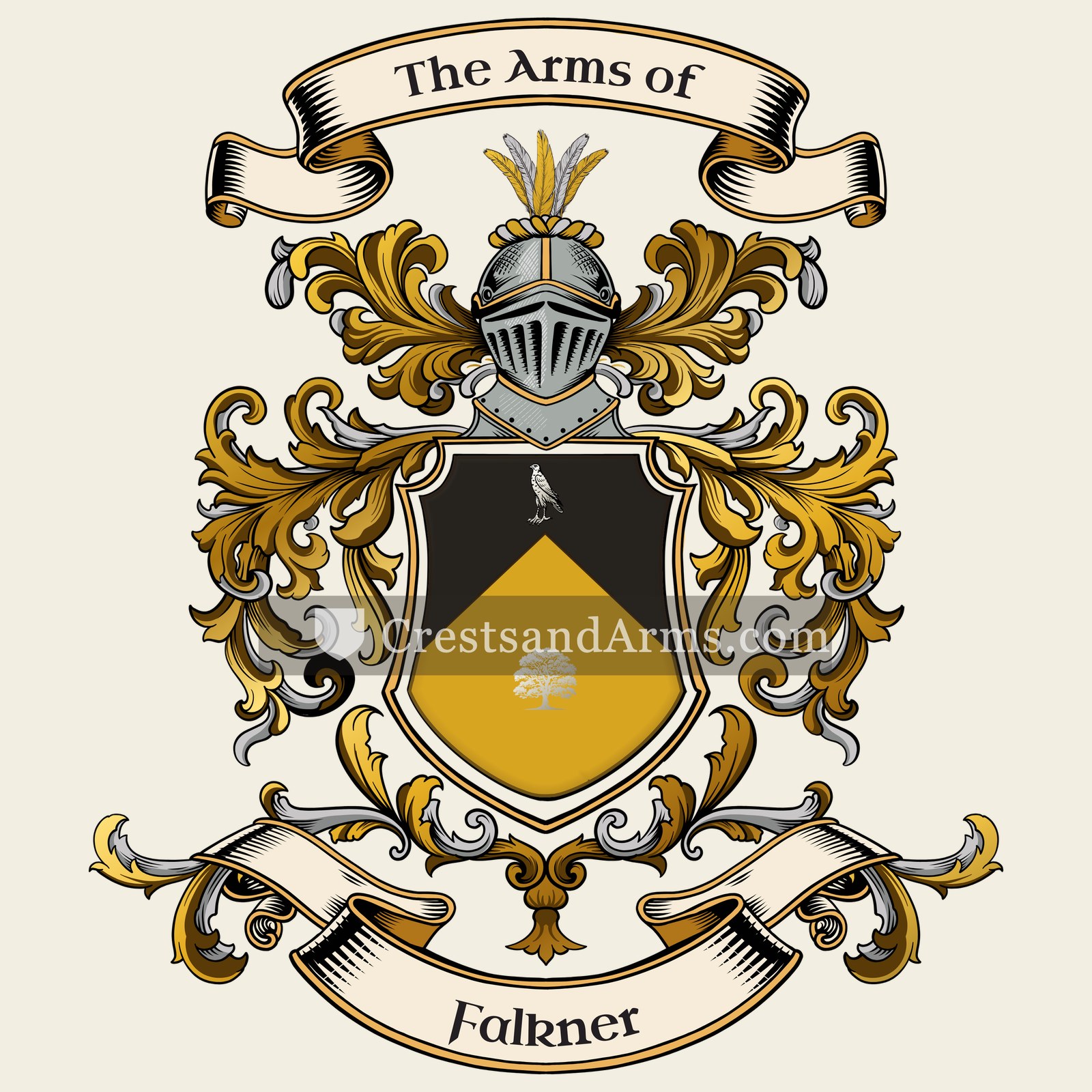
Coat of Arms & Family Crest Details
Symbols on this shield
falconOne eager and quick in pursuit
treeLife, endurance and deep roots
Colours
Black (Sable)Means: Constancy
Gold (Or)Means: Generosity
Historical info
Source
J. B. Rietstap, Armorial Général, Gouda: G. B. van Goor Zonen, 1884–87
Blazon (the actual original written record)
“De sa., chapé-ployé, à dextre d'or, à sen. de gu.; à un faucon au nat. sur le sa., les ailes levées br. sur l'or et sur le gu.; le faucon posé sur un tronc d'arbre en pal, aussi au nat. C.: un homme iss., hab. de gu., ceint et rebr. d'or, supp. de sa main dextre un faucon au nat. L.: à dextre d'or et de sa., à sen. d'arg. et de gu.”
GermanyNuremberg, c. 1765
Digital archive packCoat of arms PNG, gold border print PDF, vector SVG and the certificate of authenticity. Sent to your email in minutes.
Map of Germany showing where the Falkner arms are recorded
The Falkner arms were recorded in Nuremberg, c. 1765.
This is where the arms were entered in the register. Families often moved to other parts of the country, so the same name can turn up in more than one region.
The body that granted and recorded arms in Germany in this period.
Francis I, Holy Roman Emperor
Sovereign of the period
Francis I, Holy Roman Emperor
1745–1765
Reigning in Switzerland when the Falkner arms are first recorded.
How Arms Worked in Germany
In the Holy Roman Empire, coats of arms were often granted to individuals by the Emperor or his representatives. These arms were then passed down through the generations to all legitimate descendants of the original holder. Younger branches of a family usually kept the same shield design without needing to change it, as the arms belonged to the entire lineage.
Granting authority
The Holy Roman Emperor held the sole power to grant new coats of arms throughout his vast imperial territories.
How they got arms
Families typically obtained their coats of arms through a formal imperial grant or by proving their noble status to the authorities.
Where arms were recorded
These grants were officially recorded in the Imperial Chancery registers, which began keeping formal records of such honors during the Middle Ages.
The family's standing
Recorded among the armigerous families of Germany.
Origin & History of the Falkner Family in Germany
The surname Falkner originates from the Middle High German word *valkenære*, which translates to falconer. During the Middle Ages, falconry was a prestigious pursuit reserved for the nobility and the wealthy elite, as training birds of prey required significant time, skill, and resources. Families who carried this name were often employed by local lords or rulers to manage the hunting birds used for sport and food. By the time the family was documented in Nuremberg in 1765, the name had transitioned from a professional title into a hereditary surname. Living in a major trade hub like Nuremberg suggests that the family had moved away from rural hunting estates and into the urban middle class. They likely integrated into the city’s vibrant economy, perhaps working as skilled craftsmen or merchants who benefited from the city's reputation for innovation and metalwork. This shift reflects the broader history of German surnames, where professional roles eventually became permanent family identifiers passed down through generations.
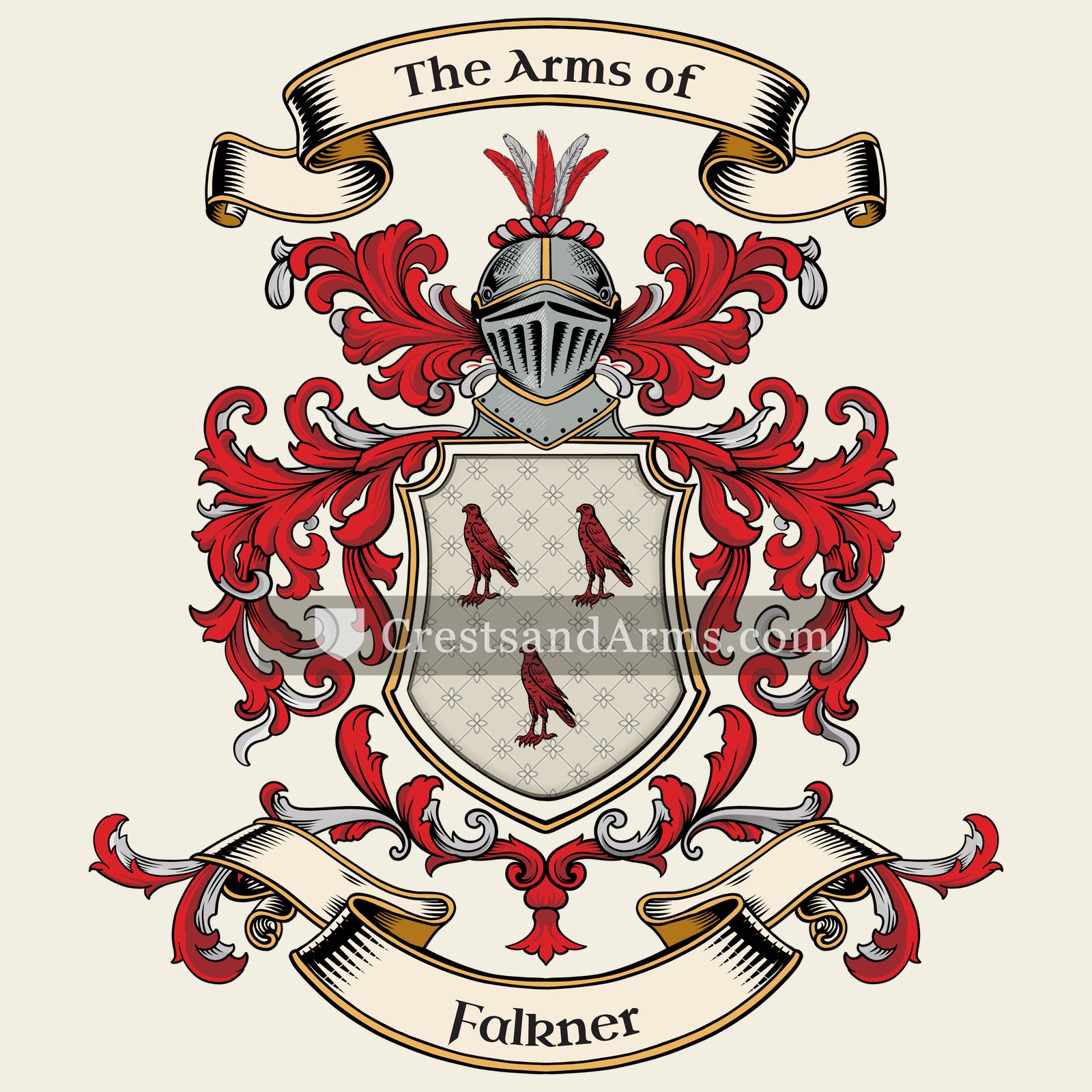
Coat of Arms & Family Crest Details
Symbols on this shield
falconOne eager and quick in pursuit
Colours
Silver (Argent)Means: Peace and sincerity
Red (Gules)Means: Military strength
Historical info
Source
Sir Bernard Burke, The General Armory of England, Scotland, Ireland and Wales, London: Harrison & Sons, 1884
Blazon (the actual original written record)
“Ar. three hawks' heads erased gu”
Irelandc. 1645
Digital archive packCoat of arms PNG, gold border print PDF, vector SVG and the certificate of authenticity. Sent to your email in minutes.
Map of Ireland showing where the Falkner arms are recorded
The Falkner arms were recorded in Ireland, c. 1645.
Arms such as these were typically recorded in Dublin.
Dublin was the seat of government in Ireland and the place where grants were sought and recorded. Families with business at the castle or the courts settled nearby, and settling there put their arms on record.
This is where the arms were entered in the register. Families often moved to other parts of the country, so the same name can turn up in more than one region.
The body that granted and recorded arms in Ireland in this period.
Charles I of England
Sovereign of the period
Charles I of England
1625–1649
Reigning in Switzerland when the Falkner arms are first recorded.
How Arms Worked in Ireland
The Ulster King of Arms granted coats of arms to individuals who proved their social standing and good character. These symbols were typically inherited by all legitimate descendants of the original holder. If a family branch wanted a unique look, they could apply for a specific change to their design through the office to ensure their identity remained distinct.
Granting authority
The Ulster King of Arms acted as the official body that regulated and issued all coats of arms throughout Ireland.
How they got arms
Families obtained their arms through formal grants issued by the office after proving their eligibility and paying the required fees.
Where arms were recorded
All official grants were recorded in the registers held by the Ulster King of Arms starting from the year 1552.
The family's standing
Recorded among the armigerous families of Ireland.
Origin & History of the Falkner Family in Ireland
The surname Falkner arrived in Ireland as part of the complex migration patterns that defined the seventeenth century. While the name originates from the occupation of a falconer, those who carried it to Ireland were often associated with the administrative and military shifts occurring during the mid-1600s. Records confirm that members of the family were firmly established in Dublin by 1645, a time when the city served as a critical hub for English settlers and officials. These early residents were likely involved in the urban development and trade networks that were expanding in the capital during this period. Over time, the family integrated into the local social fabric, moving from their roles as new arrivals to becoming part of the permanent population of the city. Their presence in Dublin during this era reflects the broader movement of people who sought new opportunities in Ireland during a time of significant political change.
Falkner Meaning & Related Branches
Root word
Falco
Latin term for a falcon or bird of prey.
This name
FalknerAn occupational surname for a falconer or someone who trained hunting birds.
also spelled
Falckner
Falkener
Faulkner
Falconer
Fawkener
Related arms
Falcknervariant spelling
Falkenervariant spelling
Falconervariant spelling
Falkinervariant spelling
Documented Sources
J. B. Rietstap, Armorial Général, Gouda: G. B. van Goor Zonen, 1884–87
Burckhardt, August, Die Bürger von Basel, 1940
Heitz, Paul, Die Basler Buchdrucker und ihre Zunft, 1895
Staatsarchiv Basel-Stadt, Bürgerverzeichnisse und Einwohnerregister
Digital archive packCoat of arms PNG, gold border print PDF, vector SVG and the certificate of authenticity. Sent to your email in minutes.


 falconOne eager and quick in pursuit
 handFaith, sincerity and justice
 falconOne eager and quick in pursuit
 handFaith, sincerity and justice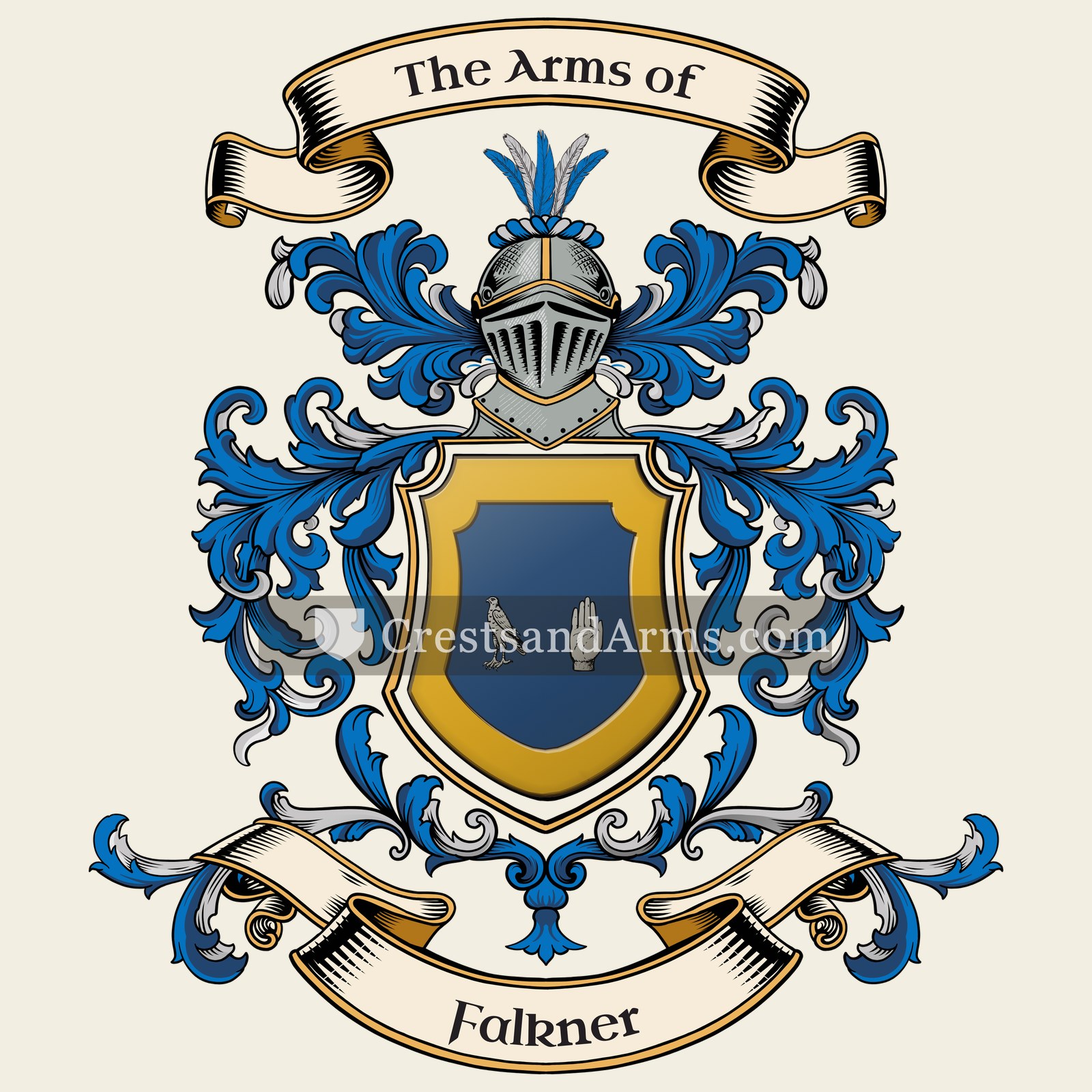

 treeLife, endurance and deep roots