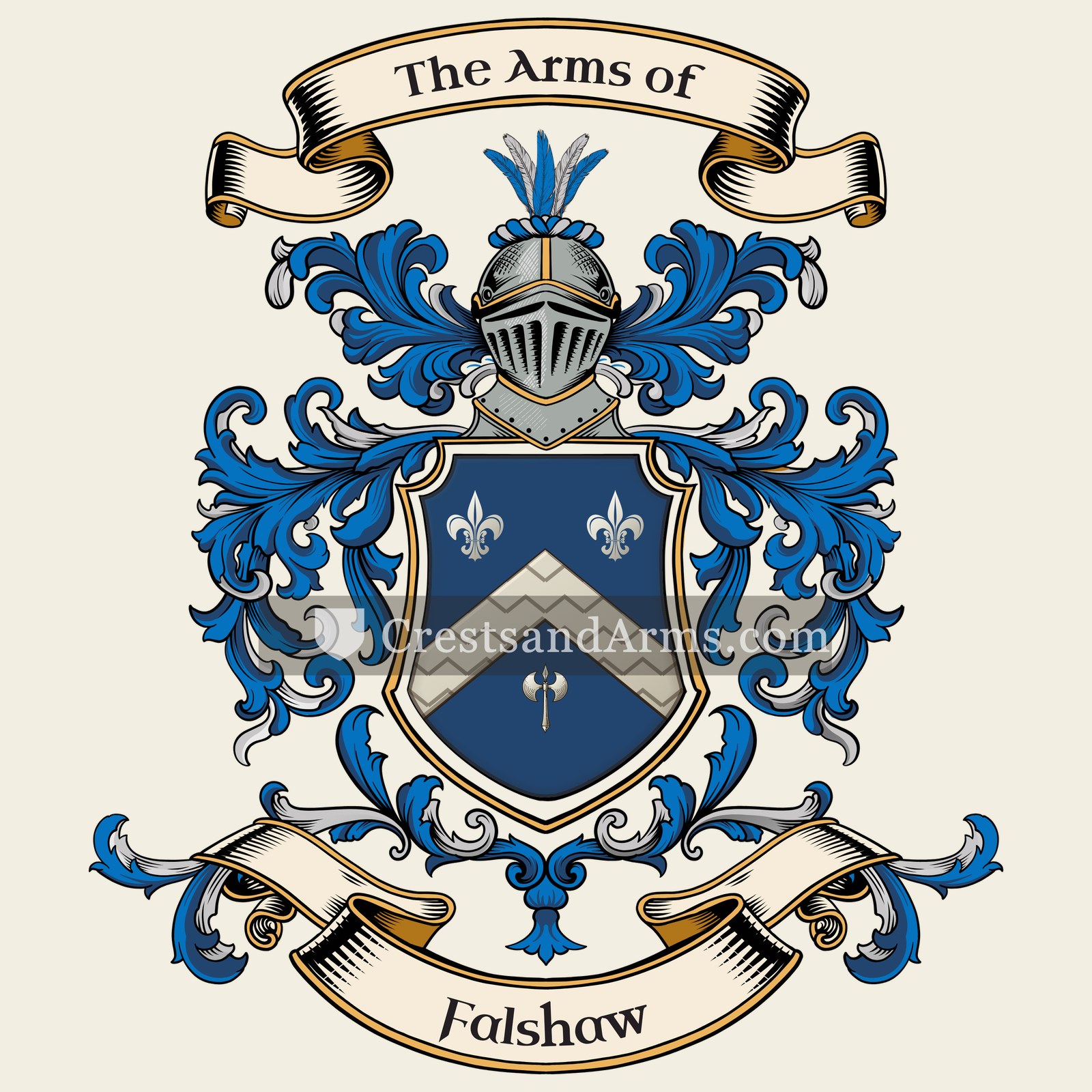
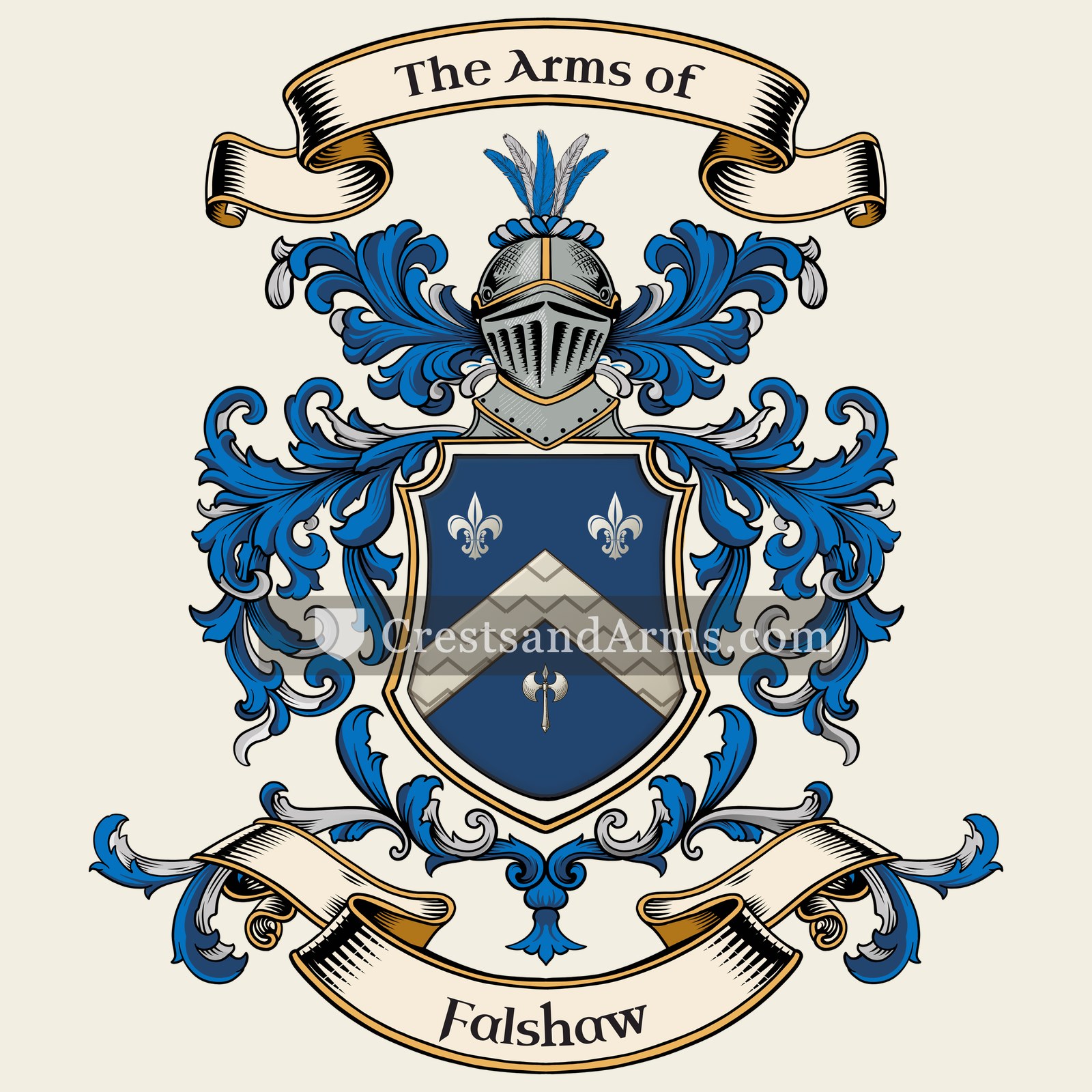
A record of documented arms, meaning and origin, researched for the Falshaw family lines. Documented in 2 countries.
Reg. 2833 · French, D–F
Coat of Arms & Family Crest Details
Symbols on this shield
chevronProtection, and faithful service completed
fleur de lisPurity, light, and the sixth son
axeThe execution of military duty
Colours
Blue (Azure)Means: Loyalty and truth
Silver (Argent)Means: Peace and sincerity
Historical info
Source
J. B. Rietstap, Armorial Général, Gouda: G. B. van Goor Zonen, 1884–87
Blazon (the actual original written record)
“D'azur au chev., acc. en chef de deux fleurs-de-lis et en p. d'une hache d'armes, posée en pal, le tout d'arg. C.: une main dextre de carn., en pal, tenant une rose d'arg., tigée et feuillée de sin. D.: IN OFFICIO IMPAVIDUS.”
FranceEdinbourg, c. 1876
Digital archive packCoat of arms PNG, gold border print PDF, vector SVG and the certificate of authenticity. Sent to your email in minutes.
Map of France showing where the Falshaw arms are recorded
The Falshaw arms were recorded in Edinbourg, c. 1876.
Arms such as these were typically recorded in Bretagne.
More families held coats of arms in Bretagne than anywhere else in France. The land was divided into many small estates rather than a few large ones, so far more households counted as gentry, and each needed a shield of its own to be told apart.
This is where the arms were entered in the register. Families often moved to other parts of the country, so the same name can turn up in more than one region.
The body that granted and recorded arms in France in this period.
How Arms Worked in France
In France, a coat of arms was a mark of honor that passed down through the male line to all legitimate descendants. Families often used the same shield without changes to show their shared heritage. If a branch wanted to stand out, they could add a small mark to their shield to show their specific place in the family tree.
Granting authority
The Juge d'armes de France acted as the official authority that regulated and verified coats of arms across the country.
How they got arms
Families typically inherited their arms from ancestors, though they could also receive them through royal grants or by proving their noble status.
Where arms were recorded
Coats of arms were officially recorded in the Armorial Général de France, which began its main collection in the year 1696.
The family's standing
Recorded among the armigerous families of France.
Origin & History of the Falshaw Family in France
The family name Falshaw carries a history deeply rooted in the cultural landscape of northern France, particularly within the region of Bretagne. While the name is often associated with later migrations, records confirm that members of the family were firmly established in this coastal province by 1876. During this period, Bretagne was a region defined by its unique linguistic heritage and strong maritime traditions, which likely influenced the daily lives and occupations of early family members. The presence of the name in French administrative documents from the late nineteenth century suggests that the family was well-integrated into the local community, participating in the social and economic shifts that defined the era. By studying these early records, we gain insight into a family that navigated the transition between traditional rural life and the modernization of the French state.
Coat of Arms & Family Crest Details
Symbols on this shield
chevronProtection, and faithful service completed
fleur de lisPurity, light, and the sixth son
axeThe execution of military duty
Colours
Blue (Azure)Means: Loyalty and truth
Silver (Argent)Means: Peace and sincerity
Historical info
Source
Sir Bernard Burke, The General Armory of England, Scotland, Ireland and Wales, London: Harrison & Sons, 1884
Blazon (the actual original written record)
“Az. a chev. betw. two fleurs-de-lis in chief and a battle axe in base ar”
EdinburghEdinburgh, c. 1876
Digital archive packCoat of arms PNG, gold border print PDF, vector SVG and the certificate of authenticity. Sent to your email in minutes.
Map of Scotland showing where the Falshaw arms are recorded
The Falshaw arms were recorded in Edinburgh, c. 1876.
Edinburgh was the seat of Scotland's government, its courts and its heralds. Families with business there settled nearby, and being close to where arms were recorded is exactly why so many of them appear.
This is where the arms were entered in the register. Families often moved to other parts of the country, so the same name can turn up in more than one region.
The body that granted and recorded arms in Scotland in this period.
Victoria
Sovereign of the period
Victoria
1837–1901
Reigning in France when the Falshaw arms are first recorded.
How Arms Worked in Scotland
Scottish heraldry is unique because it treats a coat of arms as a piece of personal property protected by law. Only one person can own a specific design at any given time. When a family grows, the head keeps the original shield while other relatives must apply for their own distinct version with slight changes to prove their specific identity.
Granting authority
The Court of the Lord Lyon acts as the official body that regulates and controls all heraldic matters throughout Scotland.
How they got arms
Individuals obtain a legal right to their arms through a formal petition process that confirms their identity and family connection.
Where arms were recorded
All valid coats of arms are officially entered into the Public Register of All Arms and Bearings starting from 1672.
The family's standing
Recorded among the armigerous families of Edinburgh.
Origin & History of the Falshaw Family in Scotland
The Falshaw family name carries a history deeply rooted in the industrial and urban growth of nineteenth-century Scotland. While the name likely originated from English locations, its presence in Edinburgh became significant by the mid-1870s as the city underwent rapid modernization. By 1876, members of the family were well-established in the capital, participating in the professional and civic life of a city that was expanding its infrastructure and influence. This period was a time of great change for Edinburgh, and families like the Falshaws were often involved in the trades and administrative roles that kept the city running during the Victorian era. Their presence in the historical records of this time reflects a broader trend of families moving into urban centers to contribute to the developing economy of Scotland.
Falshaw Meaning & Related Branches
Root word
Fals-haga
A false or deceptive enclosure or hedge.
This name
FalshawRefers to someone who lived near a misleading or false boundary marker or hedge.
also spelled
Falshau
Falshoo
Related arms
Fairfaxsimilar arms
van Peenensimilar arms
Wasserschlebensimilar arms
Arbuthnotrecorded with Falshaw, same area
Documented Sources
J. B. Rietstap, Armorial Général, Gouda: G. B. van Goor Zonen, 1884–87
Archives départementales d'Ille-et-Vilaine, État civil et registres paroissiaux
Galllouédec, Louis, La Bretagne, 1917
Le Moyne de La Borderie, Arthur, Histoire de Bretagne, 1896
Digital archive packCoat of arms PNG, gold border print PDF, vector SVG and the certificate of authenticity. Sent to your email in minutes.


 chevronProtection, and faithful service completed
 fleur de lisPurity, light, and the sixth son
 axeThe execution of military duty
 chevronProtection, and faithful service completed
 fleur de lisPurity, light, and the sixth son
 axeThe execution of military duty