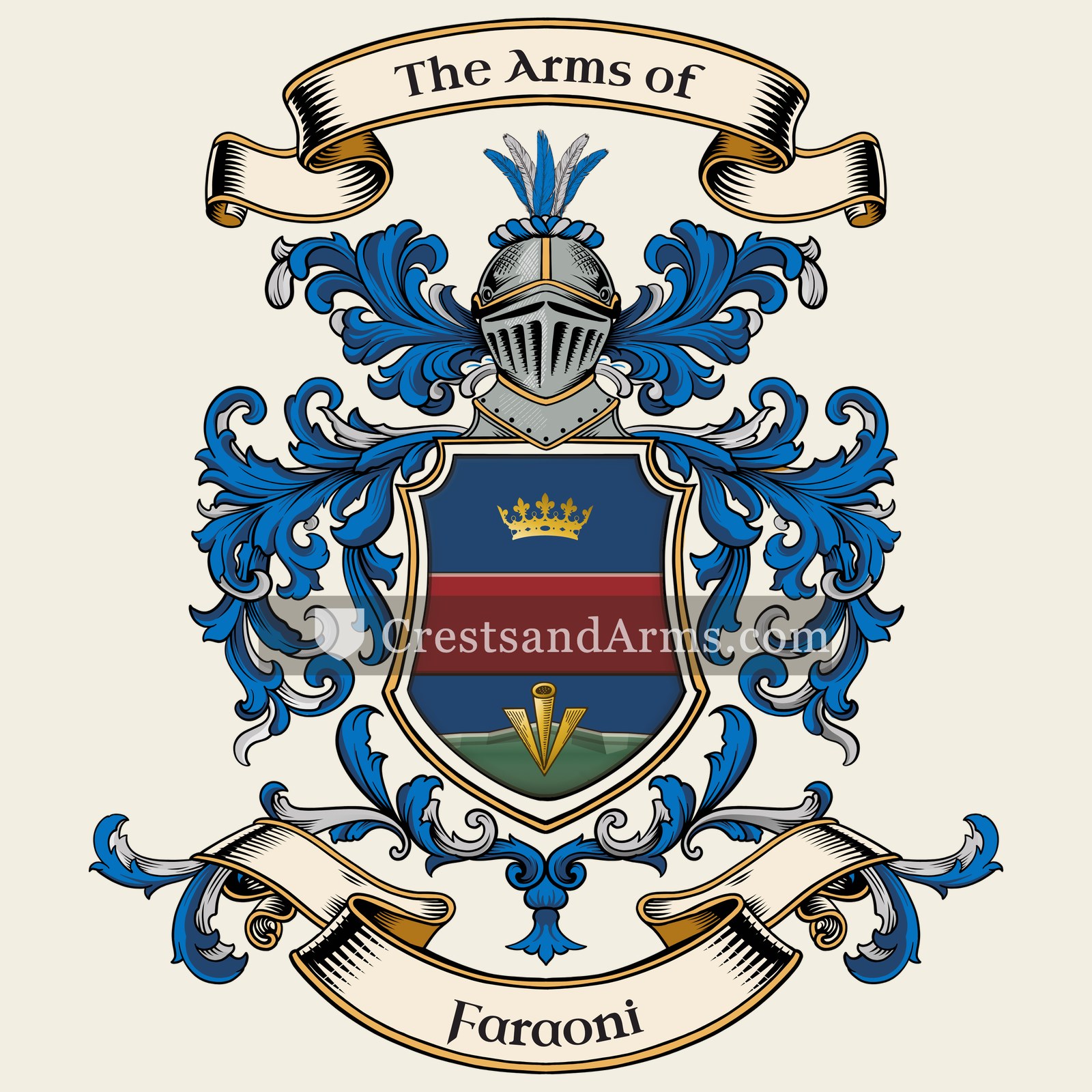
A record of documented arms, meaning and origin, researched for the Faraoni family of Italy.
Reg. 1781 · Italian, D–F
Coat of Arms & Family Crest Details
Symbols on this shield
fessThe military belt, and readiness to serve
mountThe ground held, and steadfastness upon it
crownSovereignty, authority and just reward
arrowReadiness for battle, and affliction endured
Colours
Blue (Azure)Means: Loyalty and truth
Red (Gules)Means: Military strength
Green (Vert)Means: Hope
Gold (Or)Means: Generosity
Historical info
Source
J. B. Rietstap, Armorial Général, Gouda: G. B. van Goor Zonen, 1884–87
Blazon (the actual original written record)
“D'azur à la fasce de gu., supp. un mont de trois coupeaux de sin. surm. d'une couronne d'or, et acc. en p. d'une flèche d'or, posée en pal, la pointe en bas, les pennes br. sur la fasce.”
ItalyLegnago, c. 1725
Digital archive packCoat of arms PNG, gold border print PDF, vector SVG and the certificate of authenticity. Sent to your email in minutes.
Map of Italy showing where the Faraoni arms are recorded
The Faraoni arms were recorded in Legnago, c. 1725.
This is where the arms were entered in the register. Families often moved to other parts of the country, so the same name can turn up in more than one region.
The body that granted and recorded arms in Italy in this period.
Victor Amadeus II of Savoy
Sovereign of the period
Victor Amadeus II of Savoy
1675–1730
Reigning in Italy when the Faraoni arms are first recorded.
How Arms Worked in Italy
In the Italian states, coats of arms were often used by noble families to show their status and history. These symbols were passed down through the generations to all legitimate male descendants. Younger branches of a family usually kept the original design but sometimes added small changes to distinguish their specific line from the main branch.
Granting authority
Various local rulers and city governments controlled the use of coats of arms across the different Italian states.
How they got arms
Families often assumed their own arms or received them as official grants from local lords, popes, or city councils.
Where arms were recorded
Arms were recorded in local city archives or private family books rather than in one single national register.
The family's standing
Recorded among the armigerous families of Italy.
Origin & History of the Faraoni Family in Italy
The Faraoni family name is deeply rooted in the history of the Veneto region of Italy, with documented evidence placing the family in the town of Legnago by 1725. The name itself is derived from the Italian word "faraone," which historically referred to a pharaoh or a person of significant status. During the eighteenth century, families in this area often held positions tied to local administration, agriculture, or trade along the Adige River, which served as a vital economic artery for Legnago. As residents of a strategic town that frequently saw military movement and commercial growth, the Faraoni family likely participated in the local merchant class or land management systems that defined the social structure of the era. Their presence in the official records of Legnago during this time suggests they were established citizens who contributed to the development of the community as it transitioned through the complex political landscape of the Venetian Republic.
Faraoni Meaning & Related Branches
Root word
Pharao
Derived from the Egyptian term for a great house or king.
This name
FaraoniAn occupational or descriptive surname referring to someone associated with the Egyptian pharaohs.
also spelled
Faraony
Documented Sources
J. B. Rietstap, Armorial Général, Gouda: G. B. van Goor Zonen, 1884–87
Archivio di Stato di Verona, Stato d'anime della Parrocchia di San Salvaro (Legnago), 1725
Borelli, Giorgio, Un uomo, una terra, una storia: Legnago e il suo territorio, 1985
Comune di Legnago, Archivio Storico Comunale: Registri dei battesimi e stati di famiglia, 1725–1750
Digital archive packCoat of arms PNG, gold border print PDF, vector SVG and the certificate of authenticity. Sent to your email in minutes.


 fessThe military belt, and readiness to serve
 mountThe ground held, and steadfastness upon it
 crownSovereignty, authority and just reward
 arrowReadiness for battle, and affliction endured
 fessThe military belt, and readiness to serve
 mountThe ground held, and steadfastness upon it
 crownSovereignty, authority and just reward
 arrowReadiness for battle, and affliction endured