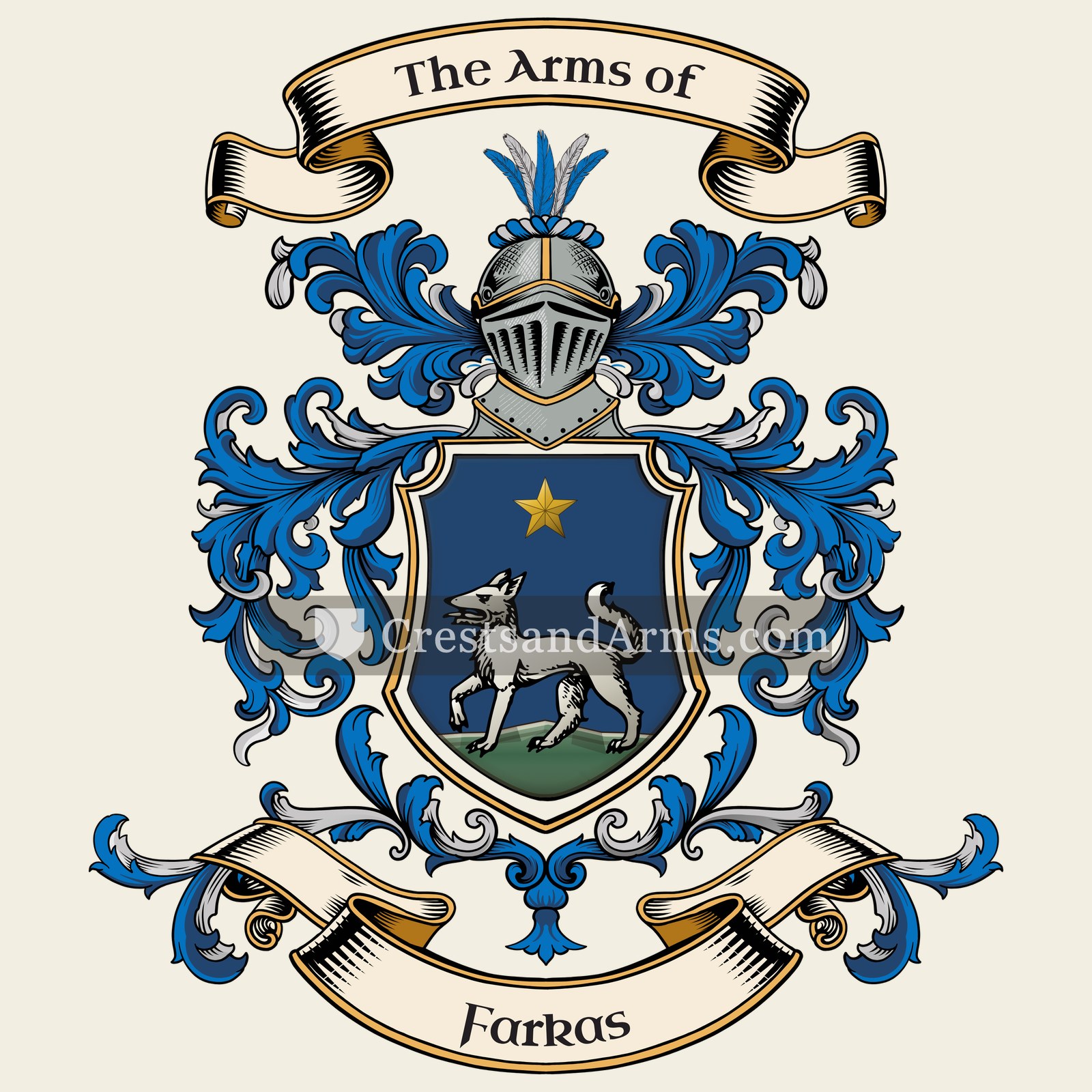
A record of documented arms, meaning and origin, researched for the Farkas family of Austria.
Reg. 9798 · Austrian, D–F
Coat of Arms & Family Crest Details
Symbols on this shield
mountThe ground held, and steadfastness upon it
wolfReward from long service and hard work
mulletThe third son, and a divine quality from above
Colours
Blue (Azure)Means: Loyalty and truth
Green (Vert)Means: Hope
Gold (Or)Means: Generosity
Historical info
Source
J. B. Rietstap, Armorial Général, Gouda: G. B. van Goor Zonen, 1884–87
Blazon (the actual original written record)
“D'azur à un loup cont. au nat., couché sur une terrasse de sin., la tête retournée à dextre, tenant sous ses pattes de devant un bouclier circulaire de fer, bordé d'or, et un sabre au nat., br. sur ledit bouclier en barre; le tout acc. en chef d'une étoile d'or, dardant six rayons d'or vers le loup, chaque rai en forme d'éventail. Cq. cour. C.: cinq pl. d'aut., alt. d'azur et d'or. L. d'or et d'azur.”
AustriaTransylvanie, c. 1820
Digital archive packCoat of arms PNG, gold border print PDF, vector SVG and the certificate of authenticity. Sent to your email in minutes.
Map of Austria showing where the Farkas arms are recorded
The Farkas arms were recorded in Transylvanie, c. 1820.
Arms such as these were typically recorded in Tyrol.
Tyrol was mountain country in western Austria, where the valleys were held by families who had been there a very long time. Old tenure counted for more than money, and old families carried arms.
This is where the arms were entered in the register. Families often moved to other parts of the country, so the same name can turn up in more than one region.
Region
Tyrol
Town
Transylvanie
First recorded
1820
Granting Authority for the Farkas Arms
Imperial and Royal chancery
Sodacan · CC BY-SA 3.0
The body that granted and recorded arms in Austria in this period.
Francis II, Holy Roman Emperor
Sovereign of the period
Francis II, Holy Roman Emperor
1804–1835
Reigning in Austria when the Farkas arms are first recorded.
How Arms Worked in Austria
Austrian coats of arms were often linked directly to noble titles granted by the Emperor. These symbols belonged to the entire family line rather than just one individual. When a family grew, new branches kept the original design without needing to change it. This system allowed all members of a noble house to share the same identity across many generations.
Granting authority
The Imperial and Royal chancery managed all heraldic matters and controlled the official granting of arms throughout the Austrian lands.
How they got arms
Families typically received their arms through a formal imperial decree that often accompanied the elevation of a person to noble status.
Where arms were recorded
Official records of these grants were kept in the Imperial Register of Nobility which began its formal documentation process in 1453.
The family's standing
Recorded among the armigerous families of Austria.
Origin & History of the Farkas Family in Austria
The surname Farkas originates from the Hungarian word for wolf, which was often used as a descriptive nickname for a person perceived to be brave, cunning, or fierce. While the name is most strongly associated with Hungarian roots, its presence in the Tyrol region by 1820 highlights the historical movement of families across the borders of the Austro-Hungarian Empire. During this period, individuals often migrated for work in mining, forestry, or trade, carrying their surnames into new linguistic and cultural landscapes. As the family settled in the Alpine environment of Tyrol, the name transitioned from a simple descriptor into a fixed hereditary identifier. This evolution reflects the broader patterns of European migration where families maintained their ancestral names even as they integrated into the social and administrative structures of their new homes.
Farkas Meaning & Related Branches
Root word
Farkas
Derived from the Proto-Slavic word for wolf.
This name
FarkasA Hungarian occupational or descriptive surname meaning wolf, often used as a nickname for a fierce warrior.
also spelled
Farkas
Farkas-Hemenau
Farkas de Hemeno
Documented Sources
J. B. Rietstap, Armorial Général, Gouda: G. B. van Goor Zonen, 1884–87
Kázmér, Miklós. Régi magyar családnevek szótára: XIV–XVII. század. 1993
Sebestyén, Árpád. A magyar családnevek eredete. 1998


 mountThe ground held, and steadfastness upon it
 wolfReward from long service and hard work
 mulletThe third son, and a divine quality from above
 mountThe ground held, and steadfastness upon it
 wolfReward from long service and hard work
 mulletThe third son, and a divine quality from above