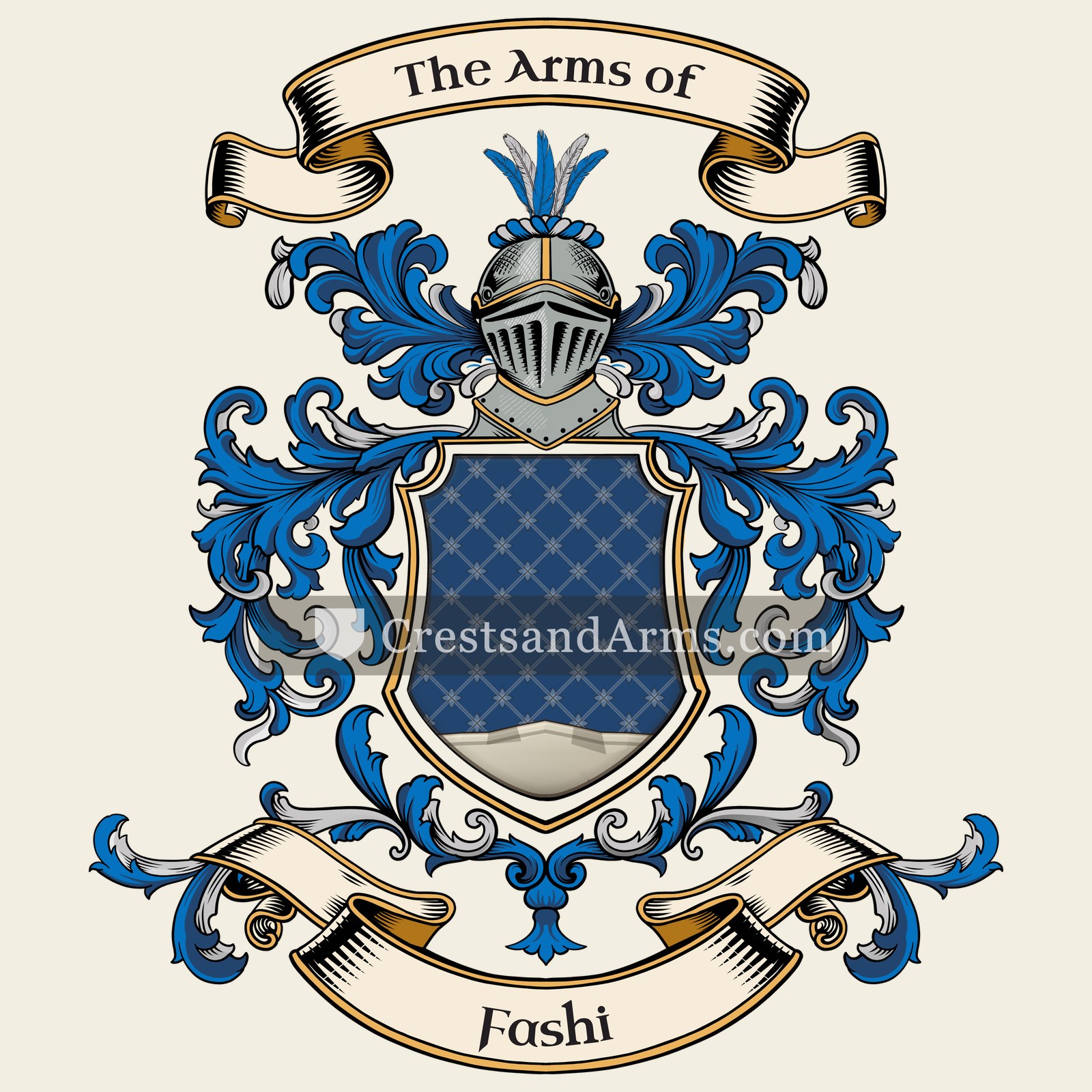
A record of documented arms, meaning and origin, researched for the Fashi family of Italy.
Reg. 0634 · Italian, D–F
Coat of Arms & Family Crest Details
Symbols on this shield
mountThe ground held, and steadfastness upon it
Colours
Blue (Azure)Means: Loyalty and truth
Silver (Argent)Means: Peace and sincerity
Historical info
Source
J. B. Rietstap, Armorial Général, Gouda: G. B. van Goor Zonen, 1884–87
Blazon (the actual original written record)
“D'azur à un monstre ayant le buste, les bras et la tête d'un homme, arm. d'une cuirasse et d'un casque, avec des ailes et des pattes de dragon, le tout au nat., posé sur un mont d'arg., mouv. de la p.”
PiedmontPiedmont, c. 1775
Digital archive packCoat of arms PNG, gold border print PDF, vector SVG and the certificate of authenticity. Sent to your email in minutes.
Map of Italy showing where the Fashi arms are recorded
The Fashi arms were recorded in Piedmont, c. 1775.
Piedmont was Alpine and river country in north-western Italy, ruled from Turin. Its noble houses were listed formally by the state, and a name on that list carried arms as a matter of record.
This is where the arms were entered in the register. Families often moved to other parts of the country, so the same name can turn up in more than one region.
The body that granted and recorded arms in Italy in this period.
Alvise Giovanni Mocenigo
Sovereign of the period
Alvise Giovanni Mocenigo
1763–1778
Reigning in Italy when the Fashi arms are first recorded.
How Arms Worked in Italy
In the Italian states, coats of arms were often used by noble families to show their status and history. These symbols were passed down through the generations to all legitimate male descendants. Younger branches of a family usually kept the original design but sometimes added small changes to distinguish their specific line from the main branch.
Granting authority
Various local rulers and city governments controlled the use of coats of arms across the different Italian states.
How they got arms
Families often assumed their own arms or received them as official grants from local lords, popes, or city councils.
Where arms were recorded
Arms were recorded in local city archives or private family books rather than in one single national register.
The family's standing
Recorded among the armigerous families of Piedmont.
Origin & History of the Fashi Family in Italy
The Fashi family name traces its roots to the rugged landscape of the Piedmont region in northwestern Italy. By the year 1775, historical records confirm that members of the family were firmly established within this area. During the late 18th century, Piedmont was a place of significant social and political change under the rule of the House of Savoy. Families like the Fashis often lived in small agricultural communities where they worked the land or participated in the local trades that supported the growing regional economy. The name itself likely evolved from local dialects common to the Alpine foothills, reflecting the distinct linguistic heritage of the people living near the border of France. As the family moved through the generations, they remained connected to the traditions and customs of their Piedmontese home, helping to shape the cultural identity of their local villages long before the unification of Italy.
Fashi Meaning & Related Branches
Root word
Fascia
Latin term referring to a band, sash, or strip of cloth.
This name
FashiAn occupational name for a maker or seller of ribbons, sashes, or bandages.
also spelled
Fashi
Fasi
Documented Sources
J. B. Rietstap, Armorial Général, Gouda: G. B. van Goor Zonen, 1884–87
Archivio di Stato di Torino, Stato civile della Restaurazione
Archivio Storico Diocesano di Torino, Libri dei battesimi e dei matrimoni
Comba, Rinaldo, Storia del Piemonte. Dalle origini all'Ottocento, 1977
Quazza, Guido, Storia del Piemonte, 1975
Digital archive packCoat of arms PNG, gold border print PDF, vector SVG and the certificate of authenticity. Sent to your email in minutes.


 mountThe ground held, and steadfastness upon it
 mountThe ground held, and steadfastness upon it