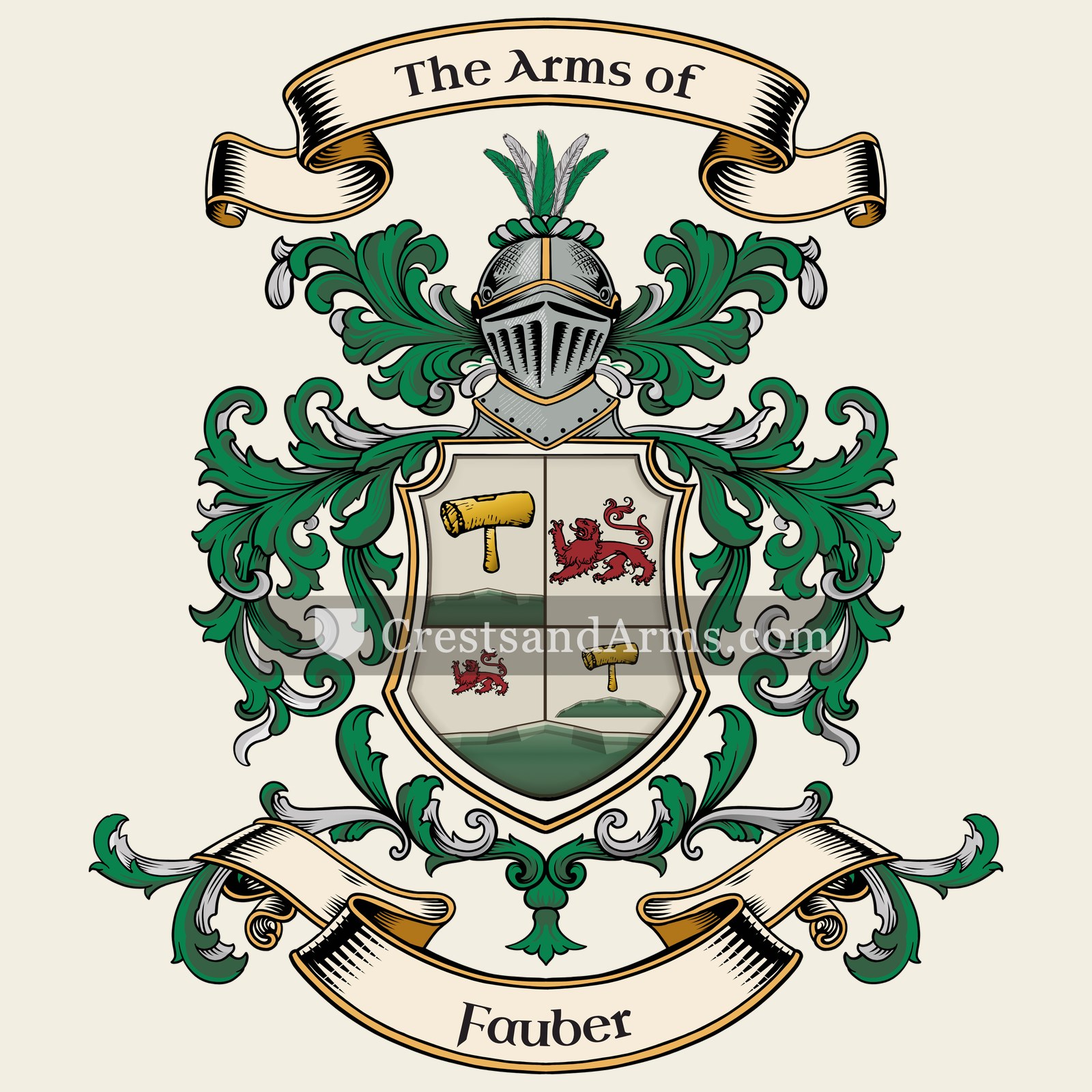
A record of documented arms, meaning and origin, researched for the Fauber family of Germany.
Reg. 4026 · German, D–F
Coat of Arms & Family Crest Details
Symbols on this shield
mountThe ground held, and steadfastness upon it
hammerHonest labour, and the smith's craft
lionCourage, strength and royalty
Colours
Silver (Argent)Means: Peace and sincerity
Green (Vert)Means: Hope
Gold (Or)Means: Generosity
Red (Gules)Means: Military strength
Historical info
Source
J. B. Rietstap, Armorial Général, Gouda: G. B. van Goor Zonen, 1884–87
Blazon (the actual original written record)
“Ec.: aux 1 et 4 d'arg. à un marteau d'or, soutenu d'un tertre de sin.; aux 2 et 3 d'arg. à une tête et col de lion de gu., celle du 3 cont. C.: 1° les meubles du 1; l. d'or et de sa.; 2° le meuble du 2; l. d'arg. et de gu.”
SwabiaSwabia, c. 1765
Digital archive packCoat of arms PNG, gold border print PDF, vector SVG and the certificate of authenticity. Sent to your email in minutes.
Map of Germany showing where the Fauber arms are recorded
The Fauber arms were recorded in Swabia, c. 1765.
Swabia was broken into a great many small territories in southern Germany, and each had its own landowners and its own leading townsmen. That fragmentation produced an unusual number of families with arms.
This is where the arms were entered in the register. Families often moved to other parts of the country, so the same name can turn up in more than one region.
The body that granted and recorded arms in Germany in this period.
Francis I, Holy Roman Emperor
Sovereign of the period
Francis I, Holy Roman Emperor
1745–1765
Reigning in Germany when the Fauber arms are first recorded.
How Arms Worked in Germany
In the Holy Roman Empire, coats of arms were often granted to individuals by the Emperor or his representatives. These arms were then passed down through the generations to all legitimate descendants of the original holder. Younger branches of a family usually kept the same shield design without needing to change it, as the arms belonged to the entire lineage.
Granting authority
The Holy Roman Emperor held the sole power to grant new coats of arms throughout his vast imperial territories.
How they got arms
Families typically obtained their coats of arms through a formal imperial grant or by proving their noble status to the authorities.
Where arms were recorded
These grants were officially recorded in the Imperial Chancery registers, which began keeping formal records of such honors during the Middle Ages.
The family's standing
Recorded among the armigerous families of Swabia.
Origin & History of the Fauber Family in Germany
The family name Fauber traces its roots to the historical region of Swabia, a territory in southwestern Germany known for its distinct cultural identity and complex political structure during the eighteenth century. By 1765, records confirm that members of the family were established within this area, living in a landscape defined by small principalities and rural farming communities. The name itself likely evolved from regional linguistic patterns, possibly relating to local occupations or descriptive nicknames common among German-speaking populations of the era. During this period, families in Swabia were often deeply connected to the land and the local parish, which served as the primary center for both social life and official record-keeping. As the family grew and moved through these German lands, they participated in the traditional agricultural and craft-based economy that defined the daily lives of Swabian citizens before the onset of the industrial age.
Fauber Meaning & Related Branches
Root word
Faber
Latin term for a craftsman, smith, or maker.
This name
FauberAn occupational surname for a blacksmith or metalworker.
also spelled
Faubert
Fober
Fauberger
Fober de Rundeg
Fauber
Documented Sources
J. B. Rietstap, Armorial Général, Gouda: G. B. van Goor Zonen, 1884–87
Brechenmacher, Josef Karlmann. Etymologisches Wörterbuch der deutschen Familiennamen. 1957
Kohlhammer, W. Historischer Atlas von Baden-Württemberg. 1972
Landesarchiv Baden-Württemberg, Kirchenbücher der evangelischen und katholischen Kirchengemeinden in Württemberg
Digital archive packCoat of arms PNG, gold border print PDF, vector SVG and the certificate of authenticity. Sent to your email in minutes.


 mountThe ground held, and steadfastness upon it
 hammerHonest labour, and the smith's craft
 lionCourage, strength and royalty
 mountThe ground held, and steadfastness upon it
 hammerHonest labour, and the smith's craft
 lionCourage, strength and royalty