A record of documented arms, meaning and origin, researched for the Faucon family lines. Documented in 3 countries.
Reg. 0392 · Belgian, D–F
Coat of Arms & Family Crest Details
Symbols on this shield
cross symbolChristian faith and service
falconOne eager and quick in pursuit
Colours
Blue (Azure)Means: Loyalty and truth
Red (Gules)Means: Military strength
Silver (Argent)Means: Peace and sincerity
Historical info
Source
J. B. Rietstap, Armorial Général, Gouda: G. B. van Goor Zonen, 1884–87
Blazon (the actual original written record)
“Ec.: au 1 d'azur à un faucon d'arg.; au 2 de gu. à la croix d'arg.; au 3 d'azur plein; au 4 de gu. plein. Cq. cour. C.: le faucon. L. d'arg. et d'azur.”
BelgiumLuxemb, c. 1676
Digital archive packCoat of arms PNG, gold border print PDF, vector SVG and the certificate of authenticity. Sent to your email in minutes.
Map of Belgium showing where the Faucon arms are recorded
The Faucon arms were recorded in Luxemb, c. 1676.
This is where the arms were entered in the register. Families often moved to other parts of the country, so the same name can turn up in more than one region.
The body that granted and recorded arms in Belgium in this period.
Charles II of Spain
Sovereign of the period
Charles II of Spain
1665–1700
Reigning in Belgium when the Faucon arms are first recorded.
How Arms Worked in Belgium
In Belgium, a coat of arms is considered personal property that is passed down through the male line to legitimate descendants. Families often use the same shield design across generations to show their shared heritage. If a branch of the family wants to change the design, they must apply for an official update to their specific version of the arms.
Granting authority
The Conseil héraldique is the official body that regulates and approves all coats of arms in Belgium.
How they got arms
Families obtain their coats of arms through formal royal grants or by confirming their historical right to use existing designs.
Where arms were recorded
All approved coats of arms are officially recorded in the public registers of the Conseil héraldique since 1844.
The family's standing
Recorded among the armigerous families of Belgium.
Origin & History of the Faucon Family in Belgium
The surname Faucon finds its roots in the medieval French language, where it served as a descriptive nickname for a person who worked with falcons or possessed the sharp, focused traits associated with the bird of prey. By the late 17th century, the family had established a notable presence in the region of Luxembourg, which was then part of the Southern Netherlands under Spanish rule. Records confirm that members of the Faucon family were living in this area by 1676, likely working as skilled laborers or landowners within the rural communities of the Ardennes. During this period, the family lived through a time of significant political transition as the territory shifted between major European powers. Their survival and growth in the region suggest they were well-integrated into the local social fabric, navigating the challenges of agricultural life and the frequent military conflicts that defined the history of the Belgian provinces during the late 1600s.
Coat of Arms & Family Crest Details
Symbols on this shield
towerGrandeur and solidity, and a stronghold defended
falconOne eager and quick in pursuit
crescentHonour by the sovereign, and the second son
Colours
Blue (Azure)Means: Loyalty and truth
Silver (Argent)Means: Peace and sincerity
Gold (Or)Means: Generosity
Historical info
Source
J. B. Rietstap, Armorial Général, Gouda: G. B. van Goor Zonen, 1884–87
Blazon (the actual original written record)
“D'azur à deux tours accostées d'arg., maçonnées de sa., acc. en chef d'un faucon d'or et en p. d'un croiss. du sec.”
LanguedocLanguedoc, c. 1663
Digital archive packCoat of arms PNG, gold border print PDF, vector SVG and the certificate of authenticity. Sent to your email in minutes.
Map of France showing where the Faucon arms are recorded
The Faucon arms were recorded in Languedoc, c. 1663.
Languedoc stretched across the south of France, a country of small towns, vineyards and old local families. Its gentry were numerous rather than grand, and a great many of them held arms even where their estates were modest.
This is where the arms were entered in the register. Families often moved to other parts of the country, so the same name can turn up in more than one region.
The body that granted and recorded arms in France in this period.
Louis XIV of France
Sovereign of the period
Louis XIV of France
1643–1715
Reigning in Belgium when the Faucon arms are first recorded.
How Arms Worked in France
In France, a coat of arms was a mark of honor that passed down through the male line to all legitimate descendants. Families often used the same shield without changes to show their shared heritage. If a branch wanted to stand out, they could add a small mark to their shield to show their specific place in the family tree.
Granting authority
The Juge d'armes de France acted as the official authority that regulated and verified coats of arms across the country.
How they got arms
Families typically inherited their arms from ancestors, though they could also receive them through royal grants or by proving their noble status.
Where arms were recorded
Coats of arms were officially recorded in the Armorial Général de France, which began its main collection in the year 1696.
The family's standing
Recorded among the armigerous families of Languedoc.
Origin & History of the Faucon Family in France
The surname Faucon finds its roots in the medieval practice of naming individuals after birds of prey, specifically the falcon. In the French language, the word *faucon* served as both a descriptive nickname for a person with sharp vision or a swift nature and as a professional identifier for those who trained these birds for hunting. By the time the family established a documented presence in the Languedoc region in 1663, the name had transitioned from a simple nickname into a formal hereditary surname. During this period, the Languedoc area was a hub of agricultural and social activity, and families like the Faucons were often integrated into the local rural economy or the growing professional classes. The persistence of the name in this southern province suggests that early ancestors were deeply embedded in the local community, living through the complex religious and political shifts that defined seventeenth-century France.
Coat of Arms & Family Crest Details
Symbols on this shield
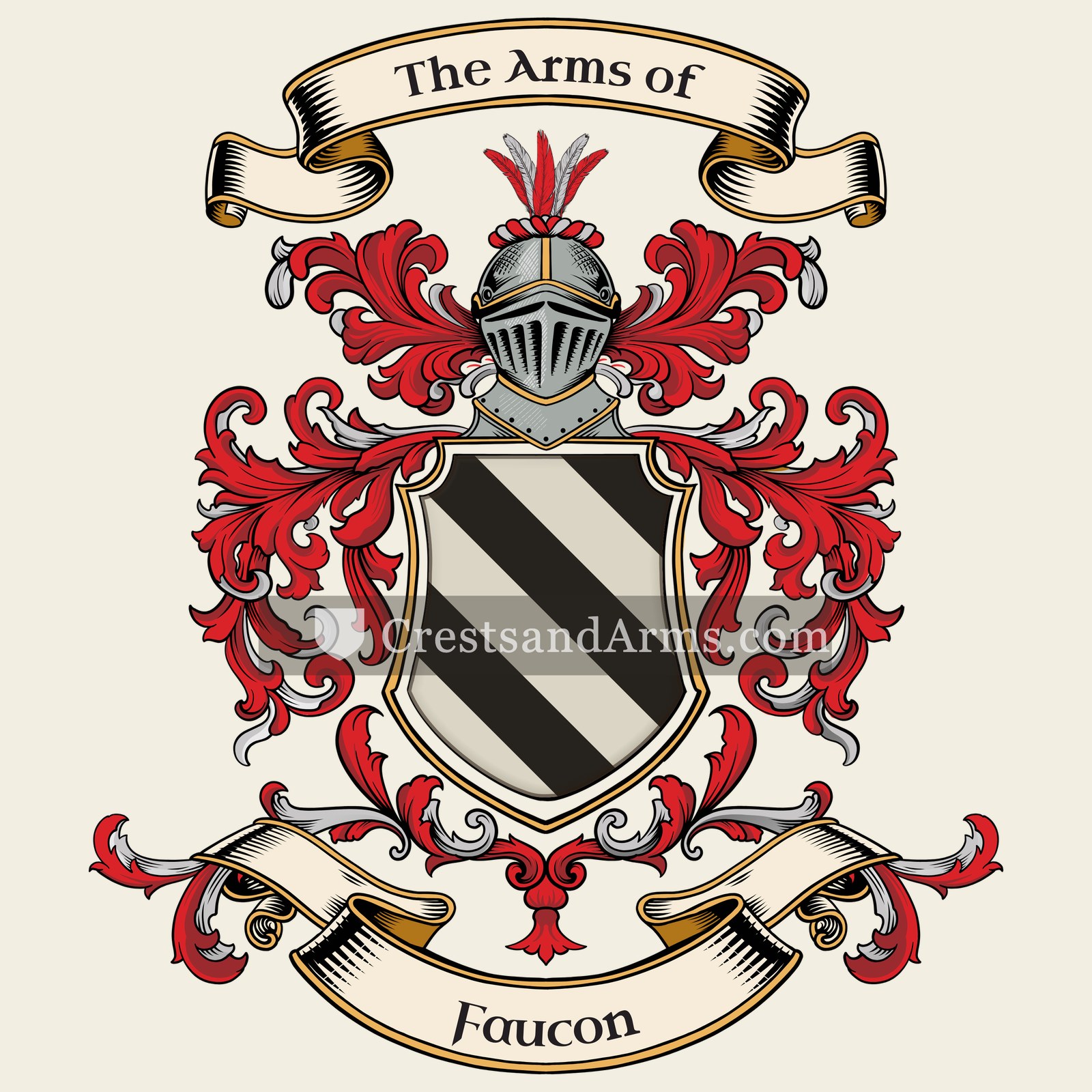
bendDefence, and the scarf of a commander
Colours
Silver (Argent)Means: Peace and sincerity
Black (Sable)Means: Constancy
Historical info
Source
J. B. Rietstap, Armorial Général, Gouda: G. B. van Goor Zonen, 1884–87
Blazon (the actual original written record)
“Bandé d'arg. et de sa. C.: un demi-vol d'arg.”
SwitzerlandFribourg, c. 1745
Digital archive packCoat of arms PNG, gold border print PDF, vector SVG and the certificate of authenticity. Sent to your email in minutes.
Map of Switzerland showing where the Faucon arms are recorded
The Faucon arms were recorded in Fribourg, c. 1745.
This is where the arms were entered in the register. Families often moved to other parts of the country, so the same name can turn up in more than one region.
The body that granted and recorded arms in Switzerland in this period.
How Arms Worked in Switzerland
In Switzerland, coats of arms were not restricted to the nobility and were often adopted by common citizens and families. These symbols were passed down through generations to show family identity. When branches of a family grew, they often changed small details of the design to distinguish their own line from the original group.
Granting authority
Cantonal and civic authorities managed the use of coats of arms within their specific regions and local jurisdictions.
How they got arms
Families typically assumed their own coats of arms based on local custom rather than receiving them from a central monarch.
Where arms were recorded
Arms were recorded in various cantonal and civic registers starting from the fourteenth century throughout the Swiss region.
The family's standing
Recorded among the armigerous families of Switzerland.
Origin & History of the Faucon Family in Switzerland
The family name Faucon has deep roots in the French-speaking regions of Switzerland, particularly within the canton of Fribourg. By the middle of the eighteenth century, members of the family were already established as active participants in the local community. Historical records confirm their presence in Fribourg by 1745, a time when the region was defined by its complex social hierarchies and agricultural traditions. The name itself is derived from the French word for falcon, which suggests that the family’s earliest ancestors may have been associated with the practice of falconry or lived near a location known for these birds of prey. As the family settled into the Fribourg landscape, they became integrated into the fabric of Swiss society, contributing to the local economy and the development of the region over several generations. Their transition from potentially itinerant origins to settled residents reflects the broader patterns of migration and family growth that shaped the Swiss cantons during the Enlightenment era.
Faucon Meaning & Related Branches
Root word
falco
Latin term for a falcon or bird of prey
This name
FauconAn occupational name for a falconer or a nickname for someone resembling a hawk
also spelled
Fauconne
Foscon
Fauconnet
Focon
Related arms
Duchampsimilar arms
Documented Sources
J. B. Rietstap, Armorial Général, Gouda: G. B. van Goor Zonen, 1884–87
Archives de l'État à Arlon, Registres paroissiaux de la province de Luxembourg
Archives générales du Royaume, Fonds de l'administration espagnole aux Pays-Bas
Dauzat, Albert, Dictionnaire étymologique des noms et prénoms de France, 1951
Herbillon, Jules and Germain, Jean, Dictionnaire des noms de famille en Belgique romane et dans les régions limitrophes, 1996
Digital archive packCoat of arms PNG, gold border print PDF, vector SVG and the certificate of authenticity. Sent to your email in minutes.


 cross symbolChristian faith and service
 falconOne eager and quick in pursuit
 cross symbolChristian faith and service
 falconOne eager and quick in pursuit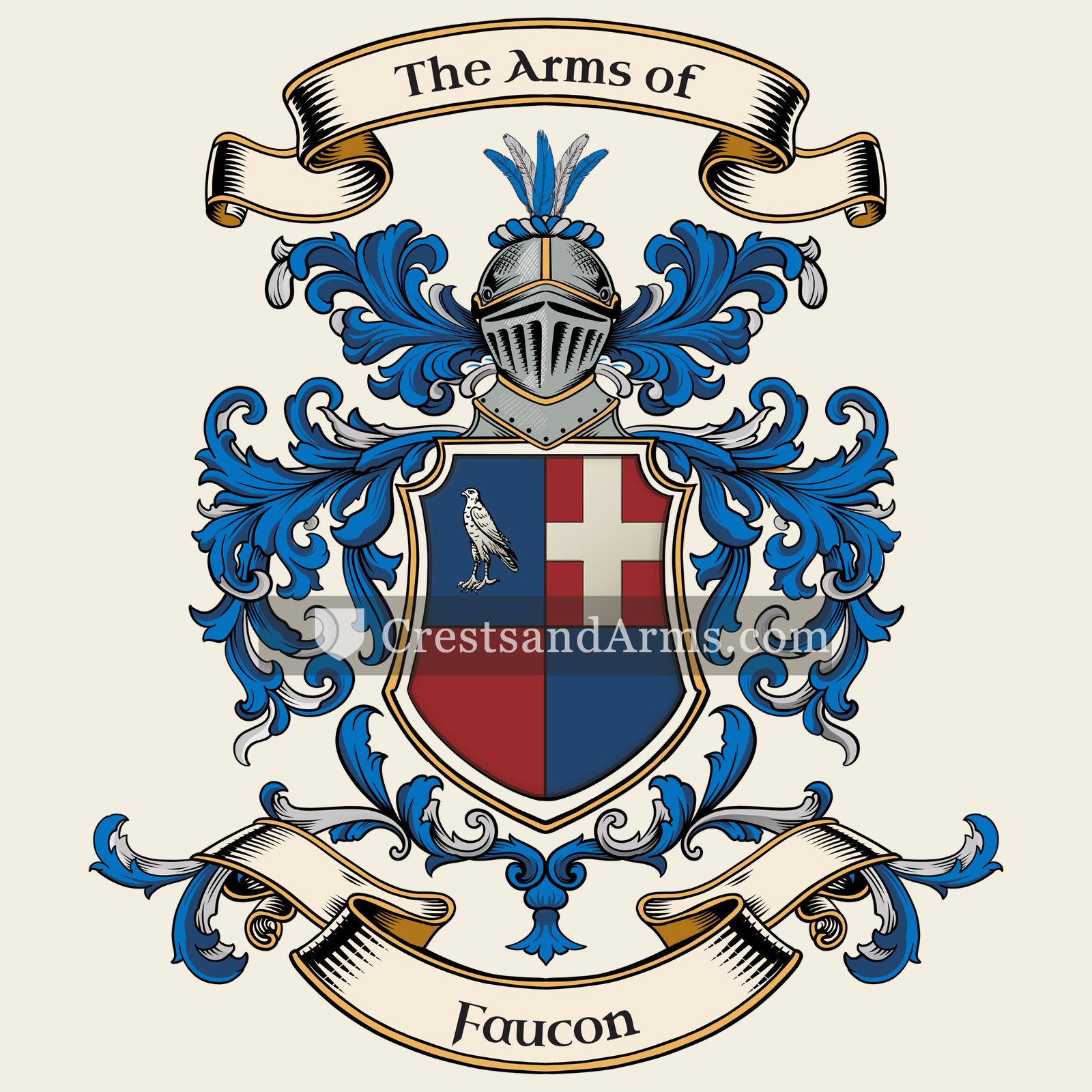


 towerGrandeur and solidity, and a stronghold defended
 crescentHonour by the sovereign, and the second son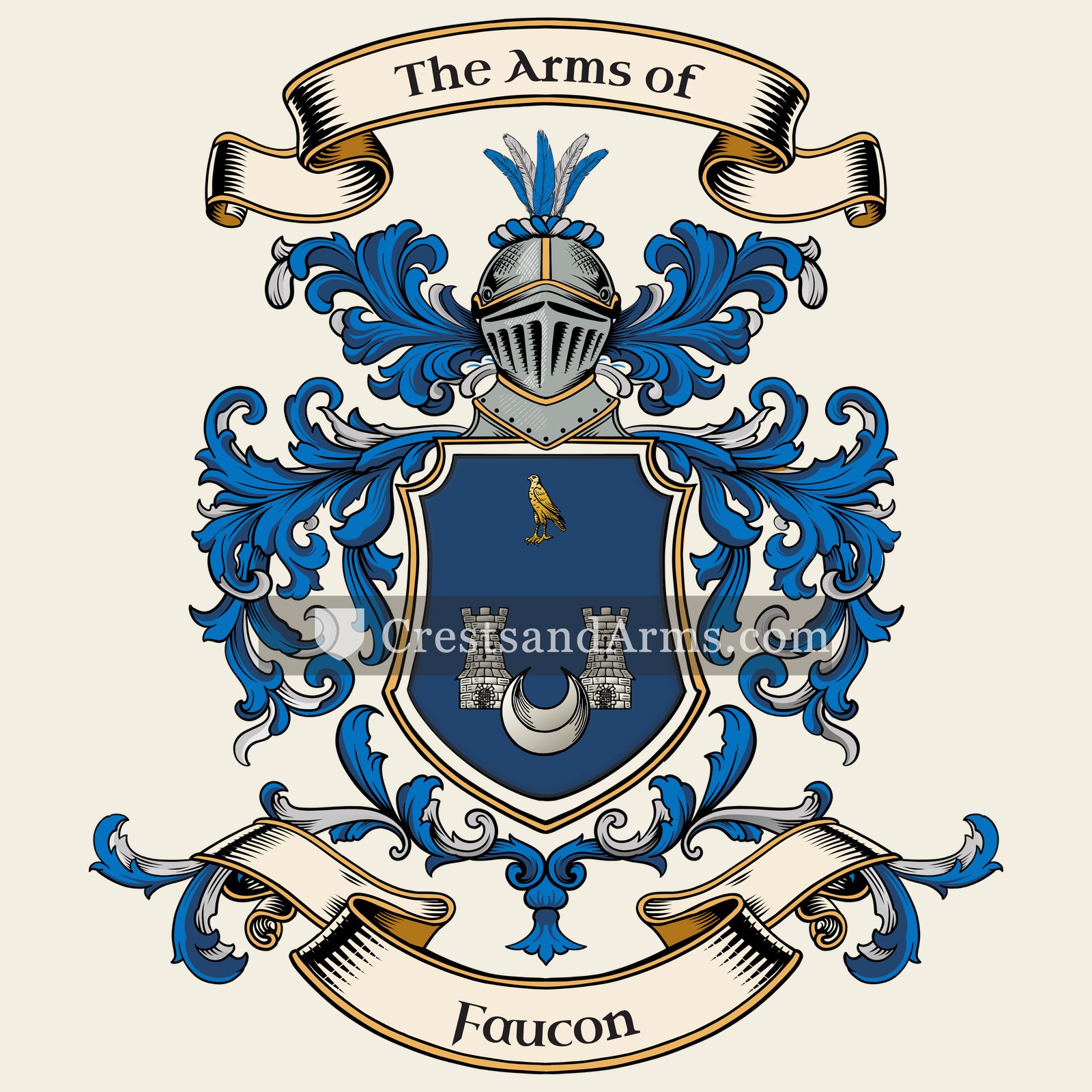


 bendDefence, and the scarf of a commander