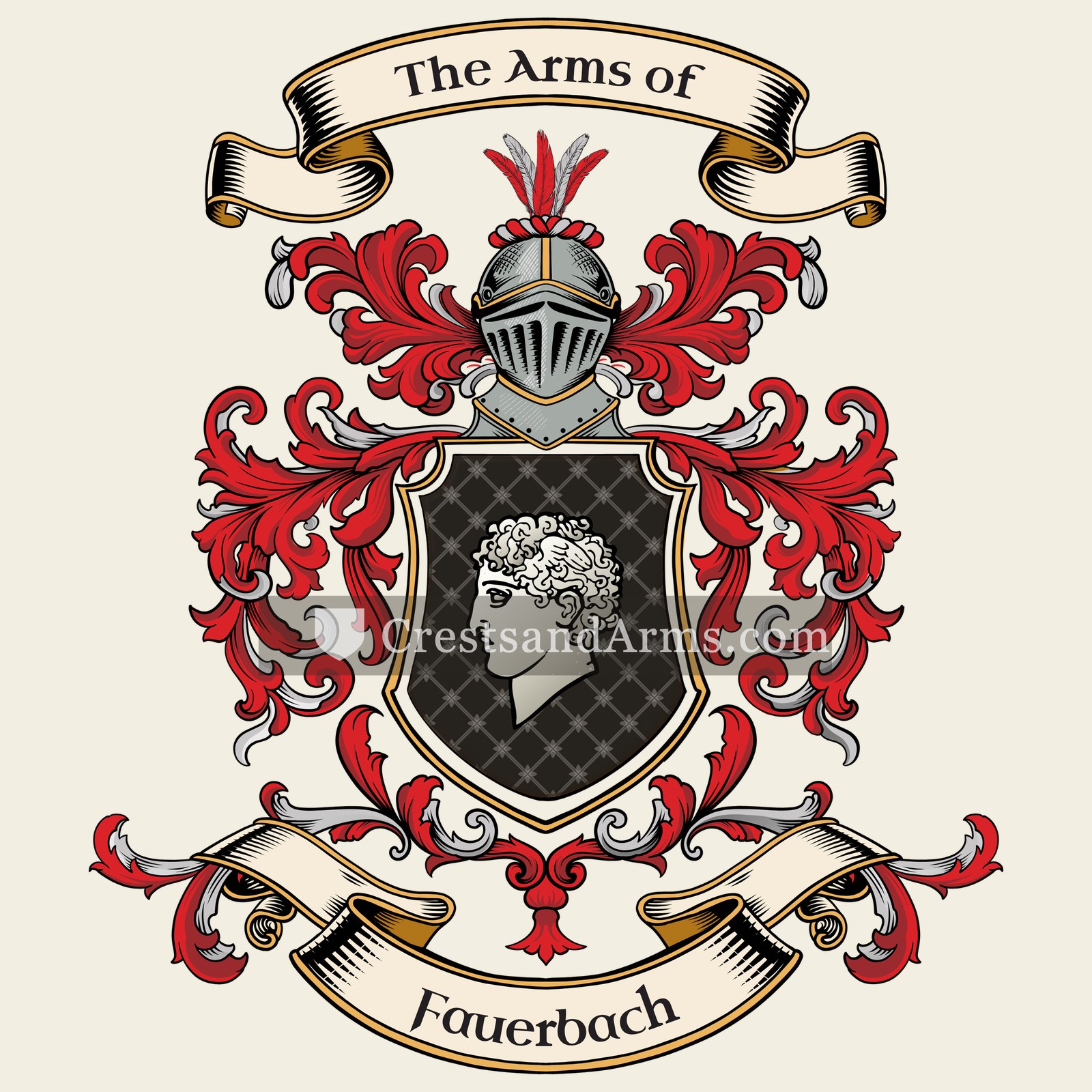
A record of documented arms, meaning and origin, researched for the Fauerbach family of Germany.
Reg. 3702 · German, D–F
Coat of Arms & Family Crest Details
Symbols on this shield
savages head affrontyAn enemy overcome
Colours
Black (Sable)Means: Constancy
Historical info
Source
J. B. Rietstap, Armorial Général, Gouda: G. B. van Goor Zonen, 1884–87
Blazon (the actual original written record)
“De sa. à un More, iss. d'un feu au nat., ledit More hab. d'or, rebr. de gu., tort. d'arg., l'oreille ornée d'un annelet d'or, tenant de sa main dextre un sabre. C.: les meubles de l'écu. L. d'or et de sa.”
GermanyGörlitz, c. 1545
Digital archive packCoat of arms PNG, gold border print PDF, vector SVG and the certificate of authenticity. Sent to your email in minutes.
Map of Germany showing where the Fauerbach arms are recorded
The Fauerbach arms were recorded in Görlitz, c. 1545.
This is where the arms were entered in the register. Families often moved to other parts of the country, so the same name can turn up in more than one region.
The body that granted and recorded arms in Germany in this period.
Charles V
Sovereign of the period
Charles V
1519–1556
Reigning in Germany when the Fauerbach arms are first recorded.
How Arms Worked in Germany
In the Holy Roman Empire, coats of arms were often granted to individuals by the Emperor or his representatives. These arms were then passed down through the generations to all legitimate descendants of the original holder. Younger branches of a family usually kept the same shield design without needing to change it, as the arms belonged to the entire lineage.
Granting authority
The Holy Roman Emperor held the sole power to grant new coats of arms throughout his vast imperial territories.
How they got arms
Families typically obtained their coats of arms through a formal imperial grant or by proving their noble status to the authorities.
Where arms were recorded
These grants were officially recorded in the Imperial Chancery registers, which began keeping formal records of such honors during the Middle Ages.
The family's standing
Recorded among the armigerous families of Germany.
Origin & History of the Fauerbach Family in Germany
The family name Fauerbach originates from the German language and is classified as a topographic surname, which means it was likely adopted by people living near a specific geographic feature. The name is composed of two parts: "fauer," an older variation of the word for fire or perhaps a dry landscape, and "bach," which means a stream or brook. This suggests that the earliest ancestors to carry the name probably lived near a stream that was known for a distinct quality, such as being near a kiln or a fire-related industry. By 1545, the family was well-established in the city of Görlitz, a significant trading hub in the region of Upper Lusatia. During this period, families in such cities were often involved in the growing merchant class or skilled crafts, helping to cement the family's presence in the historical records of the sixteenth century.
Related Branches & Arms
Root word
Fau-bach
A combination of a stream or brook and a meadow or pasture.
This name
FauerbachRefers to a person who lived near a meadow stream or a brook in a pasture.
also spelled
Feuerbak
Feuerbache
Feuerback
Foyerbah
Documented Sources
J. B. Rietstap, Armorial Général, Gouda: G. B. van Goor Zonen, 1884–87
Bahlow, Hans, Deutsches Namenlexikon: Familien- und Vornamen nach Ursprung und Sinn erklärt, 1967
Stadtarchiv Görlitz, Ratsarchiv der Stadt Görlitz: Bürger- und Einwohnerverzeichnisse, 1545
Heintze, Albert, Die deutschen Familien-Namen: geschichtlich, geographisch, sprachlich, 1903
Digital archive packCoat of arms PNG, gold border print PDF, vector SVG and the certificate of authenticity. Sent to your email in minutes.


 savages head affrontyAn enemy overcome
 savages head affrontyAn enemy overcome