Map of England showing where the Faulconer arms are recorded
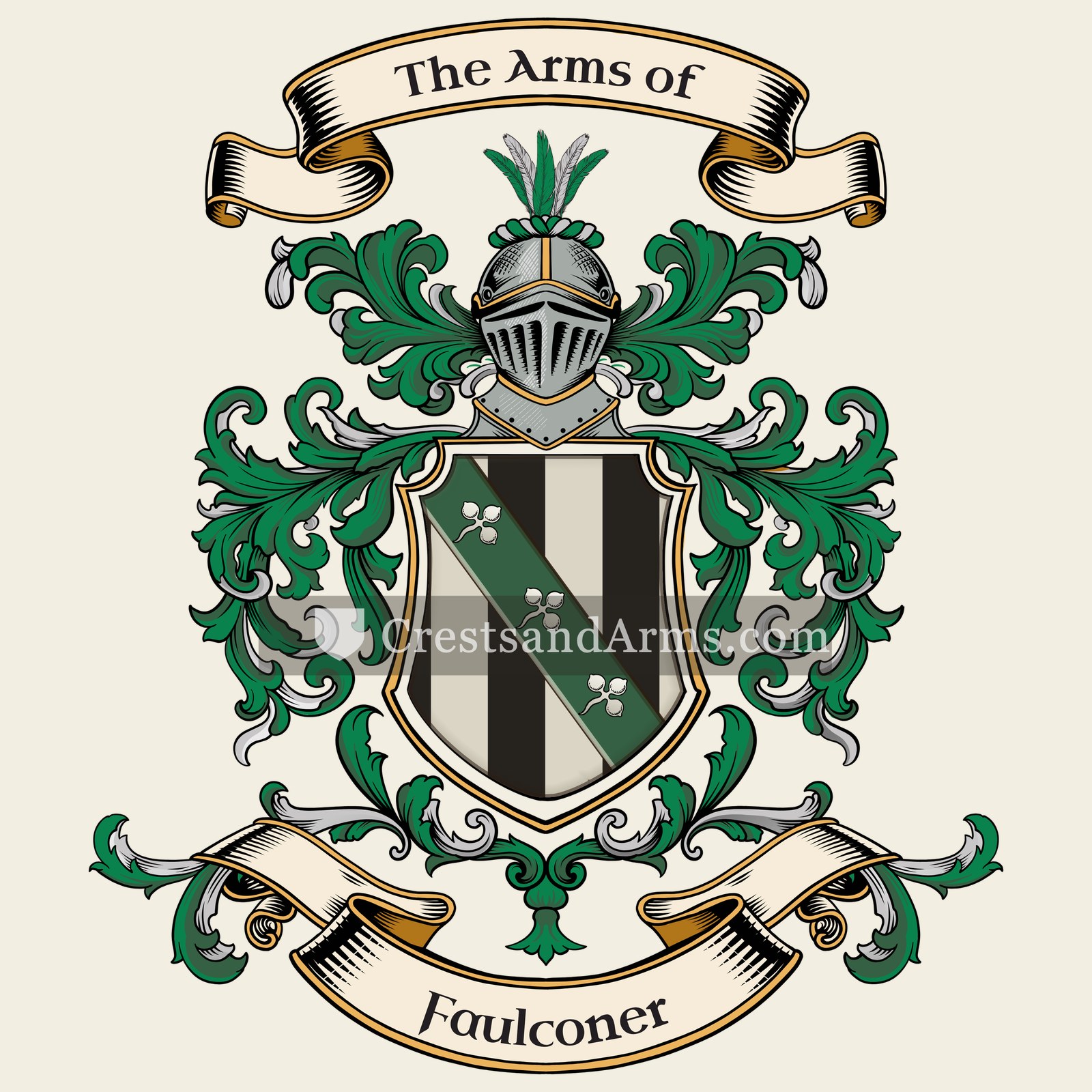
The Faulconer arms were recorded in Hants, c. 1620.
Hampshire had the naval dockyards at Portsmouth on one side and good farmland on the other. Sea money and land money both bought estates, and an estate was what brought a family its coat of arms.
This is where the arms were entered in the register. Families often moved to other parts of the country, so the same name can turn up in more than one region.
The body that granted and recorded arms in England in this period.
James VI and I
Sovereign of the period
James VI and I
1603–1625
Reigning in England when the Faulconer arms are first recorded.
How Arms Worked in England
English heraldry allowed arms to be shared by all legitimate descendants of the original owner. These symbols were treated as personal property that moved through the generations to all children. While the eldest son kept the original design, other family members could use the same shield without needing to change it or register their own unique versions.
Granting authority
The College of Arms in London has regulated the use of coats of arms throughout England and Wales since 1484.
How they got arms
Families typically obtained their coats of arms through a formal grant from the Crown or by proving their ancient right to them.
Where arms were recorded
All official coats of arms are recorded in the registers kept at the College of Arms, which date back to the fifteenth century.
The family's standing
Recorded among the armigerous families of Hants.
Origin & History of the Faulconer Family in England
The Faulconer family name is rooted in the medieval tradition of occupational surnames, specifically referring to those who trained or handled falcons for hunting. By the early 17th century, members of the family had established a notable presence in the county of Hampshire, England. Records confirm that individuals bearing this name were settled in the region by 1620, living as part of the local landed gentry and agricultural community. During this period, the family was integrated into the social and economic fabric of southern England, often participating in local parish administration and land management. Their early history reflects the broader movement of English families who maintained stable ties to their home counties while contributing to the development of local rural society before many of their descendants eventually sought new opportunities in the American colonies.
Faulconer Meaning & Related Branches
Root word
falco
Latin term for a falcon or bird of prey.
This name
FaulconerAn occupational surname for a person who trained or hunted with falcons.
also spelled
Falconer
Fauconer
Fawkner
Related arms
Falconersimilar arms
Fawknersimilar arms
Fauconervariant spelling
Documented Sources
Sir Bernard Burke, The General Armory of England, Scotland, Ireland and Wales, London: Harrison & Sons, 1884
Berry, William, County Genealogies: Pedigrees of the Families in the County of Hants, 1833
Hampshire Archives, Bishop’s Transcripts of Parish Registers, 1620
Lower, Mark Antony, Patronymica Britannica: A Dictionary of the Family Names of the United Kingdom, 1860
Digital archive packCoat of arms PNG, gold border print PDF, vector SVG and the certificate of authenticity. Sent to your email in minutes.


 bendDefence, and the scarf of a commander
 trefoilPerpetuity, and the Trinity
 bendDefence, and the scarf of a commander
 trefoilPerpetuity, and the Trinity