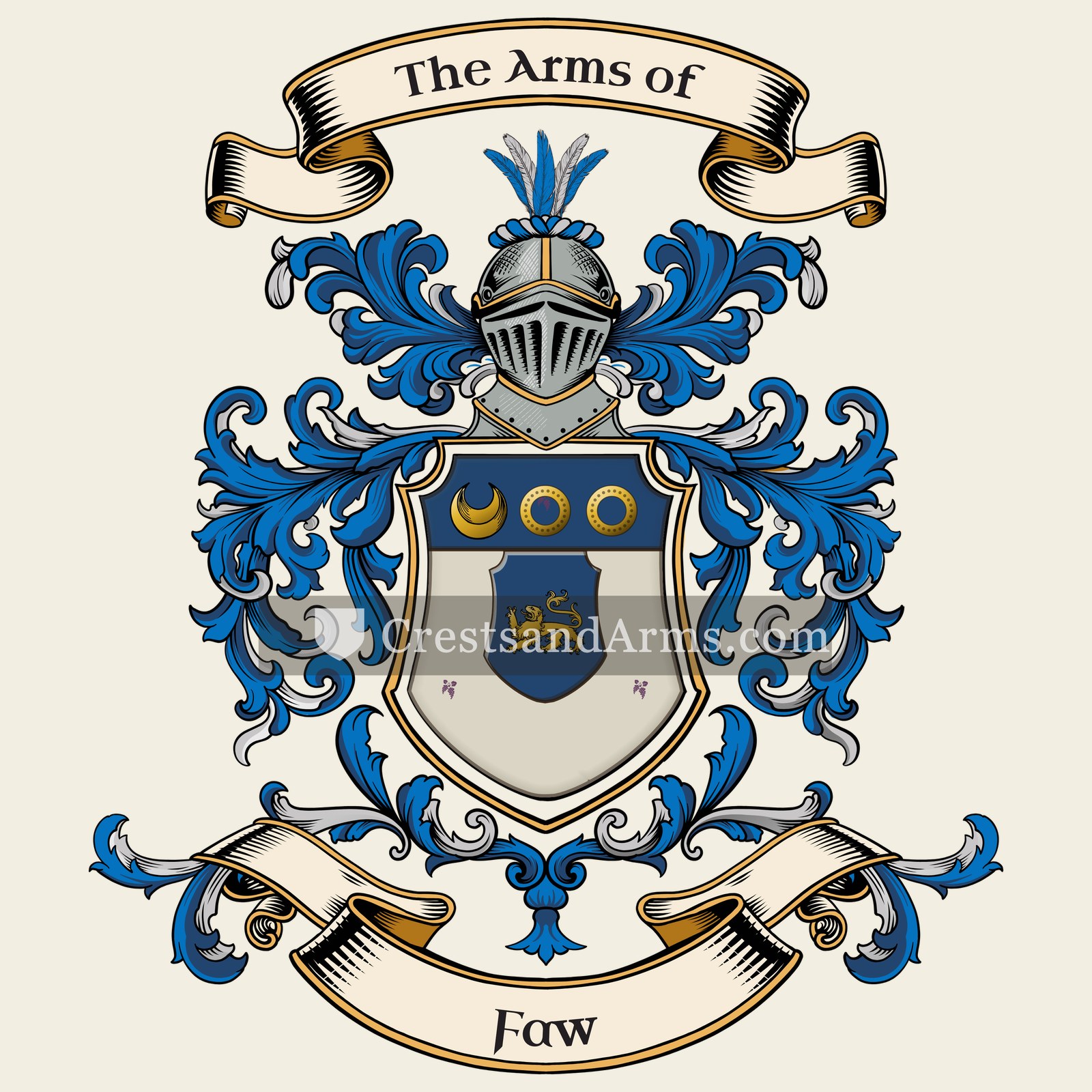
A record of documented arms, meaning and origin, researched for the Faw family of France.
Reg. 2055 · French, D–F
Coat of Arms & Family Crest Details
Symbols on this shield
chiefAuthority, wisdom and dominion
lionCourage, strength and royalty
grapesPlenty, and the labour of the vine
crescentHonour by the sovereign, and the second son
ringFidelity, and a promise kept
Colours
Silver (Argent)Means: Peace and sincerity
Blue (Azure)Means: Loyalty and truth
Gold (Or)Means: Generosity
Purple (Purpure)Means: Royal majesty
Historical info
Source
J. B. Rietstap, Armorial Général, Gouda: G. B. van Goor Zonen, 1884–87
Blazon (the actual original written record)
“D'arg. à un écusson d'azur en abîme, ch. d'un lion d'or et acc. de trois grappes de raisins de pourpre, pamprées de sin.; au chef d'azur, ch. d'un croiss. d'or entre deux annelets du même.”
FranceParis, c. 1663
Digital archive packCoat of arms PNG, gold border print PDF, vector SVG and the certificate of authenticity. Sent to your email in minutes.
Map of France showing where the Faw arms are recorded
The Faw arms were recorded in Paris, c. 1663.
This is where the arms were entered in the register. Families often moved to other parts of the country, so the same name can turn up in more than one region.
The body that granted and recorded arms in France in this period.
Louis XIV of France
Sovereign of the period
Louis XIV of France
1643–1715
Reigning in France when the Faw arms are first recorded.
How Arms Worked in France
In France, a coat of arms was a mark of honor that passed down through the male line to all legitimate descendants. Families often used the same shield without changes to show their shared heritage. If a branch wanted to stand out, they could add a small mark to their shield to show their specific place in the family tree.
Granting authority
The Juge d'armes de France acted as the official authority that regulated and verified coats of arms across the country.
How they got arms
Families typically inherited their arms from ancestors, though they could also receive them through royal grants or by proving their noble status.
Where arms were recorded
Coats of arms were officially recorded in the Armorial Général de France, which began its main collection in the year 1696.
The family's standing
Recorded among the armigerous families of France.
Origin & History of the Faw Family in France
The family name Faw carries a history that reaches back into the heart of seventeenth-century France. Records confirm that members of the family were established in Paris by 1663, a time when the city was undergoing massive cultural and architectural growth under the reign of Louis XIV. During this era, the name likely functioned as a geographic or occupational identifier, common for families living in the dense urban environment of the French capital. As the family moved through the following decades, they participated in the social and economic shifts of the period, eventually spreading across borders as political and religious changes transformed Europe. While the exact origins of the name remain tied to these early Parisian roots, the family’s presence in such a prominent city suggests they were part of the active, evolving society of the time.
Faw Meaning & Related Branches
Root word
fagus
Latin term referring to the beech tree.
This name
FawA topographic surname for someone who lived near a prominent beech tree or in a beech forest.
also spelled
Faux
Faud
Fauv
Fo
Faw
Documented Sources
J. B. Rietstap, Armorial Général, Gouda: G. B. van Goor Zonen, 1884–87
Archives Nationales, Minutier central des notaires de Paris
Digital archive packCoat of arms PNG, gold border print PDF, vector SVG and the certificate of authenticity. Sent to your email in minutes.


 chiefAuthority, wisdom and dominion
 lionCourage, strength and royalty
 grapesPlenty, and the labour of the vine
 crescentHonour by the sovereign, and the second son
 ringFidelity, and a promise kept
 chiefAuthority, wisdom and dominion
 lionCourage, strength and royalty
 grapesPlenty, and the labour of the vine
 crescentHonour by the sovereign, and the second son
 ringFidelity, and a promise kept