Map of France showing where the Fay arms are recorded
The Fay arms were recorded in Artois, c. 1663.
Artois lay on the disputed ground between France and the Low Countries and was fought over for centuries. Families there held their land under arms, and a shield was how a fighting household was known.
This is where the arms were entered in the register. Families often moved to other parts of the country, so the same name can turn up in more than one region.
The body that granted and recorded arms in France in this period.
Louis XIV of France
Sovereign of the period
Louis XIV of France
1643–1715
Reigning in France when the Fay arms are first recorded.
How Arms Worked in France
In France, a coat of arms was a mark of honor that passed down through the male line to all legitimate descendants. Families often used the same shield without changes to show their shared heritage. If a branch wanted to stand out, they could add a small mark to their shield to show their specific place in the family tree.
Granting authority
The Juge d'armes de France acted as the official authority that regulated and verified coats of arms across the country.
How they got arms
Families typically inherited their arms from ancestors, though they could also receive them through royal grants or by proving their noble status.
Where arms were recorded
Coats of arms were officially recorded in the Armorial Général de France, which began its main collection in the year 1696.
The family's standing
Recorded among the armigerous families of Artois.
Origin & History of the Fay Family in France
The family name Fay originates from the French word for beech tree, which suggests that the earliest ancestors likely lived near a prominent grove or forest. By the middle of the seventeenth century, the family established a notable presence in the province of Artois. This region was a strategic crossroads in northern France that experienced frequent shifts in political control during the conflicts of the era. Living in Artois required resilience, as families often had to navigate the complex social and economic changes brought about by shifting borders and regional wars. The presence of the Fay family in this area by 1663 indicates they were well-integrated into the local community during a time when the province was transitioning into a more permanent part of the French kingdom. Their history reflects the broader experience of families who built stable lives in the rural landscapes of northern France despite the turbulent political climate of the seventeenth century.
Coat of Arms & Family Crest Details
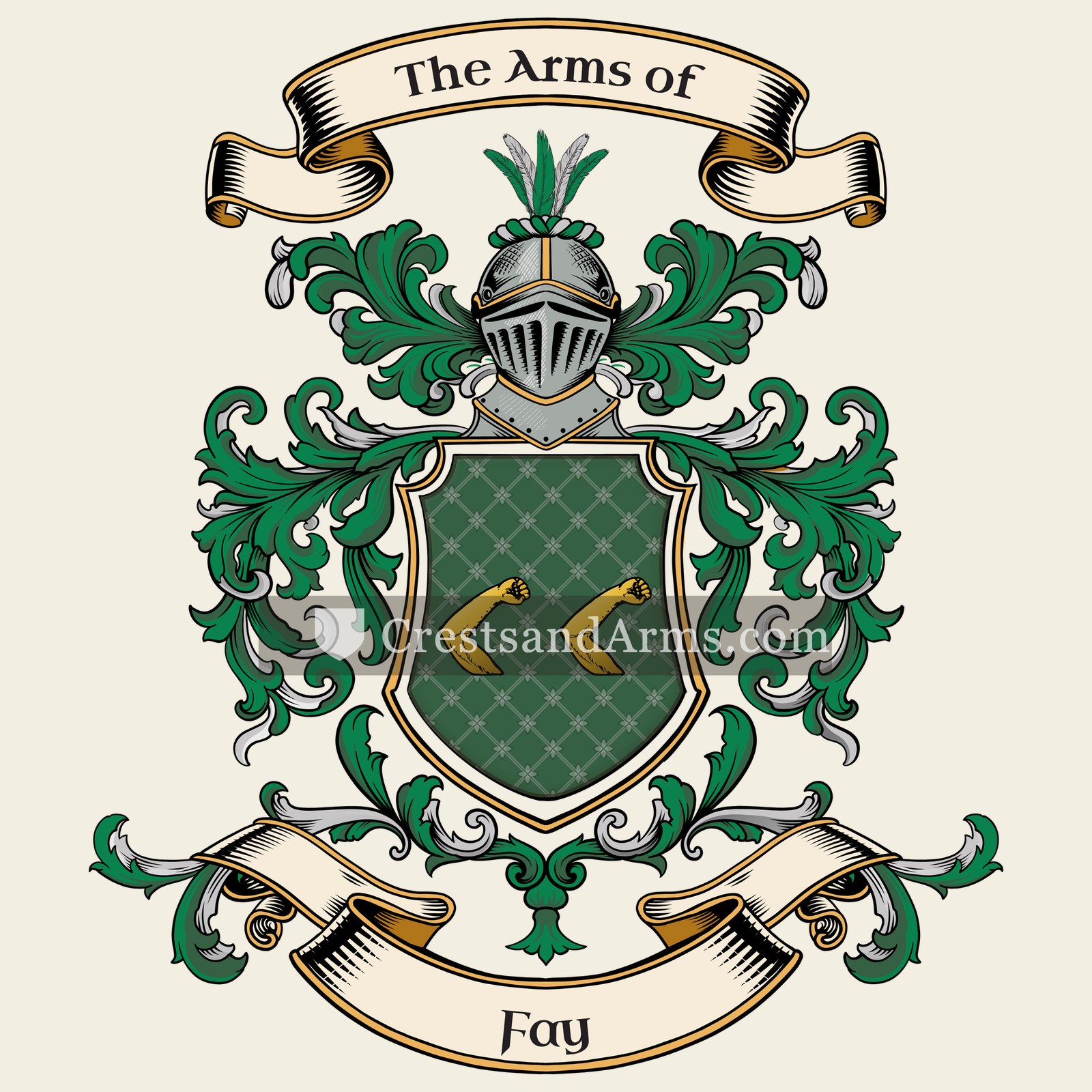
Symbols on this shield
armA person of action, industrious and laborious
Colours
Green (Vert)Means: Hope
Gold (Or)Means: Generosity
Historical info
Source
Sir Bernard Burke, The General Armory of England, Scotland, Ireland and Wales, London: Harrison & Sons, 1884
Blazon (the actual original written record)
“Vert a dexter arm issuant from the sinister side of the shield, and a sinister arm from the dexter, vested or, cuffed ar. the hands ppr. grasping a sword erect of the third, pommel and hilt of the second, the blade thrust through a dragon's head couped of the last”
KildareBallymoon · Kildare, c. 1629
Digital archive packCoat of arms PNG, gold border print PDF, vector SVG and the certificate of authenticity. Sent to your email in minutes.
Map of Ireland showing where the Fay arms are recorded
The Fay arms were recorded in Kildare, c. 1629.
Kildare was flat grazing country close to Dublin, taken early by Norman families. Being near the seat of government meant being near where arms were recorded, which is why so many Kildare names appear.
This is where the arms were entered in the register. Families often moved to other parts of the country, so the same name can turn up in more than one region.
The body that granted and recorded arms in Ireland in this period.
Charles I of England
Sovereign of the period
Charles I of England
1625–1649
Reigning in France when the Fay arms are first recorded.
How Arms Worked in Ireland
The Ulster King of Arms granted coats of arms to individuals who proved their social standing and good character. These symbols were typically inherited by all legitimate descendants of the original holder. If a family branch wanted a unique look, they could apply for a specific change to their design through the office to ensure their identity remained distinct.
Granting authority
The Ulster King of Arms acted as the official body that regulated and issued all coats of arms throughout Ireland.
How they got arms
Families obtained their arms through formal grants issued by the office after proving their eligibility and paying the required fees.
Where arms were recorded
All official grants were recorded in the registers held by the Ulster King of Arms starting from the year 1552.
The family's standing
Recorded among the armigerous families of Kildare.
Origin & History of the Fay Family in Ireland
The Fay family name has deep roots in Ireland, particularly within the eastern regions of the island. While the name likely arrived in Ireland following the arrival of the Anglo-Normans in the twelfth century, the family eventually became well-established among the local population. By 1629, records confirm that members of the Fay family were settled in County Kildare. During this era, families like the Fays often acted as landowners or local administrators who navigated the complex political shifts of the seventeenth century. Over time, the name became closely associated with the social and economic life of the Irish Midlands. The family maintained a consistent presence in the region, adapting to the changing laws and cultural landscapes that defined early modern Ireland.
Fay Meaning & Related Branches
Root word
fagus
Latin term referring to the beech tree.
This name
FayA topographic name for someone who lived near a beech tree or forest.
also spelled
Faye
Fays
Fey
Feygh
Related arms
Hackettsame arms
Faevariant spelling
Fahievariant spelling
Fahyvariant spelling
Documented Sources
J. B. Rietstap, Armorial Général, Gouda: G. B. van Goor Zonen, 1884–87
Archives Départementales du Pas-de-Calais, Registres paroissiaux et état civil
Brillon, Pierre-Jacques, Dictionnaire des noms de famille de France, 1750
Dauzat, Albert, Dictionnaire étymologique des noms de famille et prénoms de France, 1951
Digital archive packCoat of arms PNG, gold border print PDF, vector SVG and the certificate of authenticity. Sent to your email in minutes.


 saltireResolution, and St Andrew's cross
 saltireResolution, and St Andrew's cross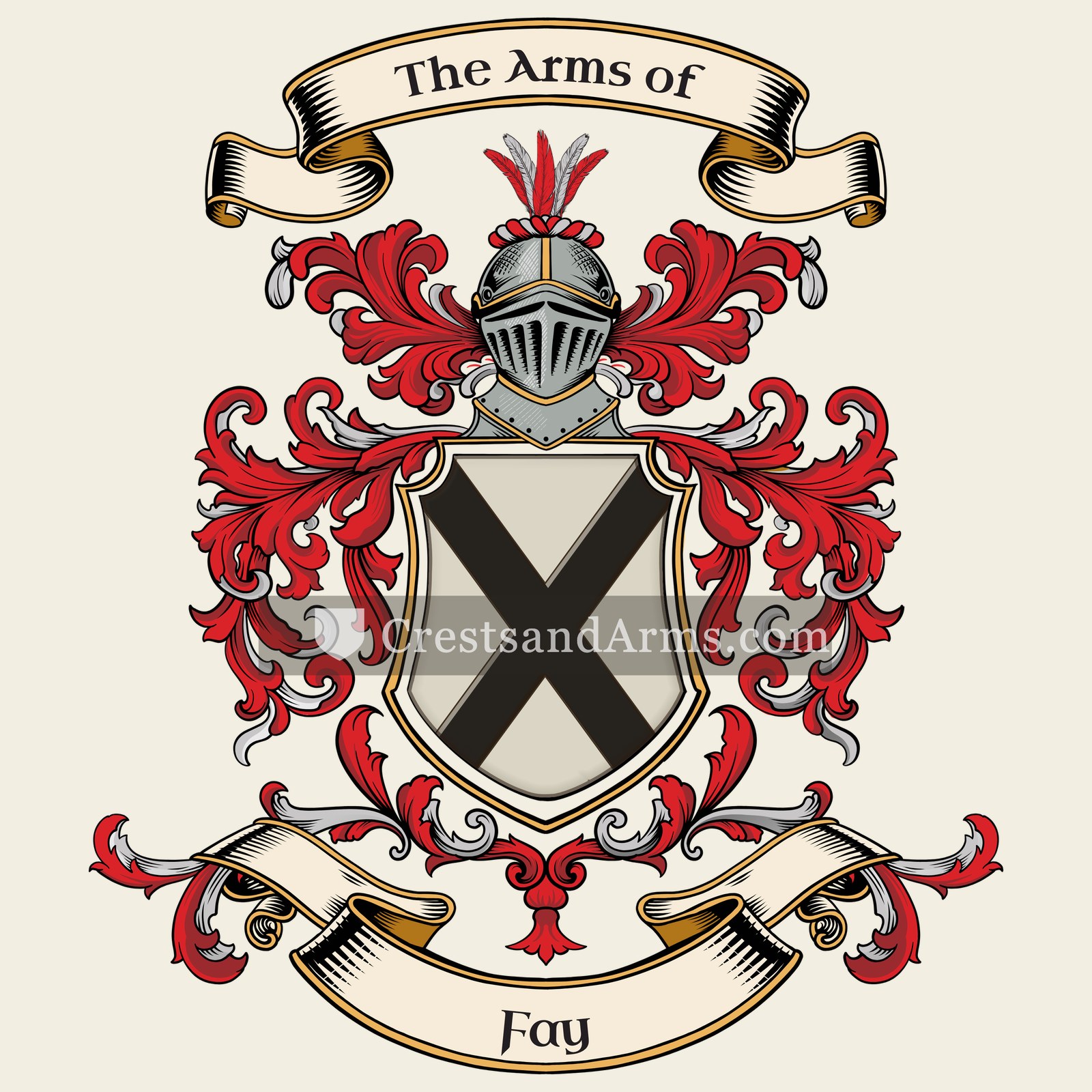


 armA person of action, industrious and laborious