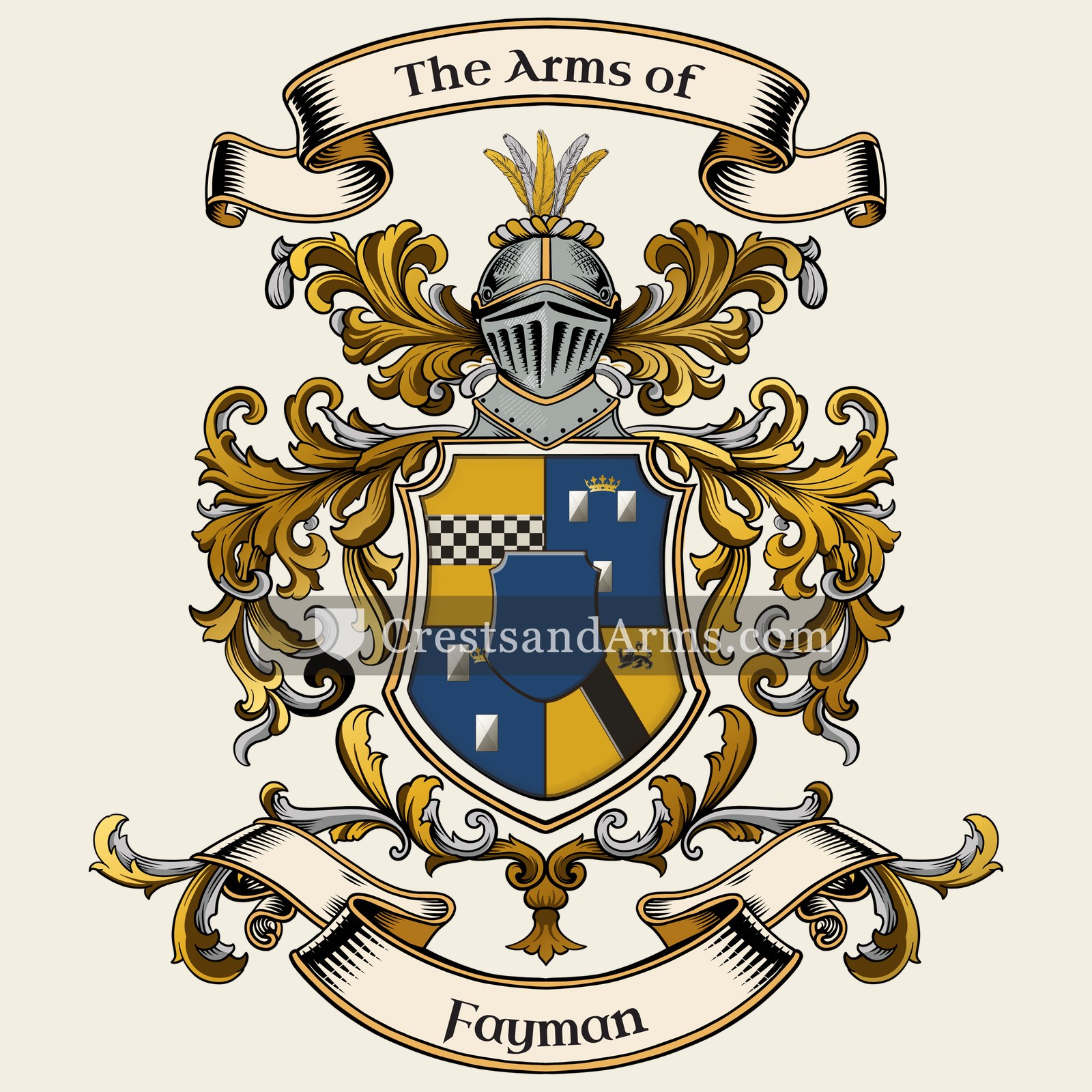
A record of documented arms, meaning and origin, researched for the Fayman family of Sweden.
Reg. 7695 · Swedish, D–F
Coat of Arms & Family Crest Details
Symbols on this shield
fessThe military belt, and readiness to serve
chequyConstancy, and the counting-board
bendDefence, and the scarf of a commander
billetThe sealed letter, and a message delivered
crownSovereignty, authority and just reward
lionCourage, strength and royalty
Colours
Gold (Or)Means: Generosity
Blue (Azure)Means: Loyalty and truth
Silver (Argent)Means: Peace and sincerity
Historical info
Source
J. B. Rietstap, Armorial Général, Gouda: G. B. van Goor Zonen, 1884–87
Blazon (the actual original written record)
“Ec.: au 1 d'or à la fasce échiq. de sa. et d'arg.; aux 2 et 3 d'azur à trois bill. d'arg., 2 et 1, acc. en chef d'une couronne d'or; au 4 taillé d'or sur sa., au lion de l'un en l'autre. Sur le tout d'azur à la bande d'arg., acc. en chef d'une balance d'arg., posée en bande, et en p. d'une branche d'olivier d'or, en bande. Deux cq. cour. C.: 1° un lion iss. d'azur, lamp. de gu., tenant un rameau d'olivier d'or; 2° deux palmes de sin., acc. de trois roses mal-ordonnées de gu. Manteau parti de sa. et d'azur, doublé d'un parti d'or et d'arg., frangé de l'un en l'autre.”
Swedenc. 1728
Where the Fayman Arms Were Recorded
Stockholm
Map of Sweden showing where the Fayman arms are recorded
The Fayman arms were recorded in Sweden, c. 1728.
Arms such as these were typically recorded in Stockholm.
Stockholm held the Swedish court and the House of Nobility, where every noble family's arms were entered and kept. Families ennobled for service registered there, which is why so many are recorded around the city.
This is where the arms were entered in the register. Families often moved to other parts of the country, so the same name can turn up in more than one region.
The body that granted and recorded arms in Sweden in this period.
Frederick I of Sweden
Sovereign of the period
Frederick I of Sweden
1720–1751
Reigning in Sweden when the Fayman arms are first recorded.
How Arms Worked in Sweden
In Sweden, a coat of arms belonged to a noble family as a whole rather than just one individual. These arms were passed down through the generations to all legitimate descendants. Younger branches of the family used the same shield without needing to change it. This system ensured that the entire lineage shared the same identity and status under the law.
Granting authority
The Riddarhuset, or House of Nobility, regulated all noble coats of arms in Sweden under royal authority.
How they got arms
Families received their coats of arms through royal grants of nobility which were then officially registered with the House.
Where arms were recorded
Coats of arms were officially recorded in the Swedish House of Nobility register starting in the year 1626.
The family's standing
Recorded among the armigerous families of Sweden.
Origin & History of the Fayman Family in Sweden
The family name Fayman carries a rich history that traces back to the bustling urban landscape of eighteenth-century Stockholm. Records confirm that members of the family were established residents of the Swedish capital by 1728, a time when the city was a major center for trade and craftsmanship in Northern Europe. During this period, families often adopted surnames that reflected their professional roles or their connection to specific geographic locations. The name likely emerged as a distinct identifier for a household navigating the social and economic shifts of the Swedish Enlightenment. By settling in Stockholm during the early 1700s, the Fayman family became part of the growing urban middle class that helped shape the city’s development into a modern administrative and cultural hub.
Related Branches & Arms
Root word
Fe
Old Swedish term for cattle, property, or wealth.
This name
FaymanA topographical or occupational name denoting a person associated with livestock, wealth, or property management.
also spelled
Fehmann
Fehmman
Fehmn
Fayman
Documented Sources
J. B. Rietstap, Armorial Général, Gouda: G. B. van Goor Zonen, 1884–87
Stockholm City Archives (Stockholms stadsarkiv), Mantalslängder 1728
Liedgren, Rut, Stockholms befolkning under 1700-talet, 1967
Digital archive packCoat of arms PNG, gold border print PDF, vector SVG and the certificate of authenticity. Sent to your email in minutes.


 fessThe military belt, and readiness to serve
 chequyConstancy, and the counting-board
 bendDefence, and the scarf of a commander
 billetThe sealed letter, and a message delivered
 crownSovereignty, authority and just reward
 lionCourage, strength and royalty
 fessThe military belt, and readiness to serve
 chequyConstancy, and the counting-board
 bendDefence, and the scarf of a commander
 billetThe sealed letter, and a message delivered
 crownSovereignty, authority and just reward
 lionCourage, strength and royalty