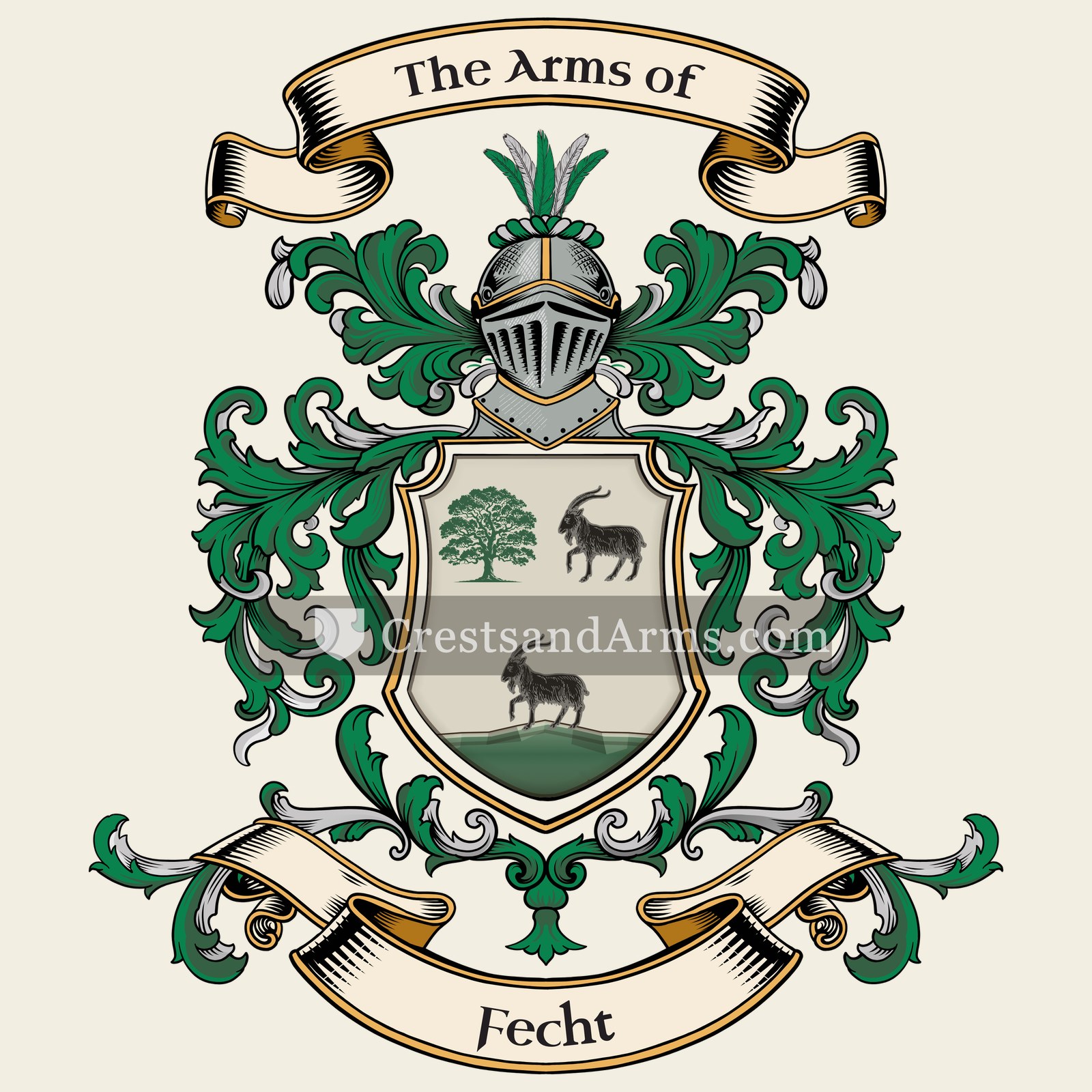
A record of documented arms, meaning and origin, researched for the Fecht family of Germany.
Reg. 8987 · German, D–F
Coat of Arms & Family Crest Details
Symbols on this shield
mountThe ground held, and steadfastness upon it
treeLife, endurance and deep roots
goatOne who wins by diplomacy rather than force
Colours
Silver (Argent)Means: Peace and sincerity
Green (Vert)Means: Hope
Black (Sable)Means: Constancy
Historical info
Source
J. B. Rietstap, Armorial Général, Gouda: G. B. van Goor Zonen, 1884–87
Blazon (the actual original written record)
“D'arg. à un arbre de sin., accosté de deux boucs ramp. et affr. de sa.; le tout soutenu d'une terrasse de sin. C.: un bouc iss. de sa. L. d'arg. et de sa.”
GermanyHambourg, c. 1765
Digital archive packCoat of arms PNG, gold border print PDF, vector SVG and the certificate of authenticity. Sent to your email in minutes.
Map of Germany showing where the Fecht arms are recorded
The Fecht arms were recorded in Hambourg, c. 1765.
This is where the arms were entered in the register. Families often moved to other parts of the country, so the same name can turn up in more than one region.
The body that granted and recorded arms in Germany in this period.
Francis I, Holy Roman Emperor
Sovereign of the period
Francis I, Holy Roman Emperor
1745–1765
Reigning in Germany when the Fecht arms are first recorded.
How Arms Worked in Germany
In the Holy Roman Empire, coats of arms were often granted to individuals by the Emperor or his representatives. These arms were then passed down through the generations to all legitimate descendants of the original holder. Younger branches of a family usually kept the same shield design without needing to change it, as the arms belonged to the entire lineage.
Granting authority
The Holy Roman Emperor held the sole power to grant new coats of arms throughout his vast imperial territories.
How they got arms
Families typically obtained their coats of arms through a formal imperial grant or by proving their noble status to the authorities.
Where arms were recorded
These grants were officially recorded in the Imperial Chancery registers, which began keeping formal records of such honors during the Middle Ages.
The family's standing
Recorded among the armigerous families of Germany.
Origin & History of the Fecht Family in Germany
The surname Fecht originates from the German-speaking regions of Northern Europe, where it functioned as a descriptive occupational name. The word itself is derived from the Middle High German term *vehten*, which relates to the act of fighting or fencing. Historically, this suggests that the earliest ancestors bearing this name may have been skilled soldiers, guards, or perhaps masters of combat training. By the mid-eighteenth century, the family had established a clear presence in the bustling port city of Hamburg. Records confirm that members of the Fecht family were living there by 1765, likely drawn to the city by its status as a major center for international trade and maritime commerce. As residents of a prominent Hanseatic city, these early family members were part of an urban environment that valued craftsmanship, navigation, and mercantile success.
Fecht Meaning & Related Branches
Root word
vechten
To fight or engage in a struggle.
This name
FechtAn occupational name for a soldier, warrior, or a person known for being combative.
also spelled
Fechtl
Fechte
Fechtte
Fekt
Related arms
Tocht (van der) - Hollsimilar arms
Documented Sources
J. B. Rietstap, Armorial Général, Gouda: G. B. van Goor Zonen, 1884–87
Brechenmacher, Josef Karlmann. Etymologisches Wörterbuch der Deutschen Familiennamen. 1957


 mountThe ground held, and steadfastness upon it
 treeLife, endurance and deep roots
 goatOne who wins by diplomacy rather than force
 mountThe ground held, and steadfastness upon it
 treeLife, endurance and deep roots
 goatOne who wins by diplomacy rather than force