A record of documented arms, meaning and origin, researched for the Fechter family lines. Documented in 2 countries.
Reg. 4513 · Swiss, D–F
Coat of Arms & Family Crest Details
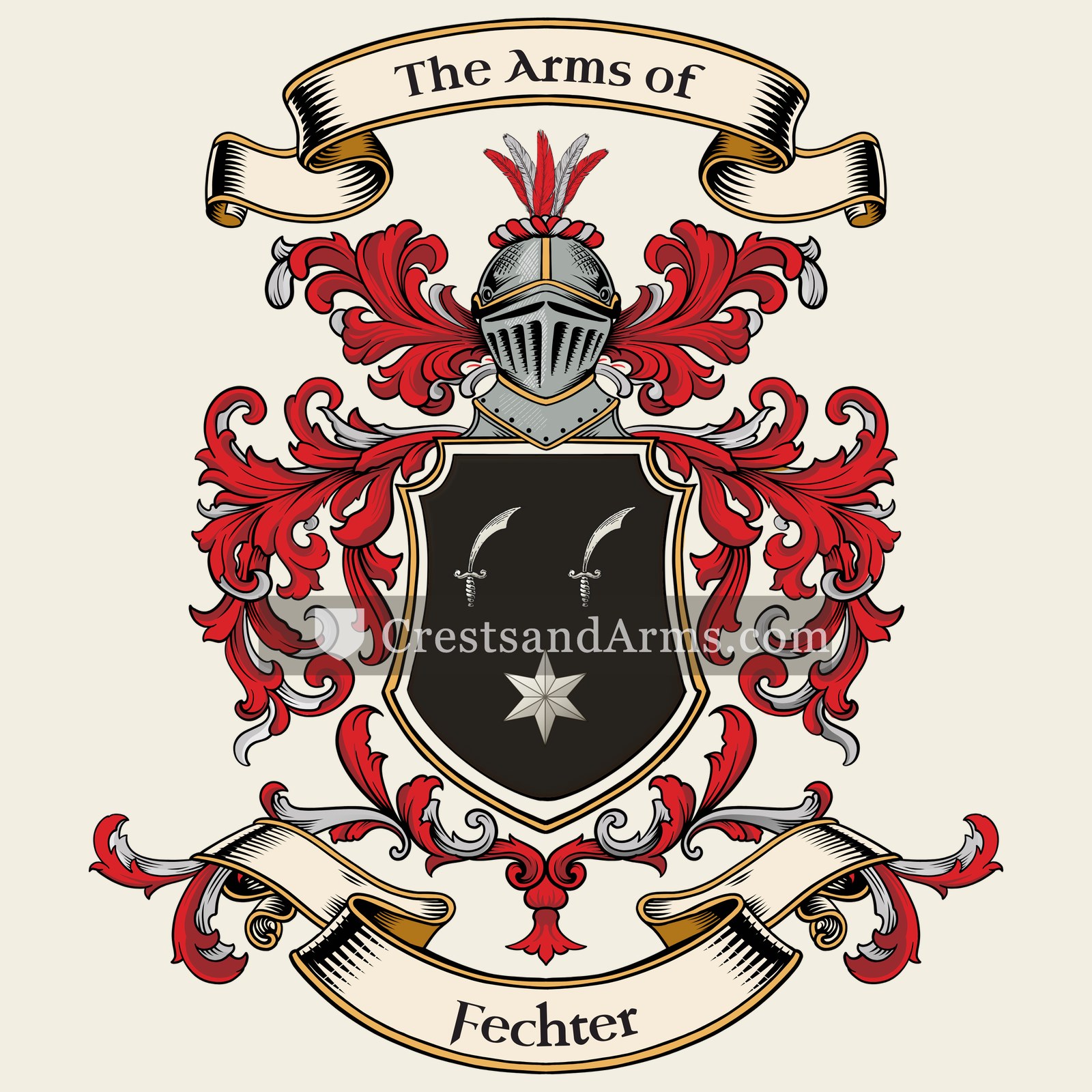
Symbols on this shield
vairProtection, and the winter fur
chiefAuthority, wisdom and dominion
swordJustice, and military honour
Colours
Silver (Argent)Means: Peace and sincerity
Historical info
Source
J. B. Rietstap, Armorial Général, Gouda: G. B. van Goor Zonen, 1884–87
Blazon (the actual original written record)
“De vair, au chef d'arg.; à deux épées d'arg., garnies d'or, passées en saut., les pointes en bas, br. sur le tout. Cq. cour. C.: un griffon iss. de sin., bq. d'or, tenant une épée en pal. L. d'arg. et d'azur.”
SwitzerlandBâle, c. 1745
Digital archive packCoat of arms PNG, gold border print PDF, vector SVG and the certificate of authenticity. Sent to your email in minutes.
Map of Switzerland showing where the Fechter arms are recorded
The Fechter arms were recorded in Bâle, c. 1745.
This is where the arms were entered in the register. Families often moved to other parts of the country, so the same name can turn up in more than one region.
The body that granted and recorded arms in Switzerland in this period.
How Arms Worked in Switzerland
In Switzerland, coats of arms were not restricted to the nobility and were often adopted by common citizens and families. These symbols were passed down through generations to show family identity. When branches of a family grew, they often changed small details of the design to distinguish their own line from the original group.
Granting authority
Cantonal and civic authorities managed the use of coats of arms within their specific regions and local jurisdictions.
How they got arms
Families typically assumed their own coats of arms based on local custom rather than receiving them from a central monarch.
Where arms were recorded
Arms were recorded in various cantonal and civic registers starting from the fourteenth century throughout the Swiss region.
The family's standing
Recorded among the armigerous families of Switzerland.
Origin & History of the Fechter Family in Switzerland
The surname Fechter originates from the German word for a fencer or a fighter, suggesting that the family’s earliest ancestors likely held roles as skilled combat instructors or professional soldiers. By the mid-eighteenth century, the family established a notable presence in the city of Basel, Switzerland. Records confirm that members of the Fechter family were active in the region by 1745, where they integrated into the local urban society. During this period, Basel was a thriving center for trade and craftsmanship, and families like the Fechters often contributed to the city's growth through their involvement in guilds and civic administration. The name reflects a time when surnames were frequently linked to a person’s trade or physical prowess, marking the family as individuals who were valued for their discipline and specialized skills within the Swiss Confederation.
Coat of Arms & Family Crest Details
Symbols on this shield
swordJustice, and military honour
starThe celestial goddess, and nobility
Colours
Black (Sable)Means: Constancy
Silver (Argent)Means: Peace and sincerity
Historical info
Source
J. B. Rietstap, Armorial Général, Gouda: G. B. van Goor Zonen, 1884–87
Blazon (the actual original written record)
“De sa. à deux épées d'arg., passées en saut., les pointes en bas, acc. en p. d'une étoile (8) du sec. C.: les épées, entre deux prob. coupées de sa. sur arg.”
GermanyNuremberg, c. 1765
Digital archive packCoat of arms PNG, gold border print PDF, vector SVG and the certificate of authenticity. Sent to your email in minutes.
Map of Germany showing where the Fechter arms are recorded
The Fechter arms were recorded in Nuremberg, c. 1765.
This is where the arms were entered in the register. Families often moved to other parts of the country, so the same name can turn up in more than one region.
The body that granted and recorded arms in Germany in this period.
Francis I, Holy Roman Emperor
Sovereign of the period
Francis I, Holy Roman Emperor
1745–1765
Reigning in Switzerland when the Fechter arms are first recorded.
How Arms Worked in Germany
In the Holy Roman Empire, coats of arms were often granted to individuals by the Emperor or his representatives. These arms were then passed down through the generations to all legitimate descendants of the original holder. Younger branches of a family usually kept the same shield design without needing to change it, as the arms belonged to the entire lineage.
Granting authority
The Holy Roman Emperor held the sole power to grant new coats of arms throughout his vast imperial territories.
How they got arms
Families typically obtained their coats of arms through a formal imperial grant or by proving their noble status to the authorities.
Where arms were recorded
These grants were officially recorded in the Imperial Chancery registers, which began keeping formal records of such honors during the Middle Ages.
The family's standing
Recorded among the armigerous families of Germany.
Origin & History of the Fechter Family in Germany
The surname Fechter originates from the Middle High German word *vehtære*, which translates to a fighter or a fencer. During the Middle Ages, this name was often used as an occupational descriptor for individuals who taught swordsmanship, served as professional soldiers, or performed as entertainers in public fencing matches. By the mid-18th century, the family had established a notable presence in the imperial city of Nuremberg. At that time, Nuremberg was a bustling center for trade and skilled craftsmanship, providing a stable environment for families to build their livelihoods. Records from 1765 confirm that members of the Fechter family were integrated into the social fabric of this city, likely contributing to its reputation as a hub for metalwork and artistic production. As the family settled into urban life, the name transitioned from a simple description of a profession into a permanent hereditary surname that identified their lineage for generations to come.
Fechter Meaning & Related Branches
Root word
fechten
To fight, fence, or struggle with a weapon.
This name
FechterAn occupational surname for a fencer, swordsman, or a professional fighter.
also spelled
Fechtner
Fechtar
Fechterr
Fekter
Related arms
Brunel de la Mathelayesimilar arms
Charpentier de Lessacsimilar arms
Documented Sources
J. B. Rietstap, Armorial Général, Gouda: G. B. van Goor Zonen, 1884–87
Staatsarchiv Basel-Stadt, Bürgerverzeichnisse und Familienregister
Staatsarchiv Basel-Stadt, Zunftakten der Stadt Basel
Burckhardt, August, Stammbäume der Basler Bürgergeschlechter, 1938
Heitz, Paul, Die Basler Zünfte, 1905
Digital archive packCoat of arms PNG, gold border print PDF, vector SVG and the certificate of authenticity. Sent to your email in minutes.


 chiefAuthority, wisdom and dominion
 swordJustice, and military honour
 chiefAuthority, wisdom and dominion
 swordJustice, and military honour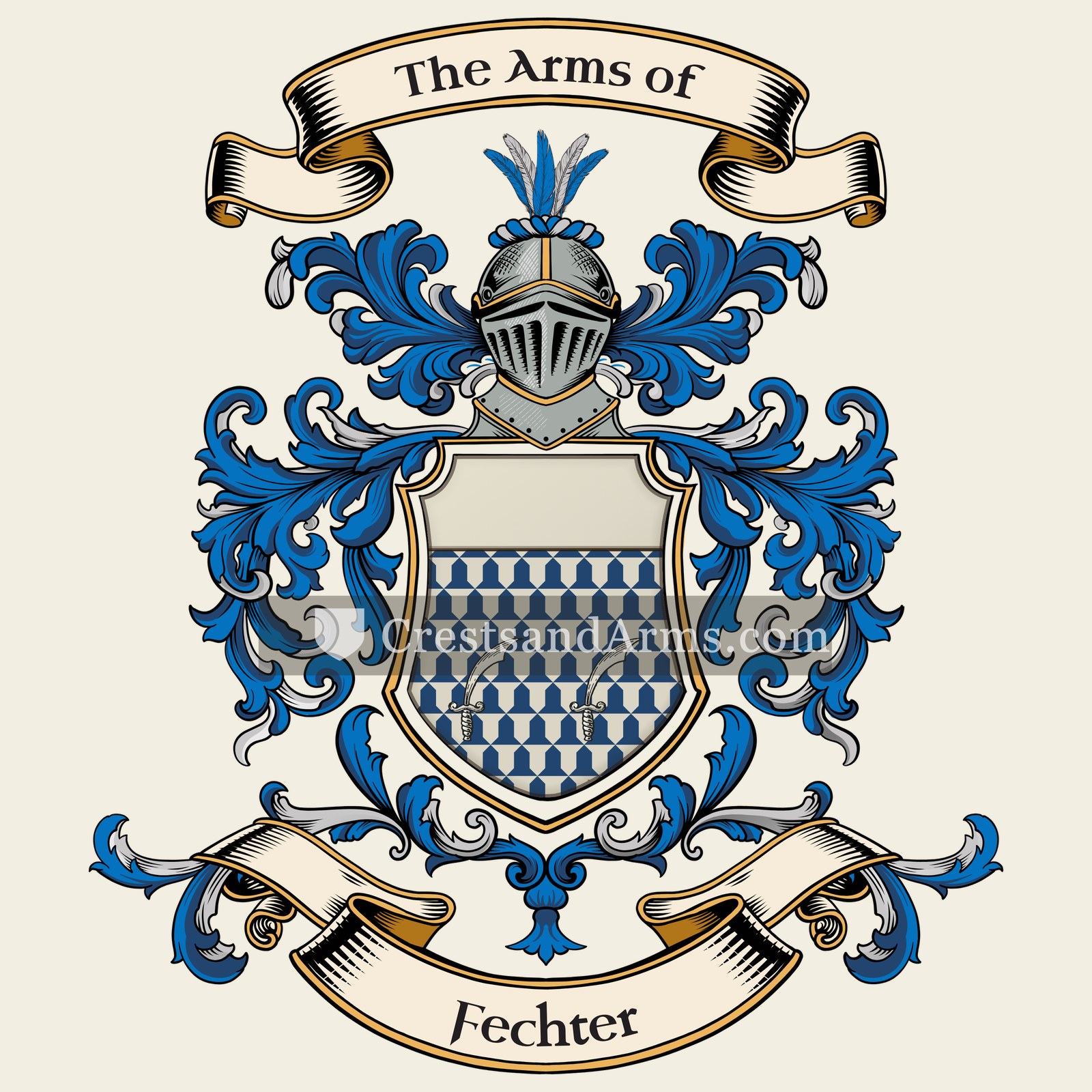

 starThe celestial goddess, and nobility