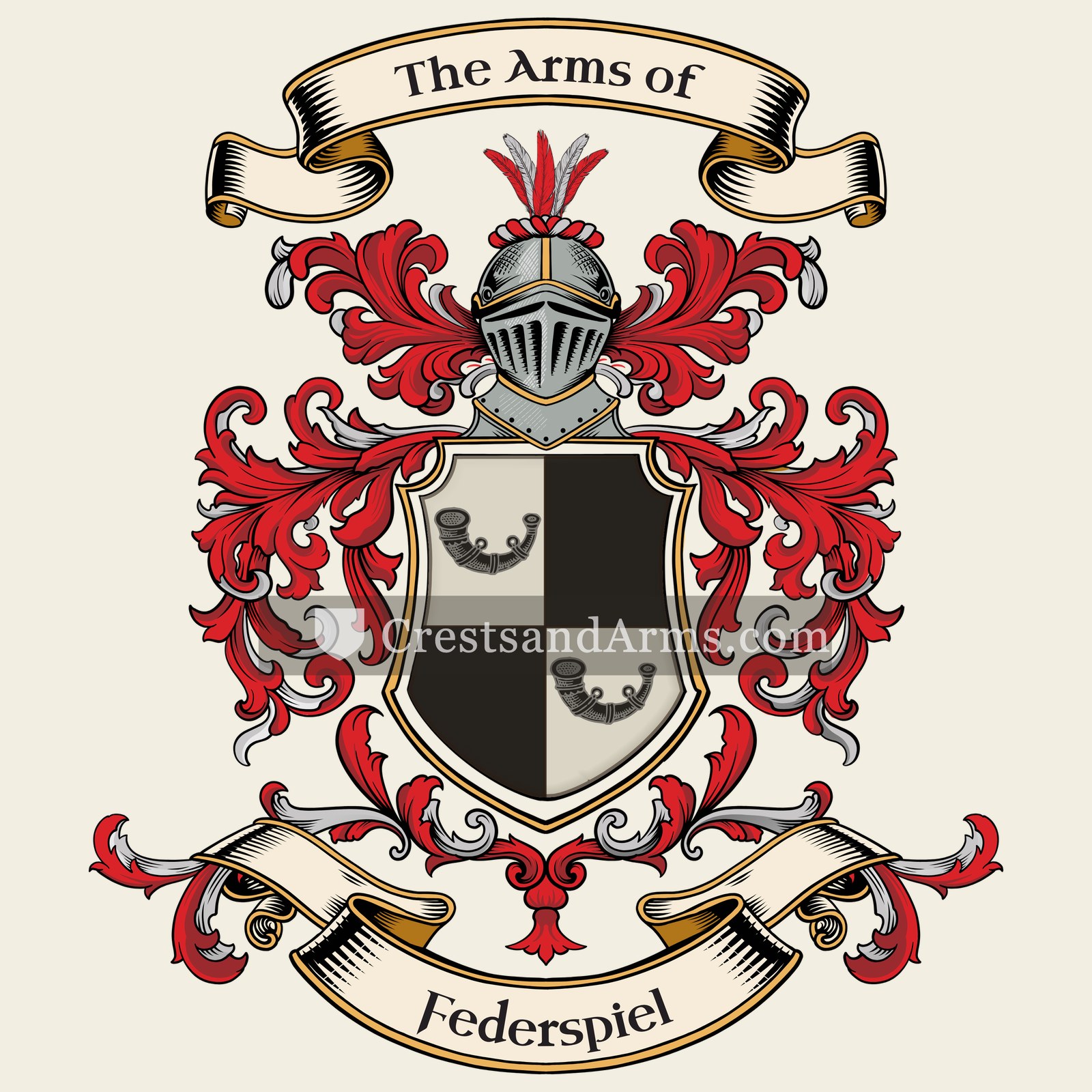
A record of documented arms, meaning and origin, researched for the Federspiel family of Switzerland.
Reg. 9654 · Swiss, D–F
Coat of Arms & Family Crest Details
Symbols on this shield
hunting horn stringedOne who delights in the chase
Colours
Silver (Argent)Means: Peace and sincerity
Black (Sable)Means: Constancy
Historical info
Source
J. B. Rietstap, Armorial Général, Gouda: G. B. van Goor Zonen, 1884–87
Blazon (the actual original written record)
“Ec.: aux 1 et 4 d'arg. à une corne de bouquetin de sa. (Federspihl); aux 2 et 3 parti d'arg. et de sa. Trois cq. cour. C.: 1° un demi-vol cont. aux armes du 1; 1. d'arg. et de sa.; 2° une aigie ép. de sa., surm. de la couronne impériale et ch. sur la poitrine d'un écusson de gu. surch. d'une fasce d'arg.; l. d'or et de sa.; 3° un bouquetin iss. de sa.; l. d'arg. et de sa.”
TyrolTyrol, c. 1702
Digital archive packCoat of arms PNG, gold border print PDF, vector SVG and the certificate of authenticity. Sent to your email in minutes.
Map of Switzerland showing where the Federspiel arms are recorded
The Federspiel arms were recorded in Tyrol, c. 1702.
Tyrol was mountain country in western Austria, where the valleys were held by families who had been there a very long time. Old tenure counted for more than money, and old families carried arms.
This is where the arms were entered in the register. Families often moved to other parts of the country, so the same name can turn up in more than one region.
The body that granted and recorded arms in Switzerland in this period.
How Arms Worked in Switzerland
In Switzerland, coats of arms were not restricted to the nobility and were often adopted by common citizens and families. These symbols were passed down through generations to show family identity. When branches of a family grew, they often changed small details of the design to distinguish their own line from the original group.
Granting authority
Cantonal and civic authorities managed the use of coats of arms within their specific regions and local jurisdictions.
How they got arms
Families typically assumed their own coats of arms based on local custom rather than receiving them from a central monarch.
Where arms were recorded
Arms were recorded in various cantonal and civic registers starting from the fourteenth century throughout the Swiss region.
The family's standing
Recorded among the armigerous families of Tyrol.
Origin & History of the Federspiel Family in Switzerland
The family name Federspiel originates from the German-speaking regions of the Alps, with deep historical roots in the Tyrol area by the early eighteenth century. The name itself is a compound word that translates literally to feather game, which historically referred to the sport of falconry. During the late Middle Ages and the early modern period, this term was often used to describe the birds of prey trained for hunting or the activity of hunting itself. Families who carried this name were likely associated with the aristocratic tradition of falconry or lived in areas where this sport was a prominent part of local culture. By 1702, records indicate that the family had established a firm presence in the Tyrolean landscape, where they integrated into the social and economic life of the mountain communities. Over time, the name transitioned from a descriptive term for a specialized skill into a permanent family identifier passed down through generations.
Federspiel Meaning & Related Branches
Root word
Feder and Spiel
Feather or quill and game or play.
This name
FederspielLikely refers to a fletcher, a maker of arrows, or a performer using feathers.
also spelled
Federspiel
Federspill
Federspyl
Federspeel
Documented Sources
J. B. Rietstap, Armorial Général, Gouda: G. B. van Goor Zonen, 1884–87
Kranzmayer, Eberhard, Ortsnamenbuch von Kärnten, 1956
Tyrol State Archives (Tiroler Landesarchiv), Tiroler Steuerkataster, 1702
Digital archive packCoat of arms PNG, gold border print PDF, vector SVG and the certificate of authenticity. Sent to your email in minutes.


 hunting horn stringedOne who delights in the chase
 hunting horn stringedOne who delights in the chase