Map of Italy showing where the Felici arms are recorded
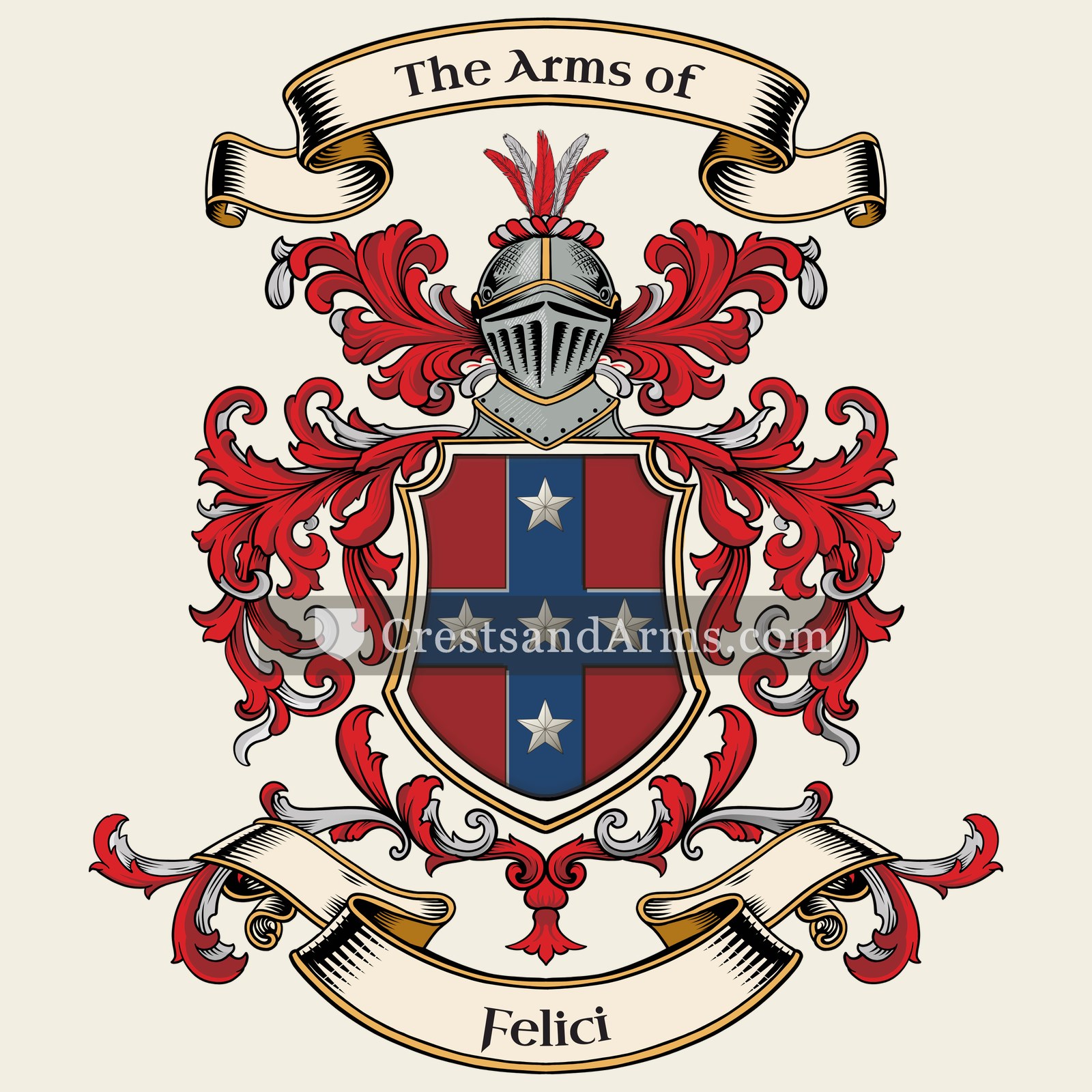
The Felici arms were recorded in Italy, c. 1775.
Arms such as these were typically recorded in Venice.
Venice ran on trade, and its great families were merchants before they were anything else. The city kept a formal list of its noble houses, and a name on that list carried arms as a matter of record.
This is where the arms were entered in the register. Families often moved to other parts of the country, so the same name can turn up in more than one region.
The body that granted and recorded arms in Italy in this period.
Alvise Giovanni Mocenigo
Sovereign of the period
Alvise Giovanni Mocenigo
1763–1778
Reigning in Italy when the Felici arms are first recorded.
How Arms Worked in Italy
In the Italian states, coats of arms were often used by noble families to show their status and history. These symbols were passed down through the generations to all legitimate male descendants. Younger branches of a family usually kept the original design but sometimes added small changes to distinguish their specific line from the main branch.
Granting authority
Various local rulers and city governments controlled the use of coats of arms across the different Italian states.
How they got arms
Families often assumed their own arms or received them as official grants from local lords, popes, or city councils.
Where arms were recorded
Arms were recorded in local city archives or private family books rather than in one single national register.
The family's standing
Recorded among the armigerous families of Italy.
Origin & History of the Felici Family in Italy
The surname Felici originates from the Latin word *felix*, which translates to lucky, happy, or fortunate. During the Middle Ages, this name was often given as a nickname or a personal name to signify someone who was blessed with good fortune or a cheerful disposition. By the time the family was documented in Venice in 1775, the name had evolved into a hereditary surname passed down through generations. In the social landscape of eighteenth-century Venice, families bearing this name were often integrated into the local merchant and artisan classes. These individuals contributed to the vibrant economic and social life of the Venetian Republic during its final decades before the city underwent significant political changes. The history of the Felici name reflects a long tradition of using descriptive personal traits to establish a family identity that persisted across centuries of Italian history.
Felici Meaning & Related Branches
Root word
Felix
Latin term meaning lucky, successful, or prosperous.
This name
FeliciDerived from the plural form of the adjective meaning happy, fortunate, or blessed.
also spelled
Felicie
Feleechee
Documented Sources
J. B. Rietstap, Armorial Général, Gouda: G. B. van Goor Zonen, 1884–87
De Felice, Emidio. Dizionario dei cognomi italiani. 1978
Fucilla, Joseph G. Our Italian Surnames. 1949
Archivio di Stato di Venezia, Anagrafe di Venezia. 1775
Digital archive packCoat of arms PNG, gold border print PDF, vector SVG and the certificate of authenticity. Sent to your email in minutes.


 cross symbolChristian faith and service
 mulletThe third son, and a divine quality from above
 cross symbolChristian faith and service
 mulletThe third son, and a divine quality from above