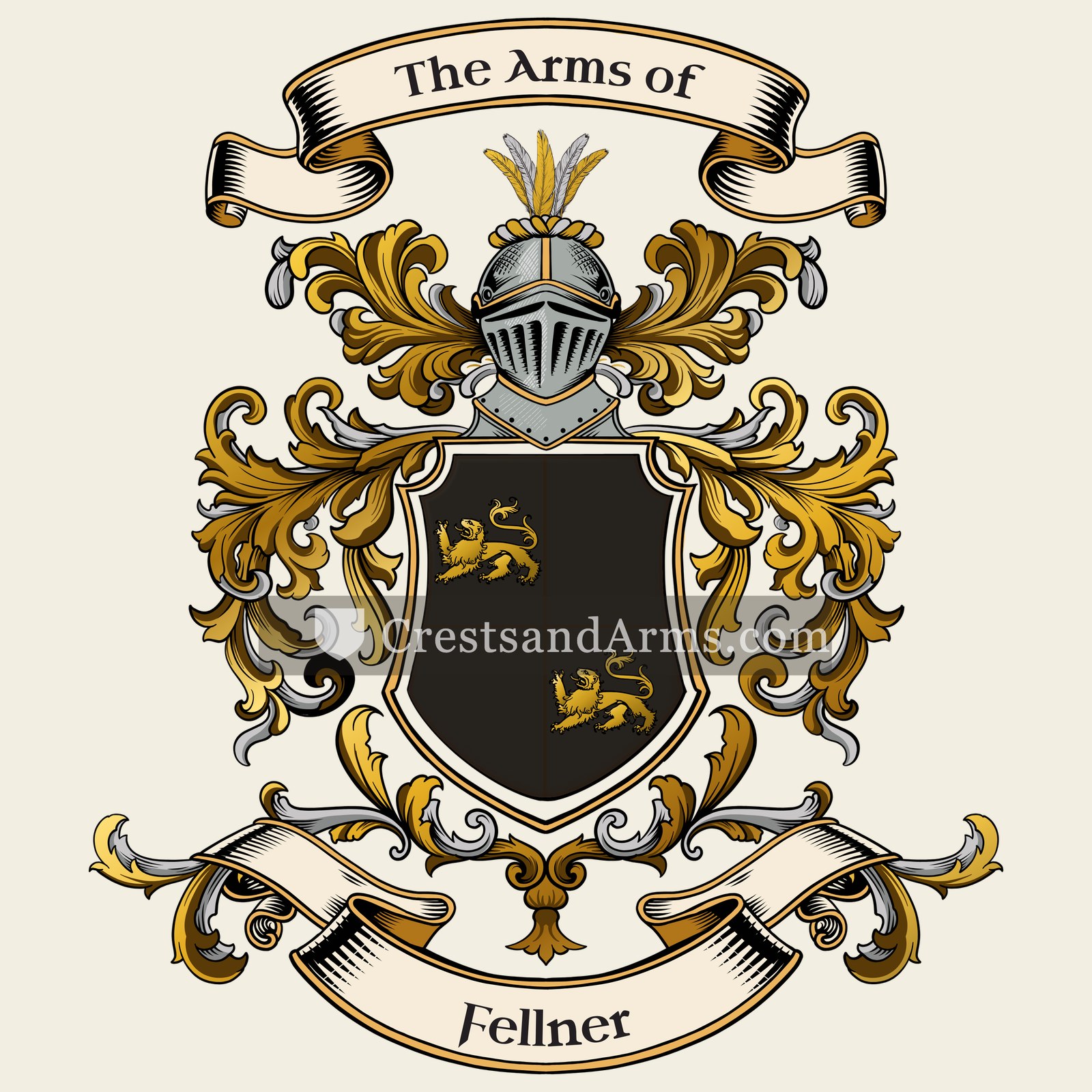
A record of documented arms, meaning and origin, researched for the Fellner family lines. Documented in 2 countries.
Reg. 8786 · Austrian, D–F
Coat of Arms & Family Crest Details
Symbols on this shield
lionCourage, strength and royalty
Colours
Black (Sable)Means: Constancy
Gold (Or)Means: Generosity
Historical info
Source
J. B. Rietstap, Armorial Général, Gouda: G. B. van Goor Zonen, 1884–87
Blazon (the actual original written record)
“Ec.: aux 1 et 4 de sa. au lion d'or, celui du 1 cont.; aux 2”
Austriac. 1589
Where the Fellner Arms Were Recorded
Tyrol
Map of Austria showing where the Fellner arms are recorded
The Fellner arms were recorded in Austria, c. 1589.
Arms such as these were typically recorded in Tyrol.
Tyrol was mountain country in western Austria, where the valleys were held by families who had been there a very long time. Old tenure counted for more than money, and old families carried arms.
This is where the arms were entered in the register. Families often moved to other parts of the country, so the same name can turn up in more than one region.
Region
Tyrol
First recorded
1589
Granting Authority for the Fellner Arms
Imperial and Royal chancery
Sodacan · CC BY-SA 3.0
The body that granted and recorded arms in Austria in this period.
Emperor Rudolf II
Sovereign of the period
Emperor Rudolf II
1576–1612
Reigning in Austria when the Fellner arms are first recorded.
How Arms Worked in Austria
Austrian coats of arms were often linked directly to noble titles granted by the Emperor. These symbols belonged to the entire family line rather than just one individual. When a family grew, new branches kept the original design without needing to change it. This system allowed all members of a noble house to share the same identity across many generations.
Granting authority
The Imperial and Royal chancery managed all heraldic matters and controlled the official granting of arms throughout the Austrian lands.
How they got arms
Families typically received their arms through a formal imperial decree that often accompanied the elevation of a person to noble status.
Where arms were recorded
Official records of these grants were kept in the Imperial Register of Nobility which began its formal documentation process in 1453.
The family's standing
Recorded among the armigerous families of Austria.
Origin & History of the Fellner Family in Austria
The family name Fellner traces its roots back to the mountainous landscapes of Tyrol, where records confirm members of the family were established by 1589. The name itself is occupational in origin, derived from the Middle High German word *fell*, which refers to a hide or a pelt. This suggests that the earliest ancestors were likely involved in the fur trade, serving as tanners, pelt merchants, or furriers who processed animal skins for clothing and warmth. Living in the rugged terrain of the Austrian Alps, these individuals played a vital role in the local economy by turning raw materials from the high-altitude wilderness into essential goods for the community. Over time, the family became deeply integrated into the social fabric of the region, moving from specialized craft roles into various administrative and civic positions as the population of Tyrol grew and trade routes expanded across the valleys.
Coat of Arms & Family Crest Details
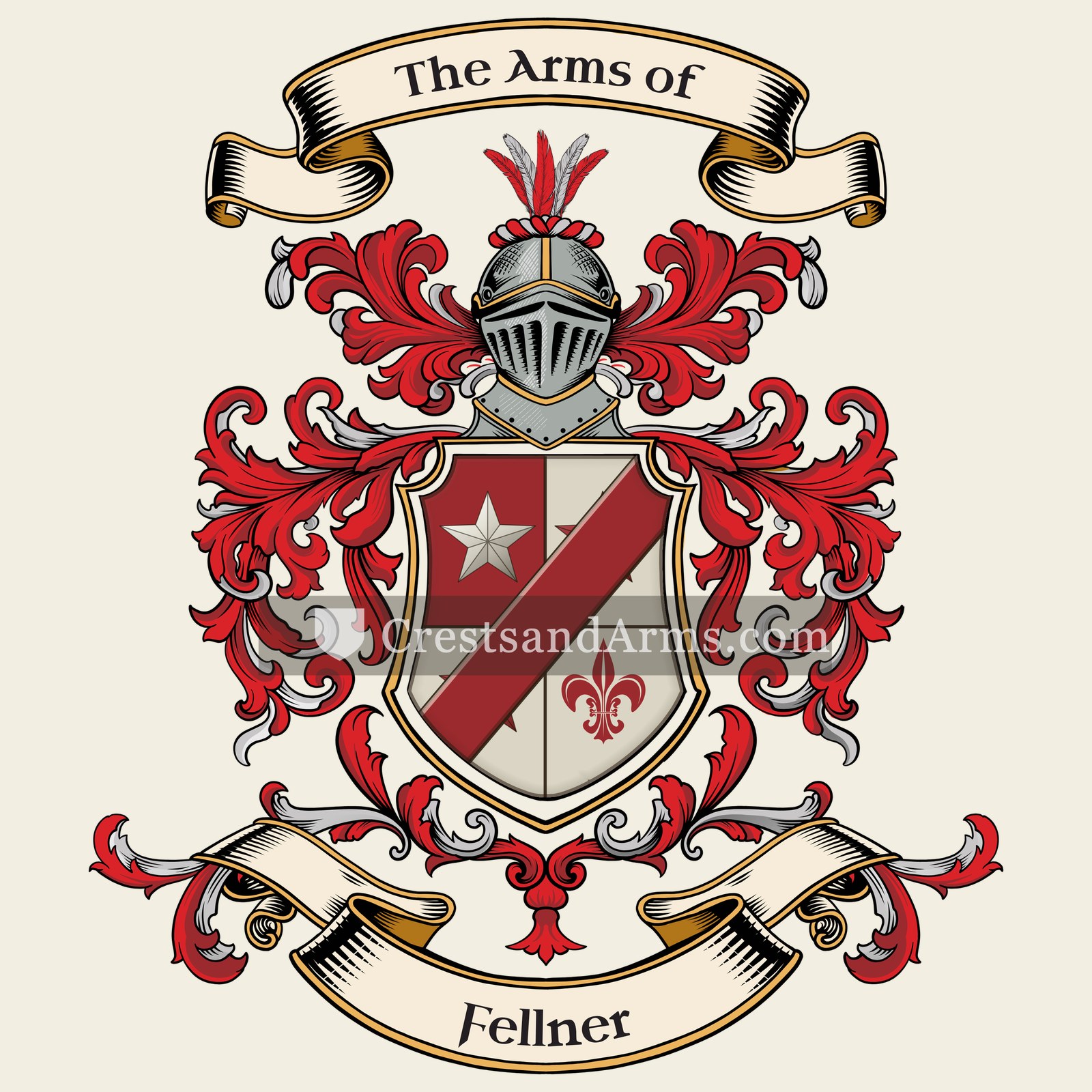
Symbols on this shield
saltireResolution, and St Andrew's cross
bendDefence, and the scarf of a commander
mulletThe third son, and a divine quality from above
fleur de lisPurity, light, and the sixth son
Colours
Red (Gules)Means: Military strength
Silver (Argent)Means: Peace and sincerity
Historical info
Source
J. B. Rietstap, Armorial Général, Gouda: G. B. van Goor Zonen, 1884–87
Blazon (the actual original written record)
“Ec. en saut.: au 1 de gu. à une étoile d'arg.; aux 2 et 3 d'arg. à une étoile de gu.; au 4 d'arg. à une fleur de lis de gu., posée en barre. A une bande de gu., br. sur le tout, et une barre d'arg., br. encore sur le tout. C.: deux prob., d'arg. et d'azur. L.: d'arg. et d'azur.”
GermanyRatisbonne, c. 1765
Where the Fellner Arms Were Recorded
Ratisbonne
Map of Germany showing where the Fellner arms are recorded
The Fellner arms were recorded in Ratisbonne, c. 1765.
This is where the arms were entered in the register. Families often moved to other parts of the country, so the same name can turn up in more than one region.
The body that granted and recorded arms in Germany in this period.
Francis I, Holy Roman Emperor
Sovereign of the period
Francis I, Holy Roman Emperor
1745–1765
Reigning in Austria when the Fellner arms are first recorded.
How Arms Worked in Germany
In the Holy Roman Empire, coats of arms were often granted to individuals by the Emperor or his representatives. These arms were then passed down through the generations to all legitimate descendants of the original holder. Younger branches of a family usually kept the same shield design without needing to change it, as the arms belonged to the entire lineage.
Granting authority
The Holy Roman Emperor held the sole power to grant new coats of arms throughout his vast imperial territories.
How they got arms
Families typically obtained their coats of arms through a formal imperial grant or by proving their noble status to the authorities.
Where arms were recorded
These grants were officially recorded in the Imperial Chancery registers, which began keeping formal records of such honors during the Middle Ages.
The family's standing
Recorded among the armigerous families of Germany.
Origin & History of the Fellner Family in Germany
The surname Fellner is rooted in the German language and historically describes a person who worked with animal hides or furs. The name is an occupational title derived from the Middle High German word *vellenere*, which refers to a skinner or a dealer in pelts. By the mid-18th century, the family was well-established in Ratisbonne, which is known today as Regensburg. During this period, the city served as the permanent seat of the Perpetual Diet of the Holy Roman Empire, making it a bustling center of political and economic activity. Families living in Regensburg at this time often participated in the city’s vibrant trade guilds, which were essential for maintaining the social and professional standing of middle-class citizens. The presence of the Fellner name in official records from 1765 suggests that the family was integrated into the urban life of this historic Bavarian city, likely contributing to the local economy through their traditional trade or through roles within the city’s administrative framework.
Related Branches & Arms
Root word
Fell
A Middle High German term referring to an animal hide or skin.
This name
FellnerAn occupational surname for a dealer in animal hides or a furrier.
also spelled
Felner
Related arms
Cervellisimilar arms
Lenard de Leonardissimilar arms
Leonardissimilar arms
Saltzingersimilar arms
Documented Sources
J. B. Rietstap, Armorial Général, Gouda: G. B. van Goor Zonen, 1884–87
Kranzmayer, Eberhard. Ortsnamenbuch von Kärnten. 1956


 lionCourage, strength and royalty
 lionCourage, strength and royalty

 saltireResolution, and St Andrew's cross
 bendDefence, and the scarf of a commander
 mulletThe third son, and a divine quality from above
 fleur de lisPurity, light, and the sixth son