Map of Britain showing where the Felton arms are recorded
The Felton arms were recorded in Suffolk, c. 1700.
Suffolk was wool country, and its cloth towns were among the wealthiest in England. Clothier families bought manors with their profits, and holding a manor was the ordinary route to a coat of arms.
This is where the arms were entered in the register. Families often moved to other parts of the country, so the same name can turn up in more than one region.
The body that granted and recorded arms in Britain in this period.
William III of England
Sovereign of the period
William III of England
1694–1702
Reigning in Britain when the Felton arms are first recorded.
How Arms Worked in Britain
English heraldry allowed arms to be shared by all legitimate descendants of the original owner. These symbols were treated as personal property that moved through the generations to all children. While the eldest son kept the original design, other family members could use the same shield without needing to change it or register their own unique versions.
Granting authority
The College of Arms in London has regulated the use of coats of arms throughout England and Wales since 1484.
How they got arms
Families typically obtained their coats of arms through a formal grant from the Crown or by proving their ancient right to them.
Where arms were recorded
All official coats of arms are recorded in the registers kept at the College of Arms, which date back to the fifteenth century.
The family's standing
Recorded among the armigerous families of Suffolk.
Origin & History of the Felton Family in Britain
The surname Felton is a locational name that originated in England, specifically derived from places named Felton in Northumberland, Herefordshire, and Somerset. The name itself comes from the Old English words "feld," meaning an open field or pasture, and "tun," meaning a settlement or enclosure. By the time the family established a notable presence in Suffolk around 1700, they were part of a long tradition of families who took their identity from the specific landscape where they lived. During the medieval period, people often adopted these place names as surnames to distinguish themselves from others in their local communities. As the family moved across the British landscape over the centuries, they carried this connection to the land with them, eventually settling in the eastern counties where they became part of the local social and economic fabric.
Coat of Arms & Family Crest Details
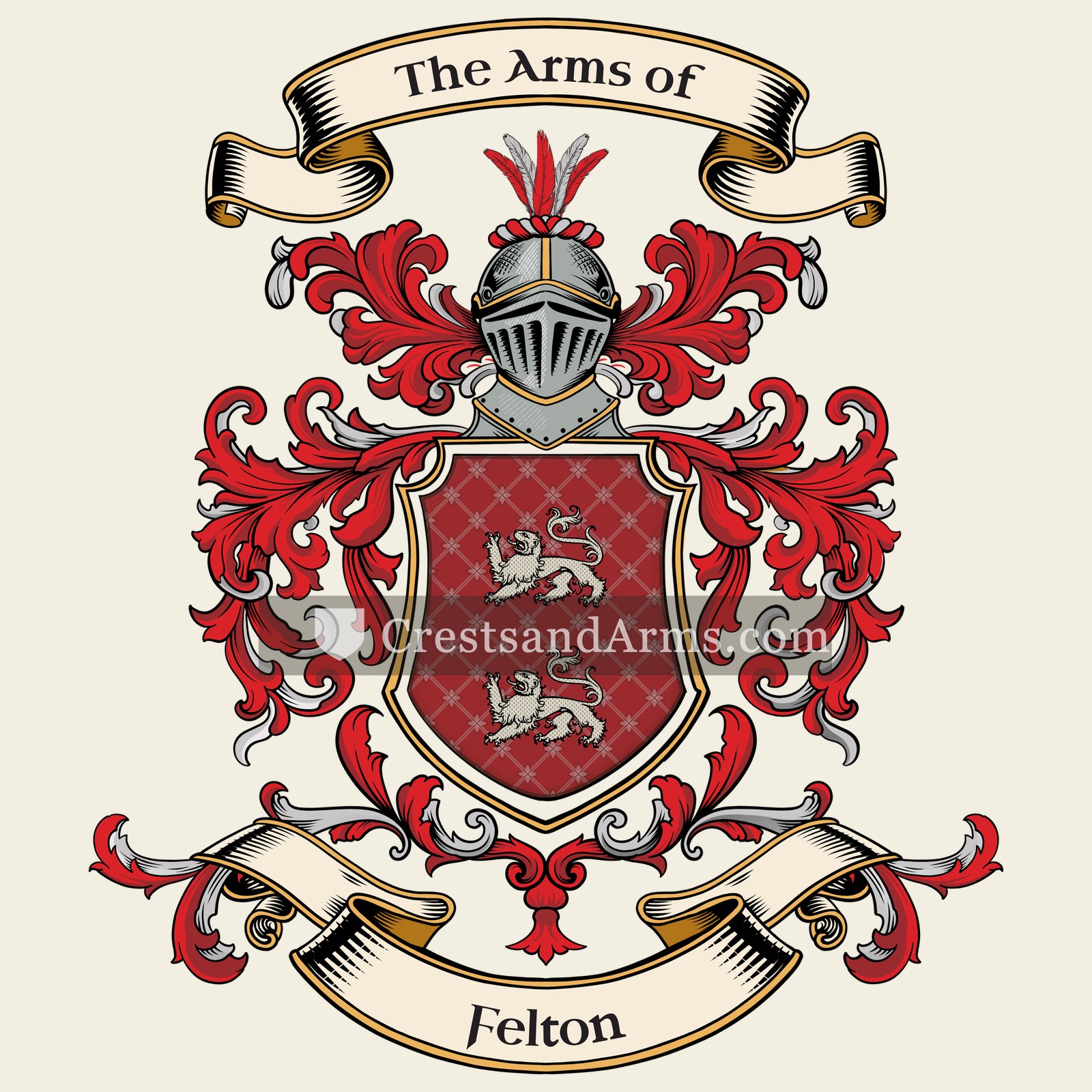
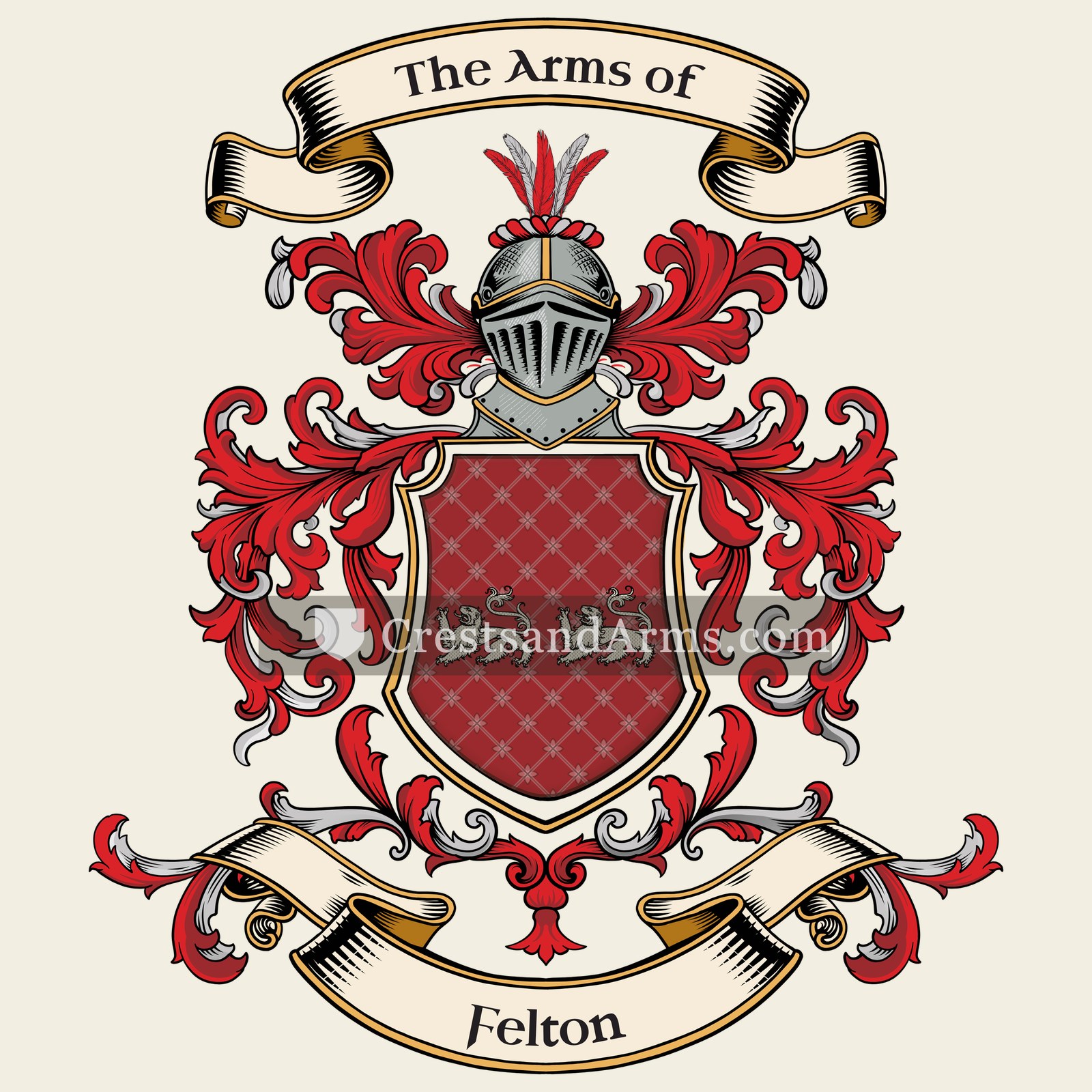
Symbols on this shield
lionCourage, strength and royalty
Colours
Red (Gules)Means: Military strength
ErmineMeans: Dignity
Historical info
Source
Sir Bernard Burke, The General Armory of England, Scotland, Ireland and Wales, London: Harrison & Sons, 1884
Blazon (the actual original written record)
“Gu. two lions pass. erm. crowned or”
Englandc. 1313
Digital archive packCoat of arms PNG, gold border print PDF, vector SVG and the certificate of authenticity. Sent to your email in minutes.
Map of England showing where the Felton arms are recorded
The Felton arms were recorded in England, c. 1313.
Arms such as these were typically recorded in York.
Yorkshire is the largest of the English counties, and it held more gentry families than any other. Land there was split among a great many households rather than a few, so a great many of them carried arms.
This is where the arms were entered in the register. Families often moved to other parts of the country, so the same name can turn up in more than one region.
The body that granted and recorded arms in England in this period.
Edward II of England
Sovereign of the period
Edward II of England
1307–1327
Reigning in Britain when the Felton arms are first recorded.
How Arms Worked in England
English heraldry allowed arms to be shared by all legitimate descendants of the original owner. These symbols were treated as personal property that moved through the generations to all children. While the eldest son kept the original design, other family members could use the same shield without needing to change it or register their own unique versions.
Granting authority
The College of Arms in London has regulated the use of coats of arms throughout England and Wales since 1484.
How they got arms
Families typically obtained their coats of arms through a formal grant from the Crown or by proving their ancient right to them.
Where arms were recorded
All official coats of arms are recorded in the registers kept at the College of Arms, which date back to the fifteenth century.
The family's standing
Recorded among the armigerous families of England.
Origin & History of the Felton Family in England
The surname Felton is a locative name, meaning it was originally derived from a specific place rather than a trade or a personal characteristic. The name refers to those who hailed from settlements named Felton, which translates from Old English as a farmstead or field located near a hill. By the early fourteenth century, the family had established a notable presence in the north of England, specifically within the city of York. Records from 1313 confirm that members of the Felton family were active participants in the social and economic life of this region during the medieval period. As the family grew, they moved beyond their original geographic roots and spread across different English counties, eventually becoming landowners and local officials. This transition from being identified by a single village to becoming a recognized surname demonstrates how families integrated into the evolving administrative structures of medieval England.
Felton Meaning & Related Branches
Root word
Feld
An open area of land or a field.
This name
FeltonRefers to a person who lived near or worked on an open field or clearing.
also spelled
Feltone
Feltun
Phalton
Felten
Feltoun
Related arms
Ravenrecorded with Felton, same area
Documented Sources
J. B. Rietstap, Armorial Général, Gouda: G. B. van Goor Zonen, 1884–87
Reaney, P.H., A Dictionary of English Surnames, 1991
Ekwall, Eilert, The Concise Oxford Dictionary of English Place-names, 1960
Suffolk Archives, Parish registers and manorial records for the county of Suffolk, 17th and 18th centuries
Digital archive packCoat of arms PNG, gold border print PDF, vector SVG and the certificate of authenticity. Sent to your email in minutes.


 lionCourage, strength and royalty
 lionCourage, strength and royalty