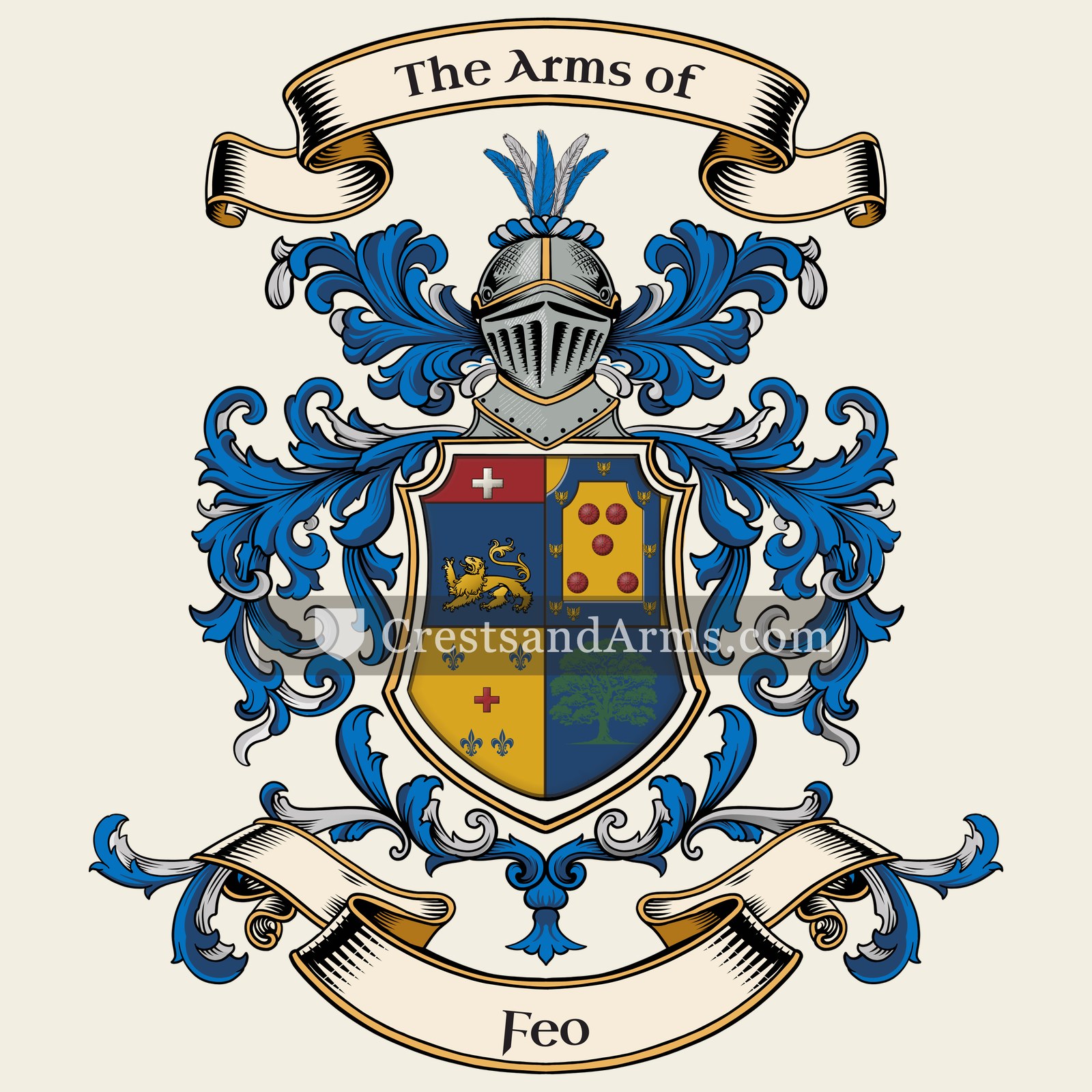
A record of documented arms, meaning and origin, researched for the Feo family of Portugal.
Reg. 9044 · Portuguese, D–F
Coat of Arms & Family Crest Details
Symbols on this shield
chiefAuthority, wisdom and dominion
cross symbolChristian faith and service
lionCourage, strength and royalty
roundelA coin, and one who has been to the crusades
eagleNobility, strength and a keen mind
fleur de lisPurity, light, and the sixth son
treeLife, endurance and deep roots
Colours
Blue (Azure)Means: Loyalty and truth
Gold (Or)Means: Generosity
Red (Gules)Means: Military strength
Silver (Argent)Means: Peace and sincerity
Green (Vert)Means: Hope
Historical info
Source
J. B. Rietstap, Armorial Général, Gouda: G. B. van Goor Zonen, 1884–87
Blazon (the actual original written record)
“Ec.: au 1 d'azur au lion d'or, arm. et lamp. de gu.; au chef de gu., ch. d'une croix alésée d'arg.; au 2 d'or à cinq sphères de gu., et une bord. d'azur ch. de huit têtes d'aigle d'or, languées de gu.; au 3 d'or à la croix de gu., cant. de quatre fleurs-de-lis d'azur; au 4 d'arg. à un arbre de sin.”
BrabantBrabant, c. 1650
Digital archive packCoat of arms PNG, gold border print PDF, vector SVG and the certificate of authenticity. Sent to your email in minutes.
Map of Portugal showing where the Feo arms are recorded
The Feo arms were recorded in Brabant, c. 1650.
Brabant lay at the heart of the Low Countries, where the trade routes met. Its towns were wealthy and its landowners many, and both kinds of family kept arms, which is why the region is so heavily represented.
This is where the arms were entered in the register. Families often moved to other parts of the country, so the same name can turn up in more than one region.
The body that granted and recorded arms in Portugal in this period.
John IV of Portugal
Sovereign of the period
John IV of Portugal
1640–1656
Reigning in Portugal when the Feo arms are first recorded.
How Arms Worked in Portugal
In Portugal, a coat of arms was a family possession that passed from a father to his children. Every legitimate descendant had the right to use the family shield without needing to change it. Younger branches of the family kept the original design, though they sometimes added small symbols to distinguish their specific line from the main branch.
Granting authority
The Cartório da Nobreza acted as the official body that managed and regulated noble titles and coats of arms in Portugal.
How they got arms
Families typically inherited their arms through bloodline, though they could also receive new grants from the crown for distinguished service.
Where arms were recorded
Coats of arms were officially recorded in the books of the Cartório da Nobreza starting in the year 1512.
The family's standing
Recorded among the armigerous families of Brabant.
Origin & History of the Feo Family in Portugal
The family name Feo carries a history deeply rooted in the cultural landscape of the Low Countries during the seventeenth century. By 1650, records confirm that members of the family were well-established residents of the Duchy of Brabant, a region known for its bustling trade networks and vibrant urban centers. During this period, the name likely functioned as a descriptive identifier within the local community, reflecting the linguistic shifts common in a region where Dutch, French, and local dialects frequently intersected. Families in Brabant at this time were often defined by their contributions to the local economy, such as craftsmanship or agriculture, and the presence of the Feo name in official registers suggests they were integrated into the social fabric of the area. As the family navigated the political and religious changes of the mid-1600s, they remained part of a society that valued community ties and regional identity, helping to preserve the name through generations of local history.
Feo Meaning & Related Branches
Root word
foedus
Latin term meaning foul, ugly, or repulsive in appearance.
This name
FeoA descriptive nickname historically applied to an unattractive or unsightly individual.
also spelled
Francoy
Feo
Franko ee Feo
Documented Sources
J. B. Rietstap, Armorial Général, Gouda: G. B. van Goor Zonen, 1884–87
Pirenne, Henri, Histoire de Belgique, 1900
State Archives in Belgium (Rijksarchief), Registers van de Brabantse Rekenkamer
Digital archive packCoat of arms PNG, gold border print PDF, vector SVG and the certificate of authenticity. Sent to your email in minutes.


 chiefAuthority, wisdom and dominion
 cross symbolChristian faith and service
 lionCourage, strength and royalty
 roundelA coin, and one who has been to the crusades
 eagleNobility, strength and a keen mind
 fleur de lisPurity, light, and the sixth son
 treeLife, endurance and deep roots
 chiefAuthority, wisdom and dominion
 cross symbolChristian faith and service
 lionCourage, strength and royalty
 roundelA coin, and one who has been to the crusades
 eagleNobility, strength and a keen mind
 fleur de lisPurity, light, and the sixth son
 treeLife, endurance and deep roots