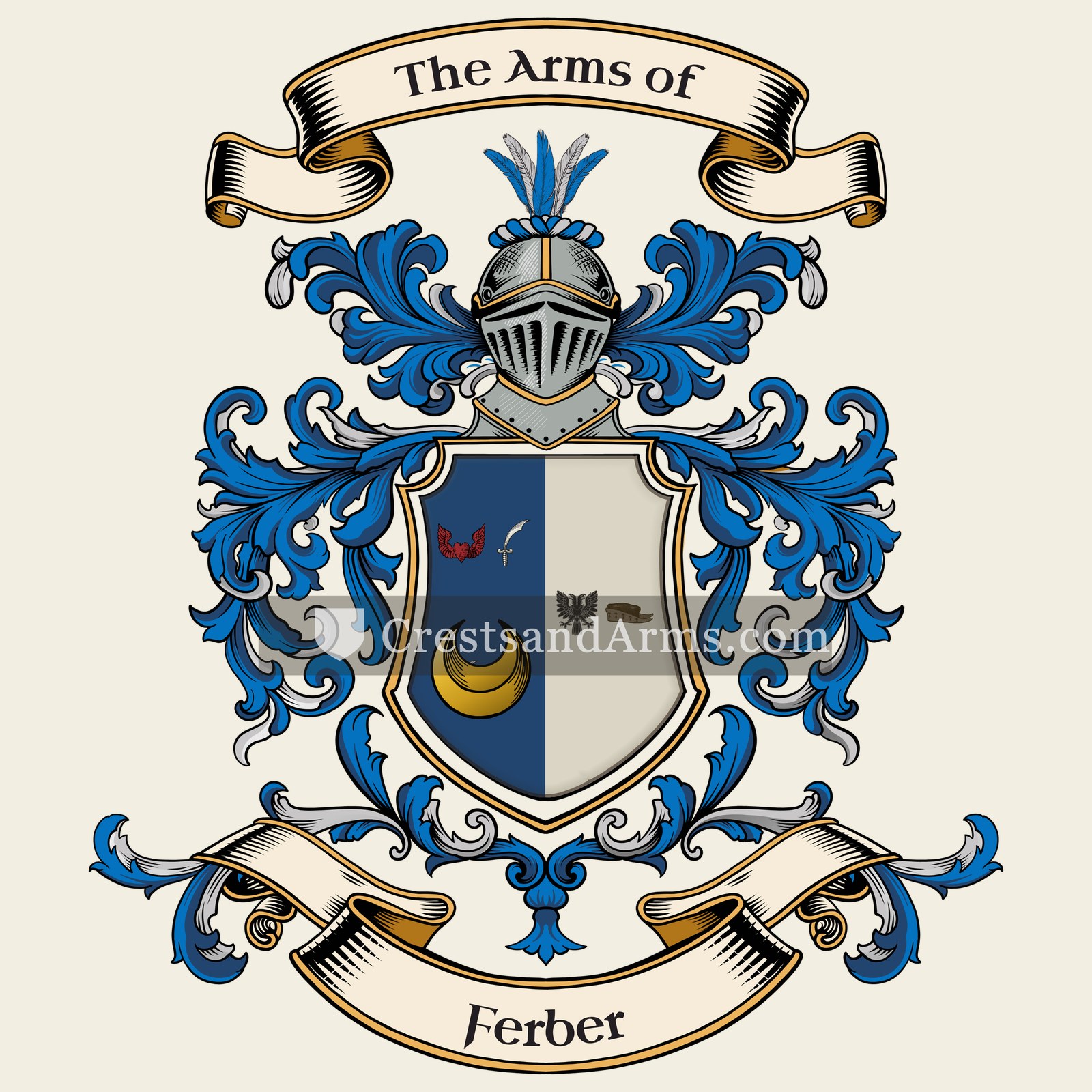
A record of documented arms, meaning and origin, researched for the Ferber family of Germany.
Reg. 7443 · German, D–F
Coat of Arms & Family Crest Details
Symbols on this shield
crescentHonour by the sovereign, and the second son
heartSincerity, charity and true affection
swordJustice, and military honour
eagleNobility, strength and a keen mind
hat or capDignity, and the honour of office
Colours
Blue (Azure)Means: Loyalty and truth
Silver (Argent)Means: Peace and sincerity
Gold (Or)Means: Generosity
Red (Gules)Means: Military strength
Historical info
Source
J. B. Rietstap, Armorial Général, Gouda: G. B. van Goor Zonen, 1884–87
Blazon (the actual original written record)
“D'azur à un croiss. figuré d'or; le champ chapé-ployé: à dextre d'arg. à un coeur de gu., et trois épées d'arg., garnies d'or, enfoncées dans ledit coeur; à sen. de gu. à une tête et col d'aigle d'arg., sommée d'un bonnet électoral au nat. Cq. cour. C.: la tête d'aigle. L.: à dextre d'arg. et de gu., à sen. d'or et d'azur. - (Nob. du St.-Empire, 29 nov. 1776.) Ec.: au 1 de gu. à une tête d'aigle d'arg., cour. d'or; au 2 d'azur à un croiss. figuré montant d'or; au 3 d'or à deux fasces d'azur; au 4 d'arg. à un coeur de gu., et trois épées d'arg., garnies d'or, enfoncées dans ledit coeur. Cq. cour. C.: deux prob., celle à dextre aux armes du 3, celle à sen. coupée de gu. sur arg. L.: à dextre d'arg. et de gu., à sen. d'or et d'azur. - (Barons du St.-Empire, 24 avril 1789.) Les armes de 1776. S.: deux aigles reg. d'arg., bq., m. et cour. d'or. D.: VITAM IMPENDERE VERO.”
SaxonySaxony, c. 1765
Digital archive packCoat of arms PNG, gold border print PDF, vector SVG and the certificate of authenticity. Sent to your email in minutes.
Map of Germany showing where the Ferber arms are recorded
The Ferber arms were recorded in Saxony, c. 1765.
Saxony had mines, trade and old landed families all at once. Silver made some fortunes and land held others, and both sorts of family kept arms, which is why Saxon names appear so often in the registers.
This is where the arms were entered in the register. Families often moved to other parts of the country, so the same name can turn up in more than one region.
The body that granted and recorded arms in Germany in this period.
Francis I, Holy Roman Emperor
Sovereign of the period
Francis I, Holy Roman Emperor
1745–1765
Reigning in Germany when the Ferber arms are first recorded.
How Arms Worked in Germany
In the Holy Roman Empire, coats of arms were often granted to individuals by the Emperor or his representatives. These arms were then passed down through the generations to all legitimate descendants of the original holder. Younger branches of a family usually kept the same shield design without needing to change it, as the arms belonged to the entire lineage.
Granting authority
The Holy Roman Emperor held the sole power to grant new coats of arms throughout his vast imperial territories.
How they got arms
Families typically obtained their coats of arms through a formal imperial grant or by proving their noble status to the authorities.
Where arms were recorded
These grants were officially recorded in the Imperial Chancery registers, which began keeping formal records of such honors during the Middle Ages.
The family's standing
Recorded among the armigerous families of Saxony.
Origin & History of the Ferber Family in Germany
The surname Ferber is rooted in the German language and historically functioned as an occupational name. It is derived from the Middle High German word *verwer*, which refers to a dyer or someone who worked with pigments and colors. By the mid-18th century, the family was well-established in the region of Saxony. During this period, Saxony was a hub of trade and craftsmanship, making it a logical home for a family associated with the textile or dyeing industries. As the family grew, they integrated into the local social and economic structures of the Saxon towns, where their name became a permanent marker of their professional heritage. These early ancestors lived through a time of significant transition in central Europe, helping to shape the local communities where their descendants would eventually thrive.
Ferber Meaning & Related Branches
Root word
ferber
Middle High German word for a ferryman or a carrier.
This name
FerberAn occupational surname for someone who operated a ferry or transported goods.
also spelled
Ferbere
Ferbar
Verber
Related arms
Achingerrecorded with Ferber, same area
Balinskirecorded with Ferber, same area
Clementen-Plemieneckirecorded with Ferber, same area
Cromerrecorded with Ferber, same area
Documented Sources
J. B. Rietstap, Armorial Général, Gouda: G. B. van Goor Zonen, 1884–87
Bahlow, Hans. Deutsches Namenlexikon: Familien- und Vornamen nach Ursprung und Sinn erklärt. 1967
Heintze, Albert. Die deutschen Familien-Namen: geschichtlich, geographisch, sprachlich. 1903
Sächsisches Staatsarchiv. Kirchenbücher der evangelisch-lutherischen Landeskirche Sachsens. 1765
Digital archive packCoat of arms PNG, gold border print PDF, vector SVG and the certificate of authenticity. Sent to your email in minutes.


 crescentHonour by the sovereign, and the second son
 heartSincerity, charity and true affection
 swordJustice, and military honour
 eagleNobility, strength and a keen mind
 hat or capDignity, and the honour of office