Map of Belgium showing where the Feron arms are recorded
The Feron arms were recorded in Brabant, c. 1737.
Brabant lay at the heart of the Low Countries, where the trade routes met. Its towns were wealthy and its landowners many, and both kinds of family kept arms, which is why the region is so heavily represented.
This is where the arms were entered in the register. Families often moved to other parts of the country, so the same name can turn up in more than one region.
The body that granted and recorded arms in Belgium in this period.
Charles VI, Holy Roman Emperor
Sovereign of the period
Charles VI, Holy Roman Emperor
1711–1740
Reigning in Belgium when the Feron arms are first recorded.
How Arms Worked in Belgium
In Belgium, a coat of arms is considered personal property that is passed down through the male line to legitimate descendants. Families often use the same shield design across generations to show their shared heritage. If a branch of the family wants to change the design, they must apply for an official update to their specific version of the arms.
Granting authority
The Conseil héraldique is the official body that regulates and approves all coats of arms in Belgium.
How they got arms
Families obtain their coats of arms through formal royal grants or by confirming their historical right to use existing designs.
Where arms were recorded
All approved coats of arms are officially recorded in the public registers of the Conseil héraldique since 1844.
The family's standing
Recorded among the armigerous families of Brabant.
Origin & History of the Feron Family in Belgium
The family name Feron has deep roots in the historical region of Brabant, where records confirm members of the family were established by 1737. The name itself is likely derived from the Old French word for an ironworker or a blacksmith, suggesting that the earliest ancestors were skilled tradespeople who played a vital role in the local economy. During the eighteenth century, Brabant was a center of agricultural and industrial development, and families like the Ferons were often integrated into the fabric of village life as craftsmen or landholders. As the family grew, they moved through the towns and rural parishes of the region, adapting to the changing political landscape of the Low Countries. Their presence in these early records highlights a history of steady labor and community participation that helped shape the social structure of the area long before the modern borders of Belgium were fully defined.
Coat of Arms & Family Crest Details
Symbols on this shield
chevronProtection, and faithful service completed
mulletThe third son, and a divine quality from above
Colours
Blue (Azure)Means: Loyalty and truth
Silver (Argent)Means: Peace and sincerity
Historical info
Source
J. B. Rietstap, Armorial Général, Gouda: G. B. van Goor Zonen, 1884–87
Blazon (the actual original written record)
“D'azur à deux chev. d'arg., acc. en chef de deux étoiles du même.”
Francec. 1663
Digital archive packCoat of arms PNG, gold border print PDF, vector SVG and the certificate of authenticity. Sent to your email in minutes.
Map of France showing where the Feron arms are recorded
The Feron arms were recorded in France, c. 1663.
Arms such as these were typically recorded in Bretagne.
More families held coats of arms in Bretagne than anywhere else in France. The land was divided into many small estates rather than a few large ones, so far more households counted as gentry, and each needed a shield of its own to be told apart.
This is where the arms were entered in the register. Families often moved to other parts of the country, so the same name can turn up in more than one region.
The body that granted and recorded arms in France in this period.
Louis XIV of France
Sovereign of the period
Louis XIV of France
1643–1715
Reigning in Belgium when the Feron arms are first recorded.
How Arms Worked in France
In France, a coat of arms was a mark of honor that passed down through the male line to all legitimate descendants. Families often used the same shield without changes to show their shared heritage. If a branch wanted to stand out, they could add a small mark to their shield to show their specific place in the family tree.
Granting authority
The Juge d'armes de France acted as the official authority that regulated and verified coats of arms across the country.
How they got arms
Families typically inherited their arms from ancestors, though they could also receive them through royal grants or by proving their noble status.
Where arms were recorded
Coats of arms were officially recorded in the Armorial Général de France, which began its main collection in the year 1696.
The family's standing
Recorded among the armigerous families of France.
Origin & History of the Feron Family in France
The surname Feron has deep roots in the French language, originating as a descriptive occupational name for an ironworker or a blacksmith. By the middle of the seventeenth century, the family had established a clear presence in the province of Bretagne, a region known for its distinct cultural identity and maritime traditions. Records from 1663 confirm that members of the Feron family were living in this area, where they likely contributed to the local economy through trade or skilled craftsmanship. During this period, families in Bretagne often lived in close-knit rural communities where surnames were passed down to identify a person’s trade or family lineage. As the family grew, they became part of the social fabric of northwestern France, reflecting the broader history of working-class families who helped build the infrastructure of the French provinces.
Coat of Arms & Family Crest Details
Symbols on this shield
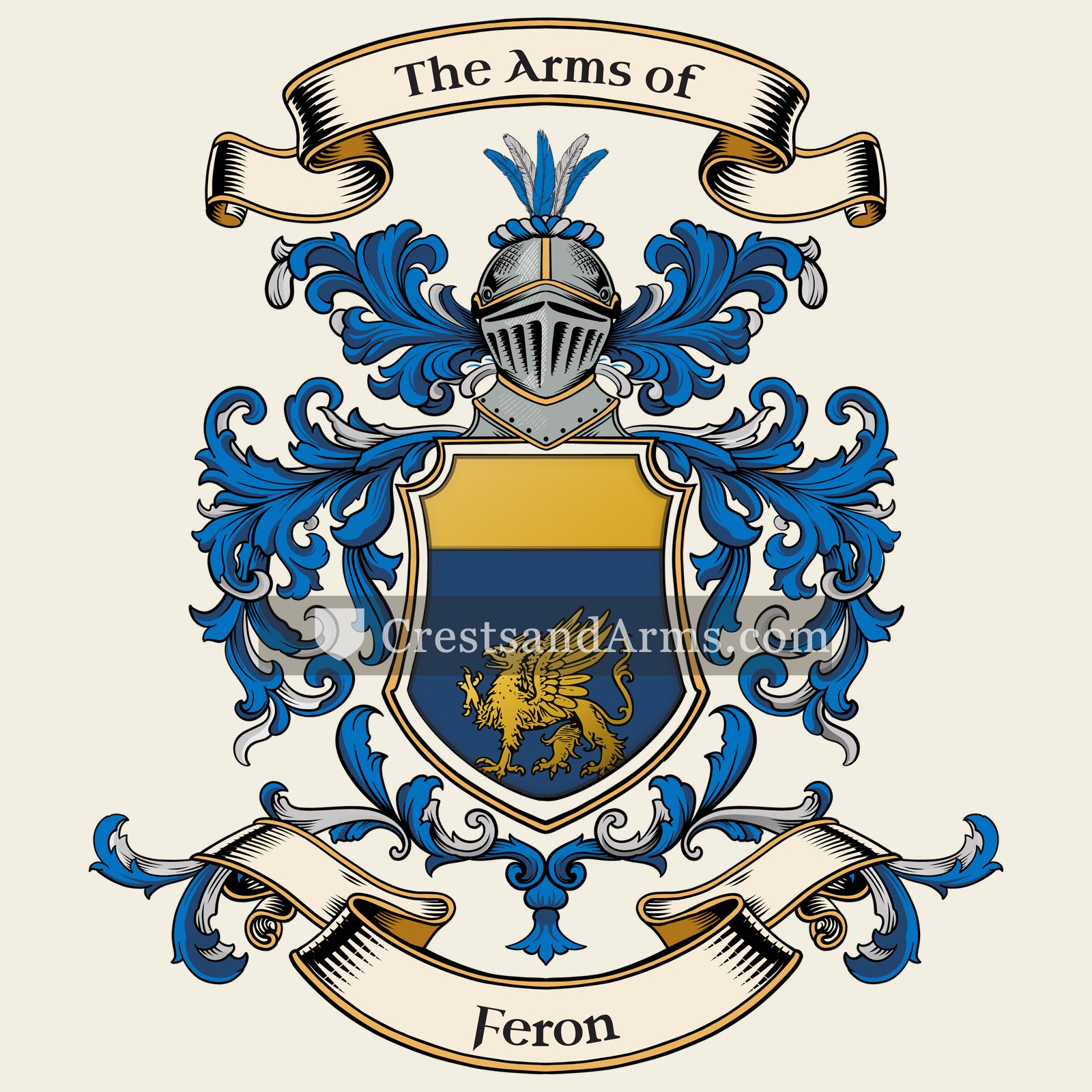
chiefAuthority, wisdom and dominion
griffinValour and vigilance, guarding great treasure
Colours
Blue (Azure)Means: Loyalty and truth
Gold (Or)Means: Generosity
Historical info
Source
Sir Bernard Burke, The General Armory of England, Scotland, Ireland and Wales, London: Harrison & Sons, 1884
Blazon (the actual original written record)
“Az. a griffin ramp. or, a chief of the last”
Scotlandc. 1748
Digital archive packCoat of arms PNG, gold border print PDF, vector SVG and the certificate of authenticity. Sent to your email in minutes.
Map of Scotland showing where the Feron arms are recorded
The Feron arms were recorded in Scotland, c. 1748.
Arms such as these were typically recorded in Edinburgh.
Edinburgh was the seat of Scotland's government, its courts and its heralds. Families with business there settled nearby, and being close to where arms were recorded is exactly why so many of them appear.
This is where the arms were entered in the register. Families often moved to other parts of the country, so the same name can turn up in more than one region.
The body that granted and recorded arms in Scotland in this period.
George II of Great Britain
Sovereign of the period
George II of Great Britain
1727–1760
Reigning in Belgium when the Feron arms are first recorded.
How Arms Worked in Scotland
Scottish heraldry is unique because it treats a coat of arms as a piece of personal property protected by law. Only one person can own a specific design at any given time. When a family grows, the head keeps the original shield while other relatives must apply for their own distinct version with slight changes to prove their specific identity.
Granting authority
The Court of the Lord Lyon acts as the official body that regulates and controls all heraldic matters throughout Scotland.
How they got arms
Individuals obtain a legal right to their arms through a formal petition process that confirms their identity and family connection.
Where arms were recorded
All valid coats of arms are officially entered into the Public Register of All Arms and Bearings starting from 1672.
The family's standing
Recorded among the armigerous families of Scotland.
Origin & History of the Feron Family in Scotland
The history of the Feron family in Scotland is deeply tied to the urban development of Edinburgh during the mid-eighteenth century. While the name likely originated from roots linked to the French word for iron, suggesting ancestors who worked as blacksmiths or metalworkers, the family established a firm presence in the Scottish capital by 1748. During this period, Edinburgh was undergoing a significant transformation as the city began to expand beyond its medieval walls. Families like the Ferons were often part of the growing class of tradespeople and merchants who supported this new era of commerce and civic growth. By settling in such a central hub, the family became integrated into the social and economic fabric of the city during a time of great change in Scottish history. They lived through the transition from the traditional life of the Old Town into the modern era of the Enlightenment, helping to shape the local community through their daily work and civic participation.
Feron Meaning & Related Branches
Root word
ferrum
Latin word meaning iron or a tool made of iron.
This name
FeronAn occupational surname for an ironworker, blacksmith, or someone who dealt in iron goods.
also spelled
Ferron
Feronne
Feronnes
Related arms
Ferronvariant spelling
Fearonvariant spelling
Documented Sources
J. B. Rietstap, Armorial Général, Gouda: G. B. van Goor Zonen, 1884–87
State Archives in Belgium (Rijksarchief te België), Parochieregisters: Brabant, 1737
Debrabandere, Frans, Woordenboek van de familienamen in België en Noord-Frankrijk, 2003
Digital archive packCoat of arms PNG, gold border print PDF, vector SVG and the certificate of authenticity. Sent to your email in minutes.


 crescentHonour by the sovereign, and the second son
 mulletThe third son, and a divine quality from above
 crescentHonour by the sovereign, and the second son
 mulletThe third son, and a divine quality from above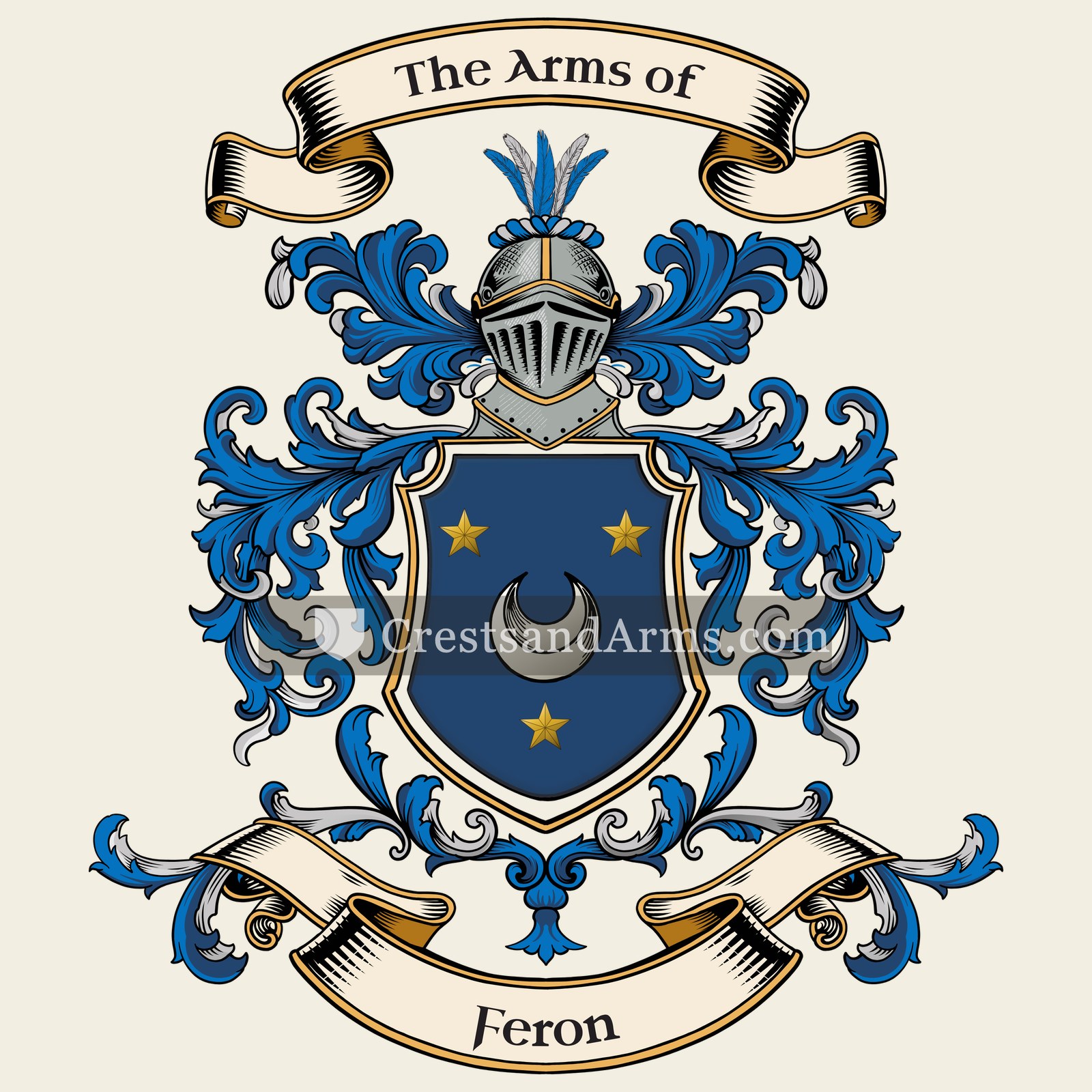


 chevronProtection, and faithful service completed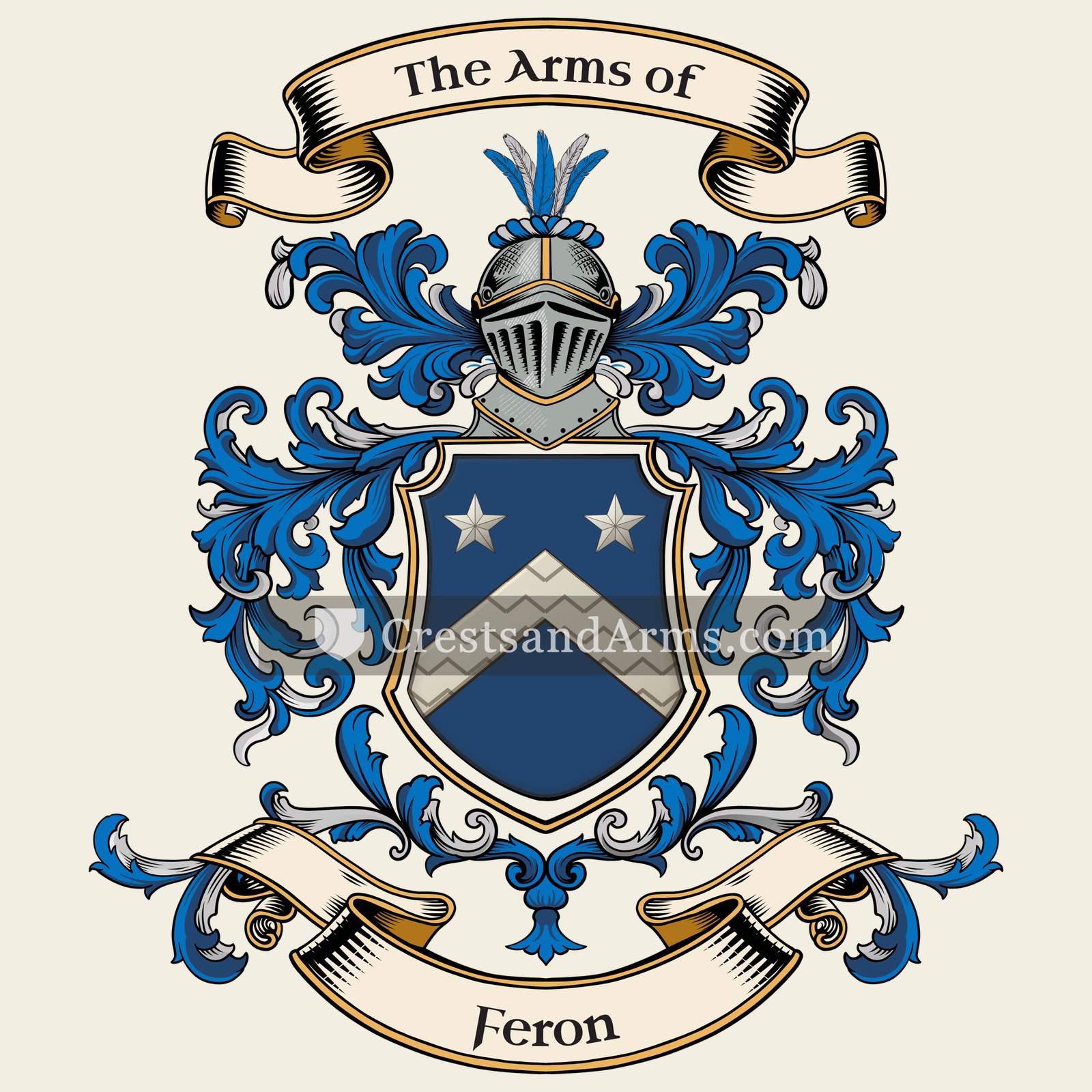


 chiefAuthority, wisdom and dominion
 griffinValour and vigilance, guarding great treasure