Map of France showing where the Ferra arms are recorded
The Ferra arms were recorded in France, c. 1663.
Arms such as these were typically recorded in Bretagne.
More families held coats of arms in Bretagne than anywhere else in France. The land was divided into many small estates rather than a few large ones, so far more households counted as gentry, and each needed a shield of its own to be told apart.
This is where the arms were entered in the register. Families often moved to other parts of the country, so the same name can turn up in more than one region.
The body that granted and recorded arms in France in this period.
Louis XIV of France
Sovereign of the period
Louis XIV of France
1643–1715
Reigning in France when the Ferra arms are first recorded.
How Arms Worked in France
In France, a coat of arms was a mark of honor that passed down through the male line to all legitimate descendants. Families often used the same shield without changes to show their shared heritage. If a branch wanted to stand out, they could add a small mark to their shield to show their specific place in the family tree.
Granting authority
The Juge d'armes de France acted as the official authority that regulated and verified coats of arms across the country.
How they got arms
Families typically inherited their arms from ancestors, though they could also receive them through royal grants or by proving their noble status.
Where arms were recorded
Coats of arms were officially recorded in the Armorial Général de France, which began its main collection in the year 1696.
The family's standing
Recorded among the armigerous families of France.
Origin & History of the Ferra Family in France
The family name Ferra has deep roots in the historical landscape of France, particularly within the rugged and culturally distinct region of Bretagne. By the mid-seventeenth century, records confirm that members of the Ferra family were established in this area, living through a time when the province maintained a unique identity under the French crown. The name itself is often linked to the Old French word for iron, which suggests that early ancestors may have been skilled metalworkers, blacksmiths, or individuals who lived near iron deposits. During the 1660s, life in Bretagne was defined by close-knit rural communities and a strong reliance on local trade and agriculture. As these early family members navigated the social structures of the time, they helped shape the local history of their parishes through their daily labor and community involvement. Their presence in the region during this era reflects the broader movement of families who built their lives and legacies in the western reaches of France long before the modern era.
Coat of Arms & Family Crest Details
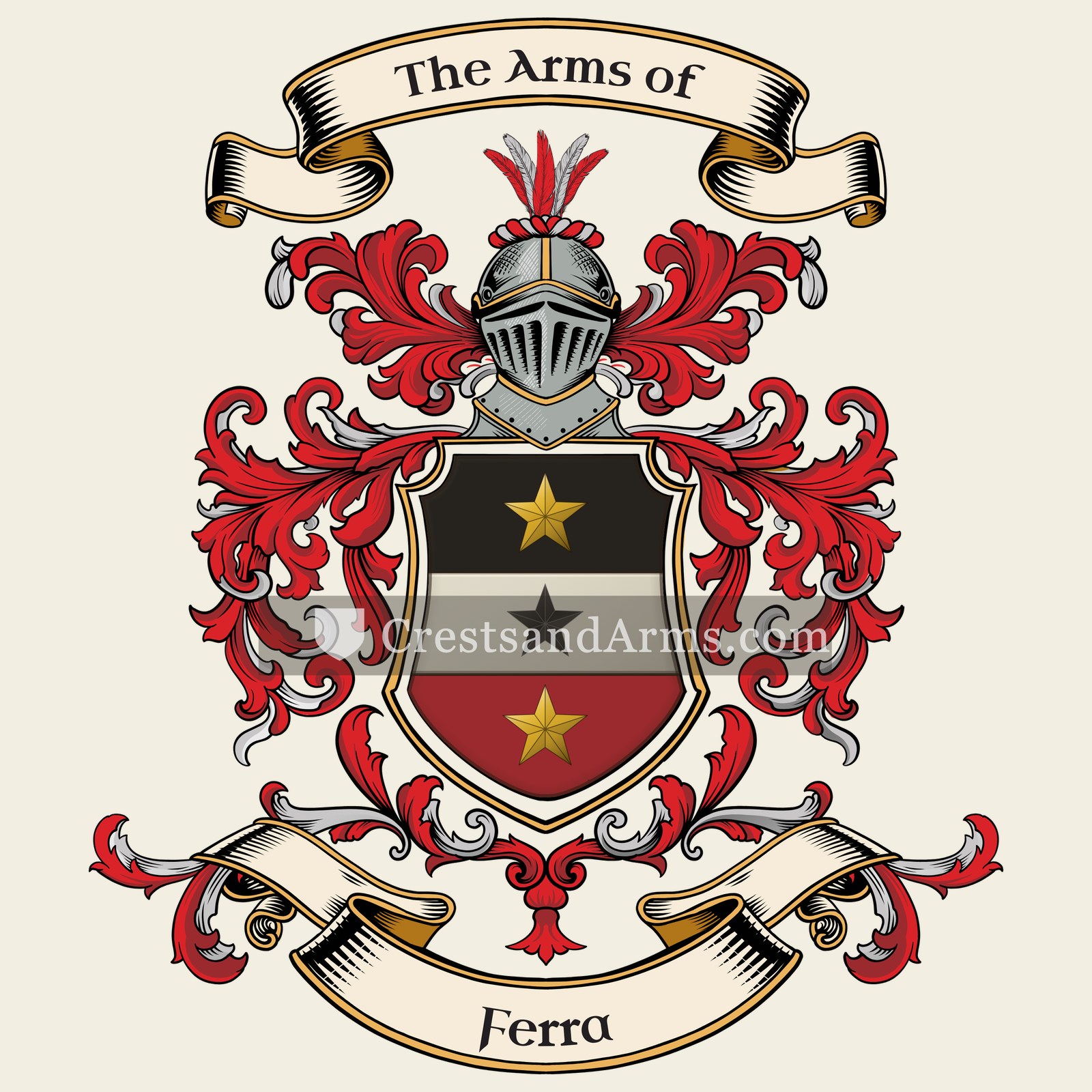
Symbols on this shield
fessThe military belt, and readiness to serve
mulletThe third son, and a divine quality from above
Colours
Black (Sable)Means: Constancy
Red (Gules)Means: Military strength
Silver (Argent)Means: Peace and sincerity
Gold (Or)Means: Generosity
Historical info
Source
J. B. Rietstap, Armorial Général, Gouda: G. B. van Goor Zonen, 1884–87
Blazon (the actual original written record)
“Coupé de sa. sur gu.; à la fasce d'arg., br. sur le coupé, ch. d'une étoile de sa. et acc. de deux étoiles d'or, 1 sur le sa. et 1 sur le gu.”
ItalyVérone, c. 1775
Digital archive packCoat of arms PNG, gold border print PDF, vector SVG and the certificate of authenticity. Sent to your email in minutes.
Map of Italy showing where the Ferra arms are recorded
The Ferra arms were recorded in Vérone, c. 1775.
This is where the arms were entered in the register. Families often moved to other parts of the country, so the same name can turn up in more than one region.
The body that granted and recorded arms in Italy in this period.
Alvise Giovanni Mocenigo
Sovereign of the period
Alvise Giovanni Mocenigo
1763–1778
Reigning in France when the Ferra arms are first recorded.
How Arms Worked in Italy
In the Italian states, coats of arms were often used by noble families to show their status and history. These symbols were passed down through the generations to all legitimate male descendants. Younger branches of a family usually kept the original design but sometimes added small changes to distinguish their specific line from the main branch.
Granting authority
Various local rulers and city governments controlled the use of coats of arms across the different Italian states.
How they got arms
Families often assumed their own arms or received them as official grants from local lords, popes, or city councils.
Where arms were recorded
Arms were recorded in local city archives or private family books rather than in one single national register.
The family's standing
Recorded among the armigerous families of Italy.
Origin & History of the Ferra Family in Italy
The family name Ferra has deep roots tied to the northern Italian region of Veneto, with documented evidence placing the family in the historic city of Verona by 1775. During this period, Verona served as a vital crossroads for trade and culture near the Adige River, which likely influenced the family's social and economic standing. The name itself is often associated with the Italian word for iron, suggesting that early ancestors may have been involved in metalworking, blacksmithing, or the regional iron trade that was essential to the local economy. As residents of a city under the influence of the Republic of Venice at the time, the Ferra family would have navigated a complex society defined by urban guilds and shifting political allegiances. By settling in such a prominent cultural hub, the family became part of the long history of artisans and merchants who helped build the architectural and social legacy of Verona.
Ferra Meaning & Related Branches
Root word
Ferrum
Latin word for iron or a metal tool.
This name
FerraAn occupational surname for a blacksmith or someone who worked with iron.
also spelled
Ferrae
Ferrah
Verra
Related arms
Feravariant spelling
Documented Sources
J. B. Rietstap, Armorial Général, Gouda: G. B. van Goor Zonen, 1884–87
Archives départementales d’Ille-et-Vilaine, Registres paroissiaux et d'état civil, 1663
Ogée, Jean, Dictionnaire historique et géographique de la province de Bretagne, 1778
Poterie, Henri, Histoire de la Bretagne, 1952
Digital archive packCoat of arms PNG, gold border print PDF, vector SVG and the certificate of authenticity. Sent to your email in minutes.


 fessThe military belt, and readiness to serve
 grasshopperNobility of birth and joy in the summer of life
 fessThe military belt, and readiness to serve
 grasshopperNobility of birth and joy in the summer of life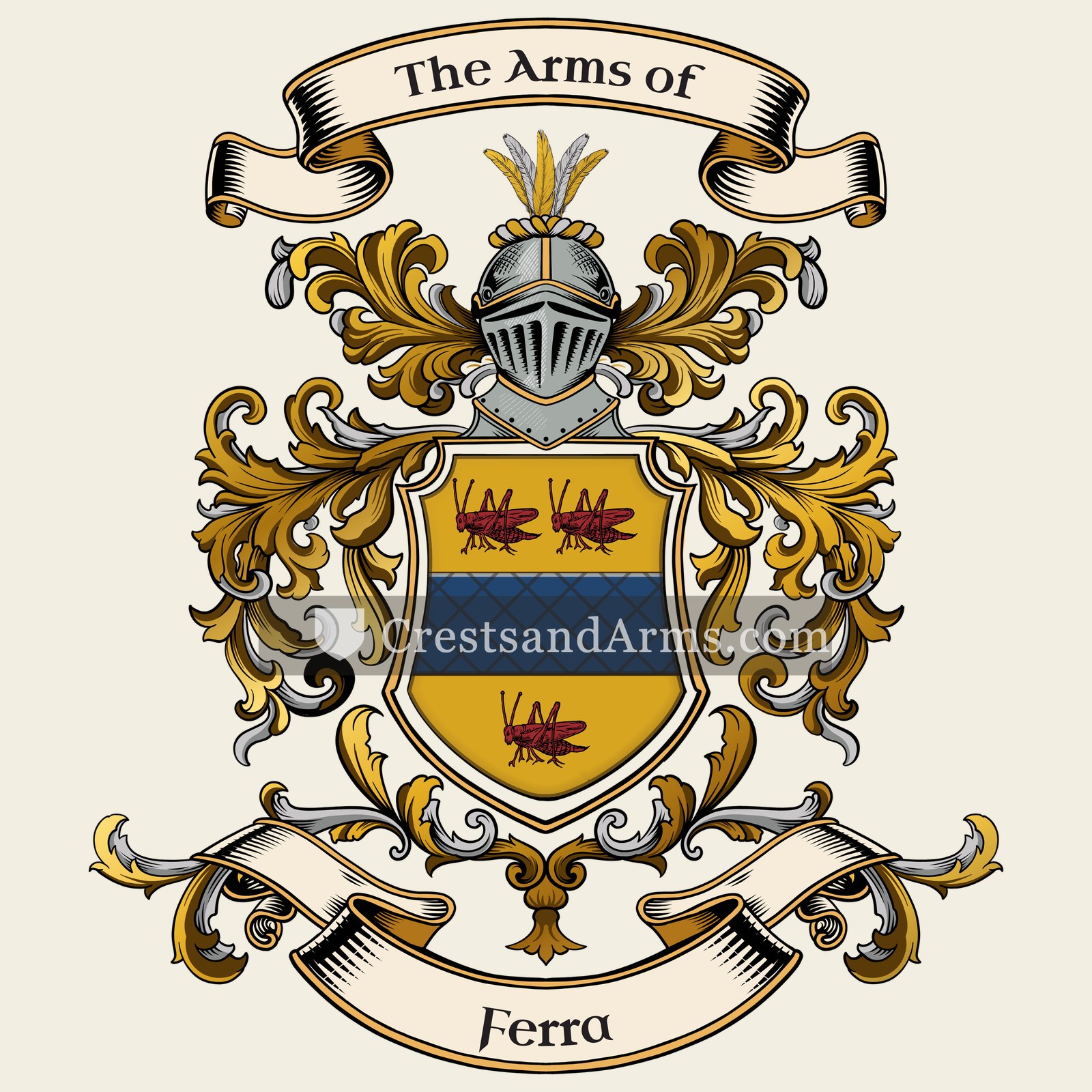


 mulletThe third son, and a divine quality from above