A record of documented arms, meaning and origin, researched for the Ferrand family lines. Documented in 3 countries.
Reg. 1581 · Dutch, D–F
Coat of Arms & Family Crest Details
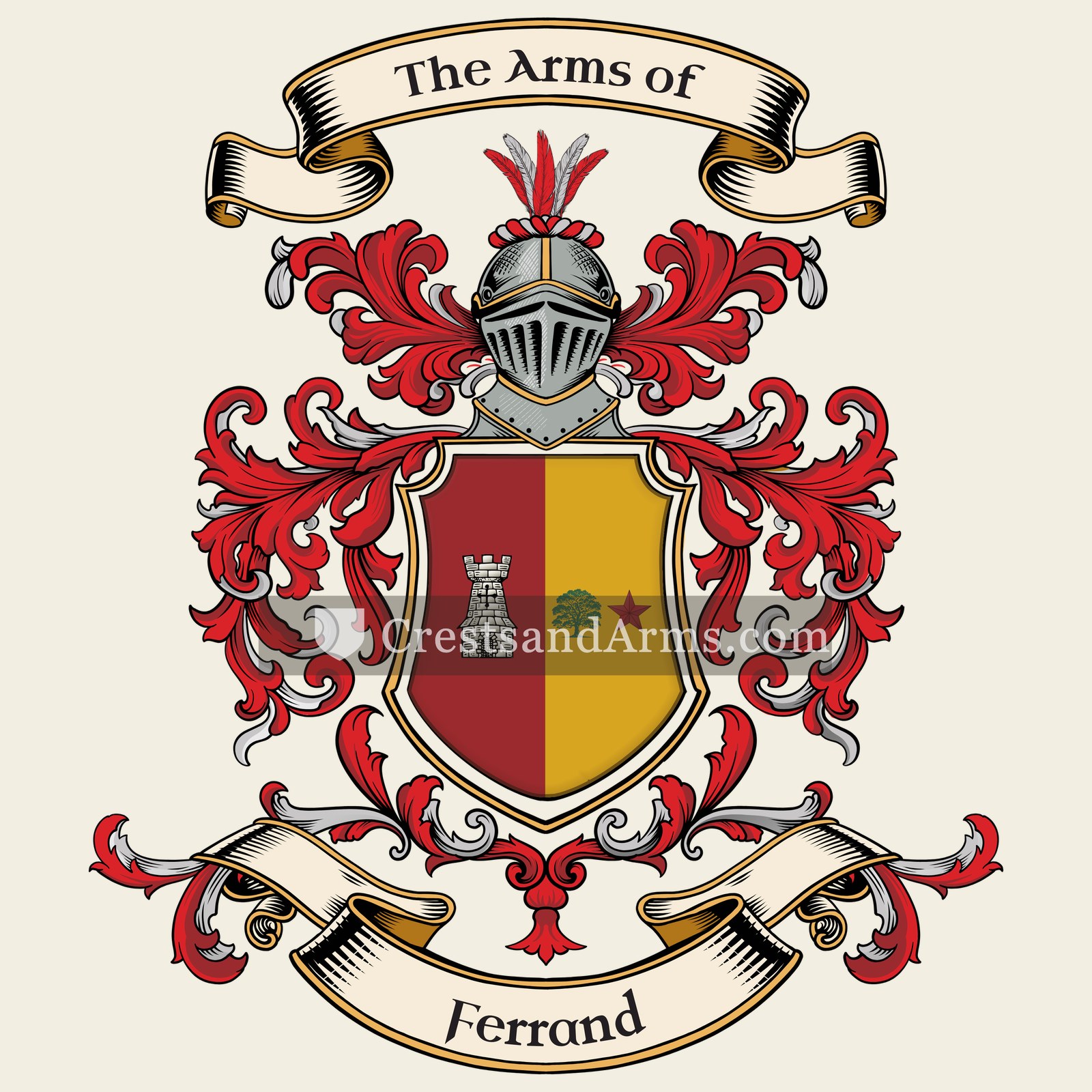
Symbols on this shield
towerGrandeur and solidity, and a stronghold defended
treeLife, endurance and deep roots
mulletThe third son, and a divine quality from above
Colours
Red (Gules)Means: Military strength
Gold (Or)Means: Generosity
Silver (Argent)Means: Peace and sincerity
Green (Vert)Means: Hope
Historical info
Source
J. B. Rietstap, Armorial Général, Gouda: G. B. van Goor Zonen, 1884–87
Blazon (the actual original written record)
“Parti: au 1 de gu. à une tour d'arg.; au 2 d'or à un arbre de sin., surm. d'une étoile de gu.”
Netherlandsc. 1815
Where the Ferrand Arms Were Recorded
Friesland
Map of Netherlands showing where the Ferrand arms are recorded
The Ferrand arms were recorded in Netherlands, c. 1815.
Arms such as these were typically recorded in Friesland.
Friesland was low, wet country on the northern coast of the Netherlands, farmed by families who had held the same land for centuries. Free landholders were unusually common there, and a free landholder could carry arms.
This is where the arms were entered in the register. Families often moved to other parts of the country, so the same name can turn up in more than one region.
Region
Friesland
First recorded
1815
Granting Authority for the Ferrand Arms
Hoge Raad van Adel
Photograph made by me · CC BY-SA 3.0
The body that granted and recorded arms in Netherlands in this period.
William I of the Netherlands
Sovereign of the period
William I of the Netherlands
1815–1840
Reigning in Netherlands when the Ferrand arms are first recorded.
How Arms Worked in Netherlands
In the Netherlands, coats of arms were often used by noble families and those who held specific public offices. These arms were passed down through the generations to legitimate descendants. Younger branches of a family usually kept the original design without needing to add special marks. This system ensured that the family identity remained clear and consistent over many years.
Granting authority
The Hoge Raad van Adel is the official body that regulates and manages noble titles and coats of arms in the Netherlands.
How they got arms
Families typically obtained their coats of arms through official royal grants or by proving their long-standing historical use of the symbols.
Where arms were recorded
Coats of arms are officially recorded in the registers held by the Hoge Raad van Adel, which began its work in 1814.
The family's standing
Recorded among the armigerous families of Netherlands.
Origin & History of the Ferrand Family in Netherlands
The family name Ferrand carries a history that stretches across Europe, eventually establishing a notable presence in the northern regions of the Netherlands. By the year 1815, records confirm that members of the Ferrand family were living in the province of Friesland. During this period, the Netherlands was undergoing significant administrative changes following the Napoleonic era, which led to the formal registration of surnames for civil records. While the name itself has roots in older linguistic traditions, its appearance in Frisian documents suggests that the family was part of the local social fabric during a time of transition for the Dutch state. These early ancestors were likely integrated into the professional or agricultural life of the region, contributing to the diverse cultural landscape of the northern provinces as the modern Dutch kingdom began to take shape.
Coat of Arms & Family Crest Details
Symbols on this shield
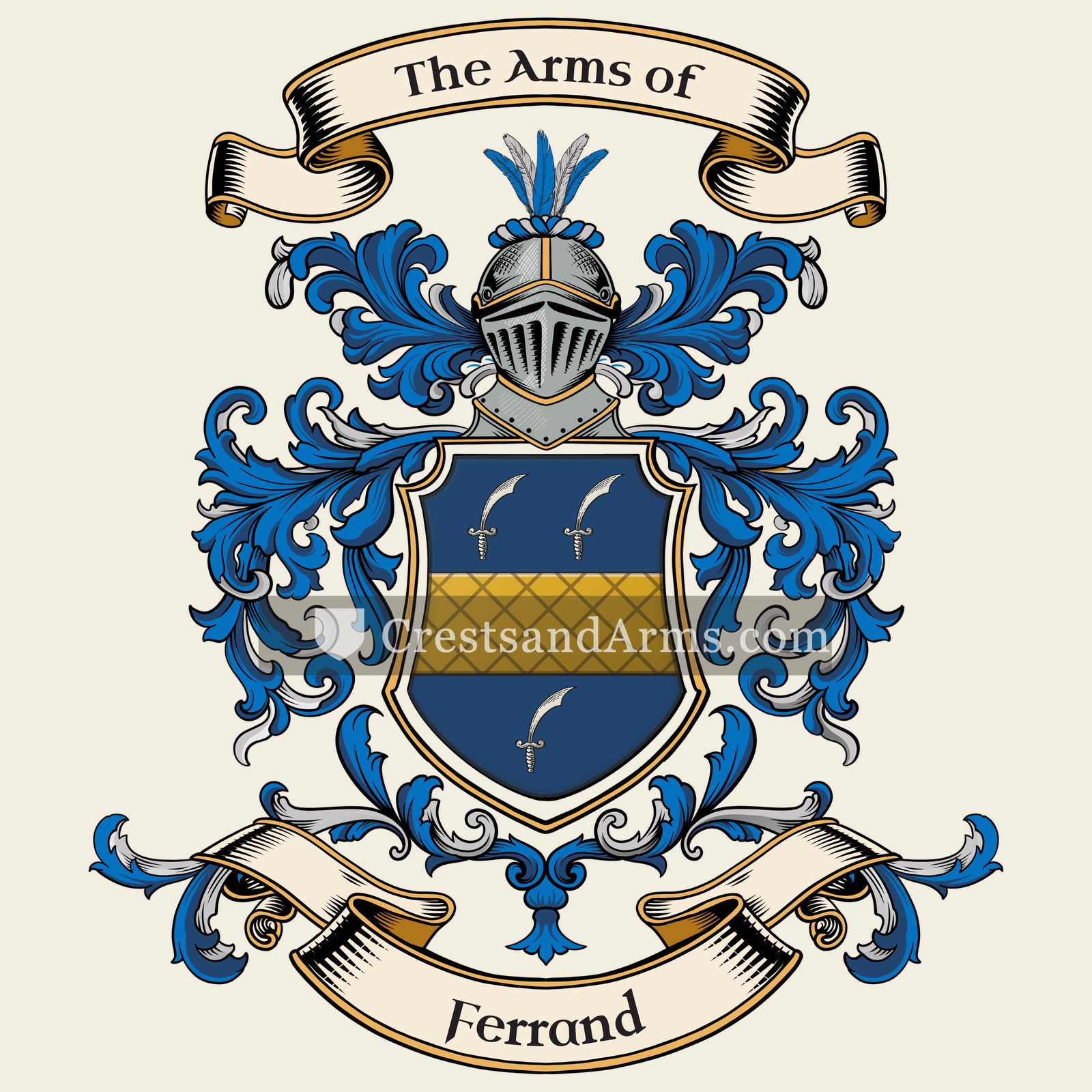
fessThe military belt, and readiness to serve
swordJustice, and military honour
Colours
Blue (Azure)Means: Loyalty and truth
Gold (Or)Means: Generosity
Silver (Argent)Means: Peace and sincerity
Historical info
Source
J. B. Rietstap, Armorial Général, Gouda: G. B. van Goor Zonen, 1884–87
Blazon (the actual original written record)
“D'azur à trois épées d'arg., garnies d'or, rangées en pal, celle de milieu la pointe en haut, les deux autres renv.; à la fasce d'or, br. sur le tout. D.: 1° PRO FIDE, PRO REGE, PRO ME; 2° NON FERIENT, SED TUEANTUR.”
Ile-de-FranceLuxemb · Ile-de-France, c. 1663
Where the Ferrand Arms Were Recorded
Ile-de-France
Map of France showing where the Ferrand arms are recorded
The Ferrand arms were recorded in Ile-de-France, c. 1663.
Ile-de-France is the country around Paris, and proximity to the court mattered. Families who served the crown were rewarded with land near it, and land near the capital carried arms almost as a matter of course.
This is where the arms were entered in the register. Families often moved to other parts of the country, so the same name can turn up in more than one region.
The body that granted and recorded arms in France in this period.
Louis XIV of France
Sovereign of the period
Louis XIV of France
1643–1715
Reigning in Netherlands when the Ferrand arms are first recorded.
How Arms Worked in France
In France, a coat of arms was a mark of honor that passed down through the male line to all legitimate descendants. Families often used the same shield without changes to show their shared heritage. If a branch wanted to stand out, they could add a small mark to their shield to show their specific place in the family tree.
Granting authority
The Juge d'armes de France acted as the official authority that regulated and verified coats of arms across the country.
How they got arms
Families typically inherited their arms from ancestors, though they could also receive them through royal grants or by proving their noble status.
Where arms were recorded
Coats of arms were officially recorded in the Armorial Général de France, which began its main collection in the year 1696.
The family's standing
Recorded among the armigerous families of Ile-de-France.
Origin & History of the Ferrand Family in France
The surname Ferrand has deep roots in the French language, originating as a descriptive nickname for individuals with iron-gray hair or those who possessed a strong, resilient nature similar to iron. By the mid-seventeenth century, the name was well-established in the Île-de-France region, which served as the cultural and political heart of the kingdom. Families bearing this name during this era often integrated into the local social fabric as skilled tradespeople, farmers, or minor officials who helped maintain the stability of the rural parishes surrounding Paris. Because the name was tied to a common physical trait, it emerged independently in several different provinces, allowing the Ferrand lineage to spread across the French landscape long before the modern era of standardized record-keeping. These early ancestors lived through a time of significant transition in France, witnessing the centralization of royal power under Louis XIV while maintaining their own distinct presence within their local communities.
Coat of Arms & Family Crest Details
Symbols on this shield
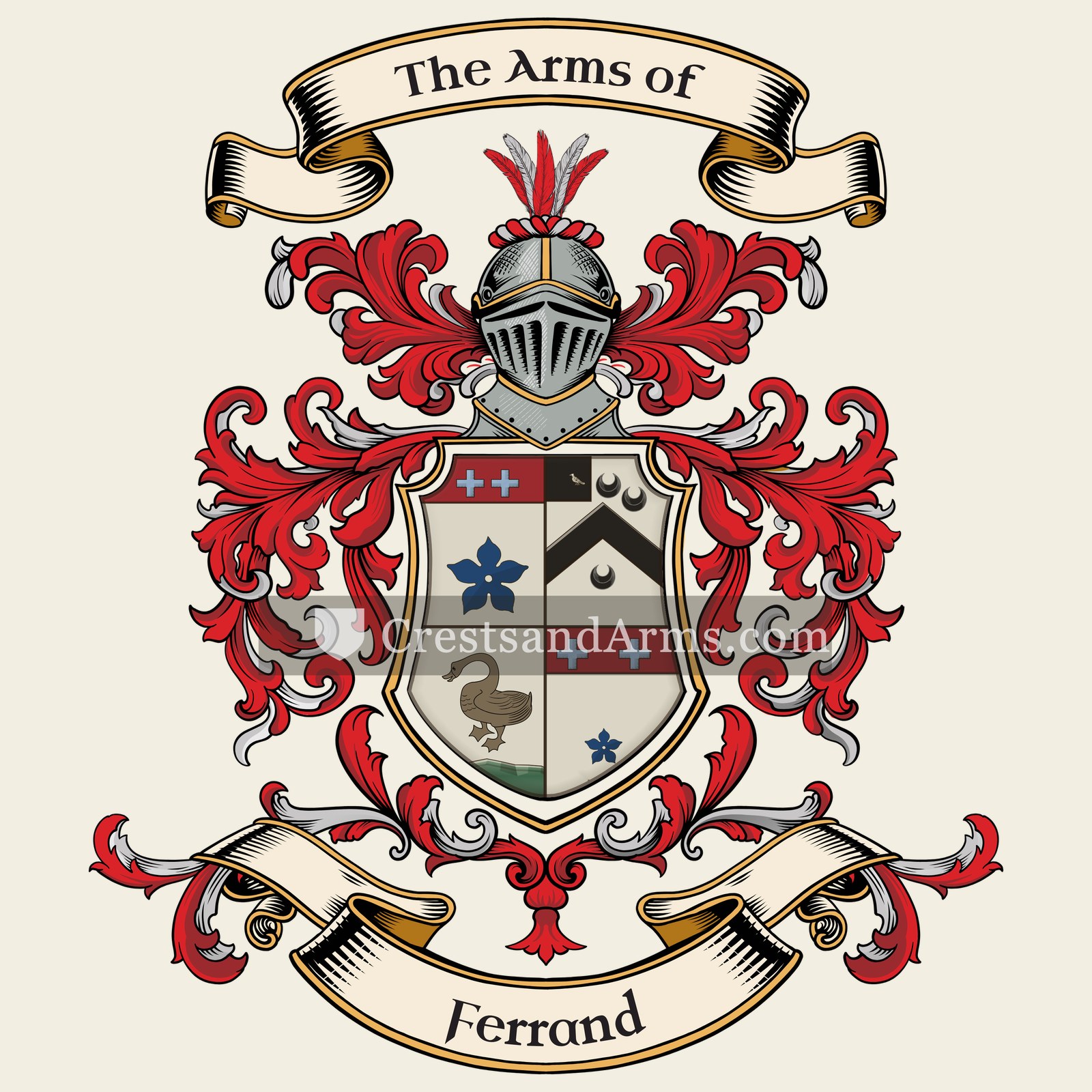
chiefAuthority, wisdom and dominion
cross symbolChristian faith and service
vairProtection, and the winter fur
chevronProtection, and faithful service completed
cantonA mark of honour granted by the sovereign
mountThe ground held, and steadfastness upon it
cinquefoilHope and joy
crescentHonour by the sovereign, and the second son
dovePeace, love and the Holy Spirit
swanGrace, light and the poet's art
Colours
Silver (Argent)Means: Peace and sincerity
Red (Gules)Means: Military strength
Black (Sable)Means: Constancy
Green (Vert)Means: Hope
VairMeans: Protection
Blue (Azure)Means: Loyalty and truth
Historical info
Source
Sir Bernard Burke, The General Armory of England, Scotland, Ireland and Wales, London: Harrison & Sons, 1884
Blazon (the actual original written record)
“Quarterly, 1st and 4th, ar. on a chief gu. two crosses flory vair a cinquefoil az. (Dugdale's Visit. co. York); but more commonly used as patonce vair without the cinquefoil, for FERRAND; 2nd, ar. a chev. betw. three crescents sa. on a canton of the second a dove with an olive branch ppr., for WALKER; 3rd, gu. on a mount vert a swan close ppr. ducally gorged and chained or, for DALE, of Dalton le Dale”
YorkYork, c. 1586
Where the Ferrand Arms Were Recorded
York
Map of England showing where the Ferrand arms are recorded
The Ferrand arms were recorded in York, c. 1586.
Yorkshire is the largest of the English counties, and it held more gentry families than any other. Land there was split among a great many households rather than a few, so a great many of them carried arms.
This is where the arms were entered in the register. Families often moved to other parts of the country, so the same name can turn up in more than one region.
The body that granted and recorded arms in England in this period.
Elizabeth I of England
Sovereign of the period
Elizabeth I of England
1558–1603
Reigning in Netherlands when the Ferrand arms are first recorded.
How Arms Worked in England
English heraldry allowed arms to be shared by all legitimate descendants of the original owner. These symbols were treated as personal property that moved through the generations to all children. While the eldest son kept the original design, other family members could use the same shield without needing to change it or register their own unique versions.
Granting authority
The College of Arms in London has regulated the use of coats of arms throughout England and Wales since 1484.
How they got arms
Families typically obtained their coats of arms through a formal grant from the Crown or by proving their ancient right to them.
Where arms were recorded
All official coats of arms are recorded in the registers kept at the College of Arms, which date back to the fifteenth century.
The family's standing
Recorded among the armigerous families of York.
Origin & History of the Ferrand Family in England
The Ferrand family name has roots that stretch back to the northern regions of England, where the family established a notable presence by the late sixteenth century. Records confirm that members of the Ferrand family were living in York by 1586, a time when the city served as a vital hub for trade and administration in the north. The name itself is believed to be derived from an Old French nickname, likely referring to the color iron-gray or a person with a stubborn temperament. As the family settled into Yorkshire, they became integrated into the local social and economic life of the region. Over the following generations, the Ferrands transitioned from their early documented appearances in city records to becoming landowners and prominent figures in the local community. Their history reflects the broader movement of families who helped shape the identity of northern England through their involvement in local governance and agriculture.
Related Branches & Arms
Root word
Ferdinandus
Derived from Germanic elements meaning brave or bold journey.
This name
FerrandA patronymic surname indicating descent from a person named Ferdinand, signifying a bold traveler.
also spelled
Ferrant
Ferand
Ferran
Related arms
Ferrantvariant spelling
Allamontrecorded with Ferrand, same area
Beckrecorded with Ferrand, same area
Boulayrecorded with Ferrand, same area
Documented Sources
J. B. Rietstap, Armorial Général, Gouda: G. B. van Goor Zonen, 1884–87
Tresoar (Fries Historisch en Letterkundig Centrum), Burgerlijke Stand van Friesland
Netherlands Nationaal Archief, Registers van de Burgerlijke Stand
Digital archive packCoat of arms PNG, gold border print PDF, vector SVG and the certificate of authenticity. Sent to your email in minutes.


 towerGrandeur and solidity, and a stronghold defended
 treeLife, endurance and deep roots
 mulletThe third son, and a divine quality from above
 towerGrandeur and solidity, and a stronghold defended
 treeLife, endurance and deep roots
 mulletThe third son, and a divine quality from above

 fessThe military belt, and readiness to serve
 swordJustice, and military honour

 chiefAuthority, wisdom and dominion
 cross symbolChristian faith and service
 chevronProtection, and faithful service completed
 cantonA mark of honour granted by the sovereign
 mountThe ground held, and steadfastness upon it
 cinquefoilHope and joy
 crescentHonour by the sovereign, and the second son
 dovePeace, love and the Holy Spirit
 swanGrace, light and the poet's art