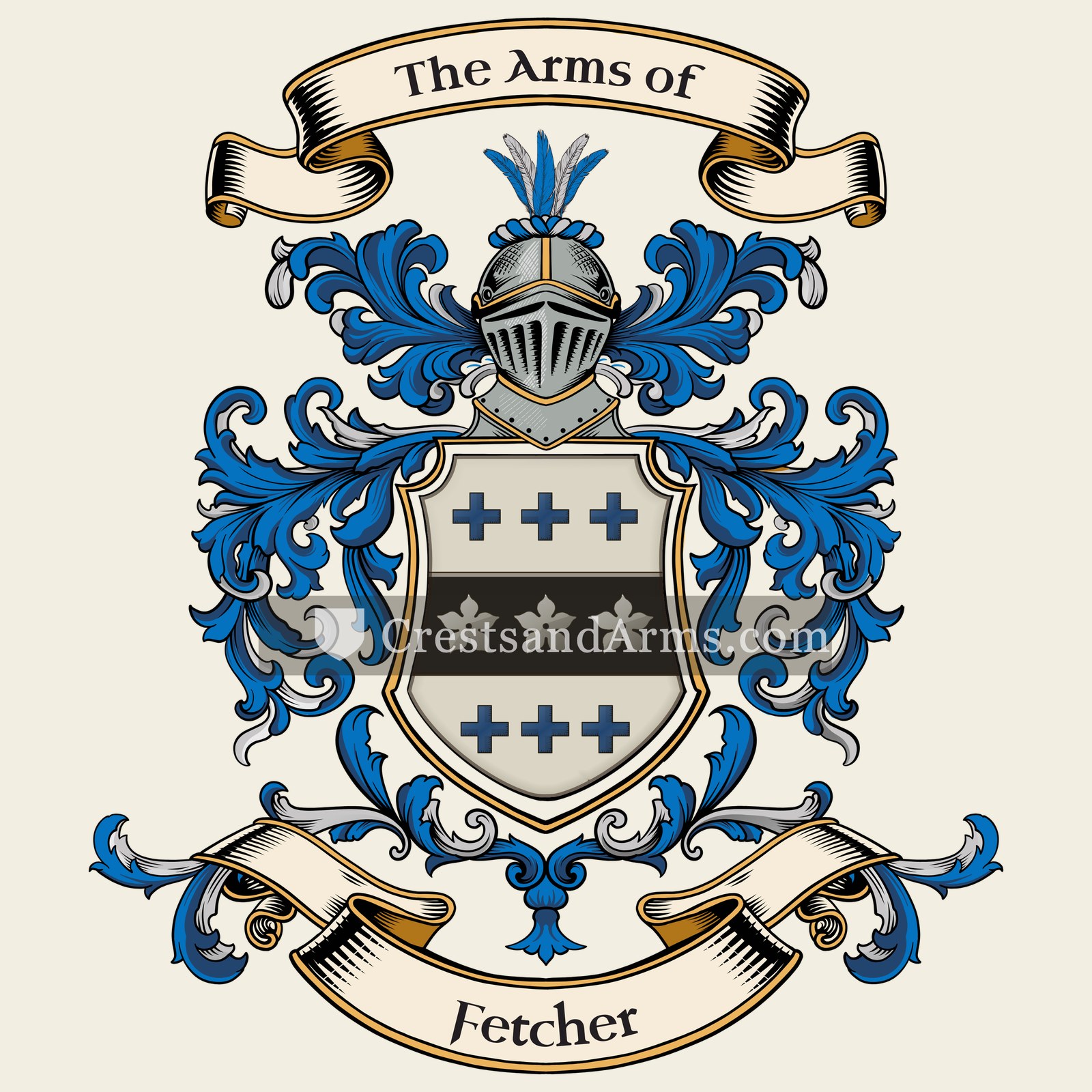
A record of documented arms, meaning and origin, researched for the Fetcher family of France.
Reg. 4273 · French, D–F
Coat of Arms & Family Crest Details
Symbols on this shield
fessThe military belt, and readiness to serve
cross symbolChristian faith and service
cinquefoilHope and joy
Colours
Silver (Argent)Means: Peace and sincerity
Black (Sable)Means: Constancy
Blue (Azure)Means: Loyalty and truth
Historical info
Source
Sir Bernard Burke, The General Armory of England, Scotland, Ireland and Wales, London: Harrison & Sons, 1884
Blazon (the actual original written record)
“Ar. on a fesse sa. betw. six crosses crosslet az. (another, gu.) three cinquefoils of the field”
FranceCalais, c. 1663
Where the Fetcher Arms Were Recorded
Calais
Map of France showing where the Fetcher arms are recorded
The Fetcher arms were recorded in Calais, c. 1663.
This is where the arms were entered in the register. Families often moved to other parts of the country, so the same name can turn up in more than one region.
The body that granted and recorded arms in France in this period.
Louis XIV of France
Sovereign of the period
Louis XIV of France
1643–1715
Reigning in France when the Fetcher arms are first recorded.
How Arms Worked in France
In France, a coat of arms was a mark of honor that passed down through the male line to all legitimate descendants. Families often used the same shield without changes to show their shared heritage. If a branch wanted to stand out, they could add a small mark to their shield to show their specific place in the family tree.
Granting authority
The Juge d'armes de France acted as the official authority that regulated and verified coats of arms across the country.
How they got arms
Families typically inherited their arms from ancestors, though they could also receive them through royal grants or by proving their noble status.
Where arms were recorded
Coats of arms were officially recorded in the Armorial Général de France, which began its main collection in the year 1696.
The family's standing
Recorded among the armigerous families of France.
Origin & History of the Fetcher Family in France
The name Fetcher is rooted in the medieval trade of archery, as it originates from the Old French word *feschier*, which describes a person who manufactured arrows. By the mid-seventeenth century, members of the family were firmly established in the port city of Calais. This location was a vital hub for trade and military movement between England and France during the 1660s. Families living in Calais at this time often navigated a complex cultural landscape, as the city had transitioned between English and French control in previous centuries. The presence of the Fetcher name in this region suggests that these early ancestors were likely skilled artisans or merchants who contributed to the logistical needs of a busy coastal town. Their ability to maintain a presence in such a strategic location indicates that the family was well-integrated into the local economy and social structure of the era.
Related Branches & Arms
Root word
fais
Derived from the Old French verb faissier meaning to make or fashion.
This name
FetcherAn occupational surname for a maker or creator of goods.
also spelled
Fecher
Feccher
Phetcher
Fetscher
Related arms
Fechervariant spelling
Hubartrecorded with Fetcher, same area
Turpinrecorded with Fetcher, same area
Documented Sources
Sir Bernard Burke, The General Armory of England, Scotland, Ireland and Wales, London: Harrison & Sons, 1884
Archives départementales du Pas-de-Calais, Registres paroissiaux et d'état civil de Calais, 1663
Dauzat, Albert, Dictionnaire étymologique des noms et prénoms de France, 1951
Reaney, Percy Hide, A Dictionary of British Surnames, 1958
Digital archive packCoat of arms PNG, gold border print PDF, vector SVG and the certificate of authenticity. Sent to your email in minutes.


 fessThe military belt, and readiness to serve
 cross symbolChristian faith and service
 cinquefoilHope and joy
 fessThe military belt, and readiness to serve
 cross symbolChristian faith and service
 cinquefoilHope and joy