A record of documented arms, meaning and origin, researched for the Fichter family lines. Documented in 2 countries.
Reg. 4662 · Swiss, D–F
Coat of Arms & Family Crest Details
Symbols on this shield
mountThe ground held, and steadfastness upon it
treeLife, endurance and deep roots
Colours
Red (Gules)Means: Military strength
Green (Vert)Means: Hope
Historical info
Source
J. B. Rietstap, Armorial Général, Gouda: G. B. van Goor Zonen, 1884–87
Blazon (the actual original written record)
“De gu. à un sapin de sin., sur un tertre du même. Brl. de gu. et de sin. C.: un homme iss., hab. de gu., ceint et rebr. de sin., au rabat du même, coiffé d'un bonnet pointu de gu., retr. de sin., tenant un sapin arr. du même; entre deux prob. coupées alt. de gu. et de sin. L. de sin. et de gu.”
SwitzerlandBâle, c. 1745
Digital archive packCoat of arms PNG, gold border print PDF, vector SVG and the certificate of authenticity. Sent to your email in minutes.
Map of Switzerland showing where the Fichter arms are recorded
The Fichter arms were recorded in Bâle, c. 1745.
This is where the arms were entered in the register. Families often moved to other parts of the country, so the same name can turn up in more than one region.
The body that granted and recorded arms in Switzerland in this period.
How Arms Worked in Switzerland
In Switzerland, coats of arms were not restricted to the nobility and were often adopted by common citizens and families. These symbols were passed down through generations to show family identity. When branches of a family grew, they often changed small details of the design to distinguish their own line from the original group.
Granting authority
Cantonal and civic authorities managed the use of coats of arms within their specific regions and local jurisdictions.
How they got arms
Families typically assumed their own coats of arms based on local custom rather than receiving them from a central monarch.
Where arms were recorded
Arms were recorded in various cantonal and civic registers starting from the fourteenth century throughout the Swiss region.
The family's standing
Recorded among the armigerous families of Switzerland.
Origin & History of the Fichter Family in Switzerland
The family name Fichter has deep roots in the Swiss region, particularly within the city of Basel. By the year 1745, members of the Fichter family were already established as active participants in the local community. The name itself is thought to be derived from the German word for the spruce tree, which suggests that the earliest ancestors may have lived near a prominent forest or worked in the timber trade. During the eighteenth century, Basel was a thriving center for trade and craftsmanship, and families like the Fichters often held roles in the city’s guilds or local administration. These early records show that the family was well-integrated into the social and economic life of the region, contributing to the steady growth and development of the city during a time of significant transition in Swiss history.
Coat of Arms & Family Crest Details
Symbols on this shield
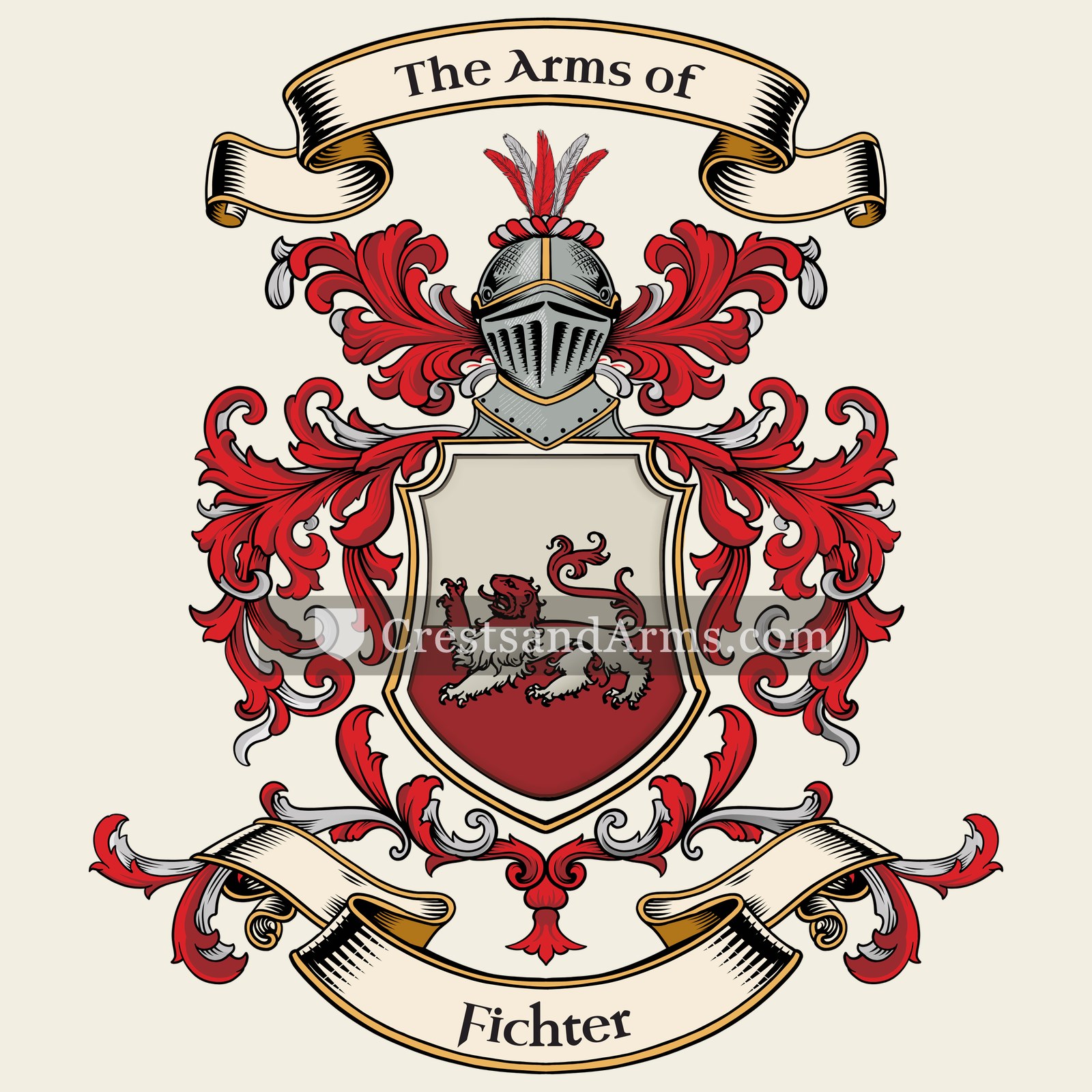
lionCourage, strength and royalty
Colours
Silver (Argent)Means: Peace and sincerity
Red (Gules)Means: Military strength
Historical info
Source
J. B. Rietstap, Armorial Général, Gouda: G. B. van Goor Zonen, 1884–87
Blazon (the actual original written record)
“Coupé d'arg. sur gu.; à une panthère héraldique de l'un en l'autre. Cq. cour. C.: la panthère iss., entre un vol à l'antique coupé d'arg. sur gu.”
AustriaKitzbühl Tirol, c. 1772
Digital archive packCoat of arms PNG, gold border print PDF, vector SVG and the certificate of authenticity. Sent to your email in minutes.
Map of Austria showing where the Fichter arms are recorded
The Fichter arms were recorded in Kitzbühl Tirol, c. 1772.
This is where the arms were entered in the register. Families often moved to other parts of the country, so the same name can turn up in more than one region.
Region
Kitzbühl
Town
Kitzbühl Tirol
First recorded
1772
Granting Authority for the Fichter Arms
Imperial and Royal chancery
Sodacan · CC BY-SA 3.0
The body that granted and recorded arms in Austria in this period.
Joseph II, Holy Roman Emperor
Sovereign of the period
Joseph II, Holy Roman Emperor
1765–1790
Reigning in Switzerland when the Fichter arms are first recorded.
How Arms Worked in Austria
Austrian coats of arms were often linked directly to noble titles granted by the Emperor. These symbols belonged to the entire family line rather than just one individual. When a family grew, new branches kept the original design without needing to change it. This system allowed all members of a noble house to share the same identity across many generations.
Granting authority
The Imperial and Royal chancery managed all heraldic matters and controlled the official granting of arms throughout the Austrian lands.
How they got arms
Families typically received their arms through a formal imperial decree that often accompanied the elevation of a person to noble status.
Where arms were recorded
Official records of these grants were kept in the Imperial Register of Nobility which began its formal documentation process in 1453.
The family's standing
Recorded among the armigerous families of Austria.
Origin & History of the Fichter Family in Austria
The Fichter family name has deep roots in the mountainous landscape of the Austrian Tyrol, where the name appears in historical records as early as the eighteenth century. By 1772, members of the family were firmly established in the town of Kitzbühel, a region known for its long history of silver and copper mining. The name Fichter is likely derived from the German word for the spruce tree, which suggests that the family’s earliest ancestors may have lived near dense evergreen forests or worked in the timber industry that sustained the local economy. During this period, families in the Tyrol often identified themselves by their proximity to specific natural landmarks or their trade. Living in Kitzbühel placed the Fichter family at the heart of a bustling Alpine community that served as a vital trade link between the Bavarian lands and the rest of the Austrian Empire. This geographic placement allowed the family to participate in the growth of a region that was transitioning from a mining hub into a center for regional commerce and agriculture.
Fichter Meaning & Related Branches
Root word
Fichte
A type of coniferous evergreen tree known as a spruce.
This name
FichterAn occupational or topographic name for someone who lived near or worked with spruce trees.
also spelled
Fichte
Ficht
Related arms
Breitenbergerrecorded with Fichter, same area
Christmannrecorded with Fichter, same area
Hackrecorded with Fichter, same area
Hoysonrecorded with Fichter, same area
Documented Sources
J. B. Rietstap, Armorial Général, Gouda: G. B. van Goor Zonen, 1884–87
Familiennamenbuch der Schweiz, Familiennamenbuch der Schweiz, 1989
Burckhardt, A., Bürgerbuch der Stadt Basel, 1928
Staatsarchiv Basel-Stadt, Bürgerverzeichnisse und Einwohnerregister
Digital archive packCoat of arms PNG, gold border print PDF, vector SVG and the certificate of authenticity. Sent to your email in minutes.


 mountThe ground held, and steadfastness upon it
 treeLife, endurance and deep roots
 mountThe ground held, and steadfastness upon it
 treeLife, endurance and deep roots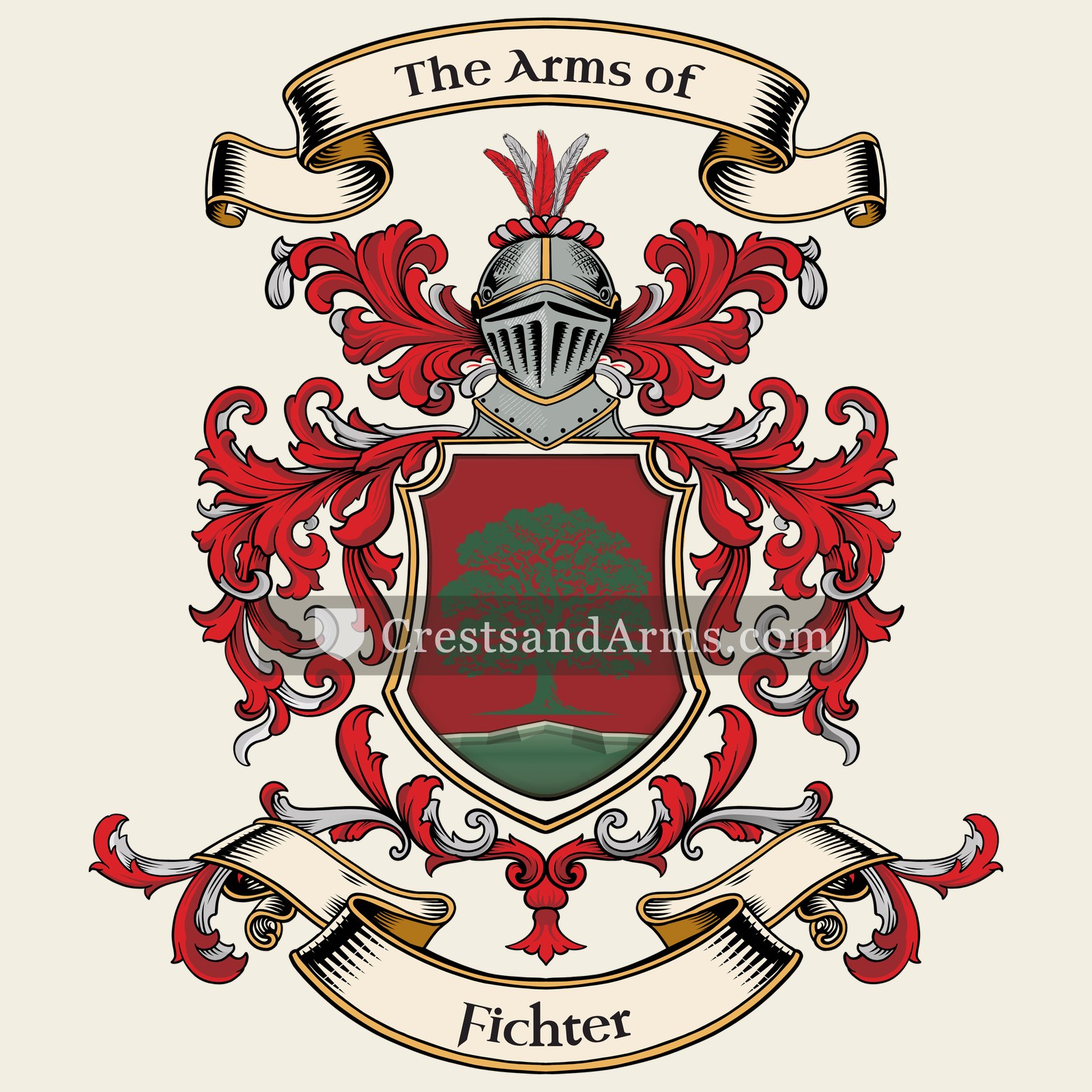

 lionCourage, strength and royalty