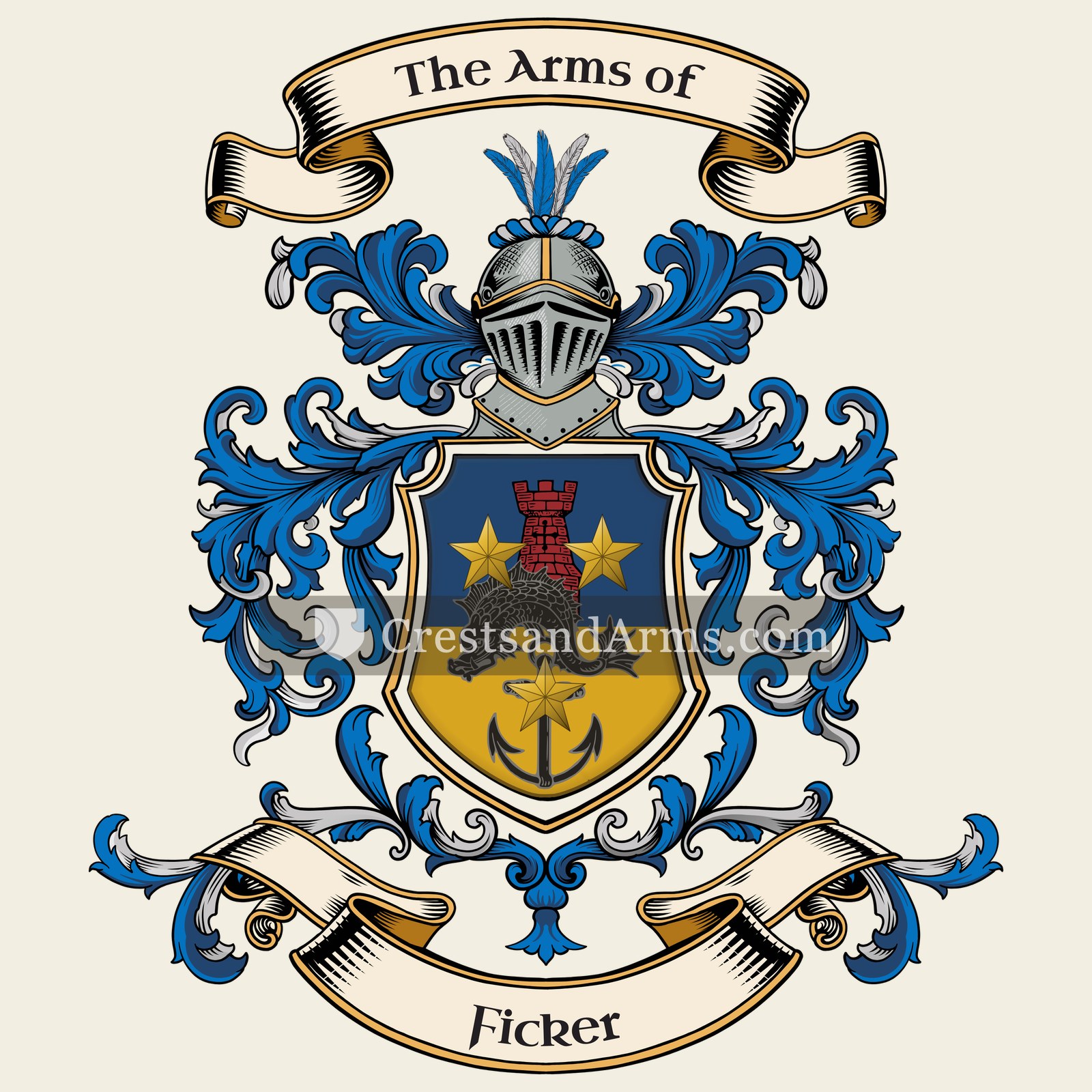
A record of documented arms, meaning and origin, researched for the Ficker family of Denmark.
Reg. 7571 · Danish, D–F
Coat of Arms & Family Crest Details
Symbols on this shield
dolphinSwiftness, charity and love
mulletThe third son, and a divine quality from above
towerGrandeur and solidity, and a stronghold defended
anchorHope, and steadfastness in trouble
Colours
Blue (Azure)Means: Loyalty and truth
Gold (Or)Means: Generosity
Black (Sable)Means: Constancy
Red (Gules)Means: Military strength
Historical info
Source
J. B. Rietstap, Armorial Général, Gouda: G. B. van Goor Zonen, 1884–87
Blazon (the actual original written record)
“Coupé: au 1 parti: a. d'azur à un mur de gu.; b. d'or à une ancre et un mousquet, passés en saut., br. sur un canon; au 2 d'arg. à un dauphin de sa. dans une eau au nat., surm. de trois étoiles d'or, 2 et 1. Cq. cour. C.: une étoile d'or, entre deux drapeaux danois.”
Denmarkc. 1797
Digital archive packCoat of arms PNG, gold border print PDF, vector SVG and the certificate of authenticity. Sent to your email in minutes.
Map of Denmark showing where the Ficker arms are recorded
The Ficker arms were recorded in Denmark, c. 1797.
Arms such as these were typically recorded in Sjaælland.
Zealand held the Danish court, the crown's offices and Copenhagen itself. Families who served the king kept estates within reach of it, and royal service was the ordinary route to a coat of arms.
This is where the arms were entered in the register. Families often moved to other parts of the country, so the same name can turn up in more than one region.
The body that granted and recorded arms in Denmark in this period.
Christian VII of Denmark
Sovereign of the period
Christian VII of Denmark
1766–1808
Reigning in Denmark when the Ficker arms are first recorded.
How Arms Worked in Denmark
Danish heraldry during this period was closely tied to noble status and royal favor rather than being open to all citizens. Arms were typically granted by the monarch to individuals, and these symbols were then shared by all members of the noble house. If a family line died out, the right to use those specific arms ended with them.
Granting authority
The Danish royal chancery held the power to issue and regulate official coats of arms for the kingdom.
How they got arms
Families usually received their arms through a formal royal grant that confirmed their noble status and rights.
Where arms were recorded
These grants were officially recorded in the Danish Royal Chancery records starting in the sixteenth century.
The family's standing
Recorded among the armigerous families of Denmark.
Origin & History of the Ficker Family in Denmark
The surname Ficker is rooted in the linguistic traditions of German-speaking regions, where it likely originated as a descriptive occupational or personal name. Historically, the term is linked to the Middle High German word "ficken," which could refer to someone who moved quickly or worked with a specific type of weaving tool. By the late 18th century, the family had established a presence in the Danish region of Sjælland, as evidenced by records from 1797. During this era, families often moved across borders for trade or military service, which explains how the name migrated from its German origins into the social fabric of Denmark. These early ancestors in Sjælland were part of a period of transition where surnames became more permanent fixtures for record-keeping in local parishes and government censuses.
Related Branches & Arms
Root word
Ficke
A diminutive form of the Germanic name Friedrich meaning peaceful ruler.
This name
FickerA patronymic or occupational surname derived from a nickname for a person of small stature or status.
also spelled
Fysker
Fisk
Documented Sources
J. B. Rietstap, Armorial Général, Gouda: G. B. van Goor Zonen, 1884–87
Danish National Archives (Rigsarkivet), Folketælling 1787 and 1801
Gottschald, Max, Deutsche Namenkunde: Unsere Familiennamen nach ihrer Entstehung und Bedeutung, 1971
Heintze, Albert, Die deutschen Familiennamen: geschichtlich, geographisch, sprachlich, 1903
Digital archive packCoat of arms PNG, gold border print PDF, vector SVG and the certificate of authenticity. Sent to your email in minutes.


 dolphinSwiftness, charity and love
 mulletThe third son, and a divine quality from above
 towerGrandeur and solidity, and a stronghold defended
 anchorHope, and steadfastness in trouble
 dolphinSwiftness, charity and love
 mulletThe third son, and a divine quality from above
 towerGrandeur and solidity, and a stronghold defended
 anchorHope, and steadfastness in trouble