A record of documented arms, meaning and origin, researched for the Fiedler family lines. Documented in 2 countries.
Reg. 7749 · Austrian, D–F
Coat of Arms & Family Crest Details
Symbols on this shield
mountThe ground held, and steadfastness upon it
knightChivalry and service in arms
mulletThe third son, and a divine quality from above
Colours
Silver (Argent)Means: Peace and sincerity
Blue (Azure)Means: Loyalty and truth
Green (Vert)Means: Hope
Gold (Or)Means: Generosity
Historical info
Source
J. B. Rietstap, Armorial Général, Gouda: G. B. van Goor Zonen, 1884–87
Blazon (the actual original written record)
“D'arg. à un chevalier, arm. de toutes pièces, le casque panaché de trois pl. d'aut. de gu., tenant de sa main dextre une épée d'arg., monté sur un cheval bai, bridé de sa., caparaçonné d'une housse de gu., bordée d'or, galopant sur une terrasse de sin.; le champ chaperonné-ployé d'azur, à deux étoiles d'or. Trois cq. cour. C.: 1º un vol cont. d'azur, chaque aile ch. d'une étoile d'or; 2º un senestrochère arm., posé sur le coude et tenant une épée, le tout au nat.; 3º trois pl. d'aut.”
Austriac. 1839
Digital archive packCoat of arms PNG, gold border print PDF, vector SVG and the certificate of authenticity. Sent to your email in minutes.
Map of Austria showing where the Fiedler arms are recorded
The Fiedler arms were recorded in Austria, c. 1839.
Arms such as these were typically recorded in Tyrol.
Tyrol was mountain country in western Austria, where the valleys were held by families who had been there a very long time. Old tenure counted for more than money, and old families carried arms.
This is where the arms were entered in the register. Families often moved to other parts of the country, so the same name can turn up in more than one region.
Region
Tyrol
First recorded
1839
Granting Authority for the Fiedler Arms
Imperial and Royal chancery
Sodacan · CC BY-SA 3.0
The body that granted and recorded arms in Austria in this period.
Ferdinand I of Austria
Sovereign of the period
Ferdinand I of Austria
1835–1848
Reigning in Austria when the Fiedler arms are first recorded.
How Arms Worked in Austria
Austrian coats of arms were often linked directly to noble titles granted by the Emperor. These symbols belonged to the entire family line rather than just one individual. When a family grew, new branches kept the original design without needing to change it. This system allowed all members of a noble house to share the same identity across many generations.
Granting authority
The Imperial and Royal chancery managed all heraldic matters and controlled the official granting of arms throughout the Austrian lands.
How they got arms
Families typically received their arms through a formal imperial decree that often accompanied the elevation of a person to noble status.
Where arms were recorded
Official records of these grants were kept in the Imperial Register of Nobility which began its formal documentation process in 1453.
The family's standing
Recorded among the armigerous families of Austria.
Origin & History of the Fiedler Family in Austria
The surname Fiedler originates from the Middle High German word *videlaere*, which translates to a person who plays the fiddle. During the Middle Ages, this name was often given as an occupational descriptor for traveling musicians or entertainers who performed in town squares and at local festivals. By the time members of the family were documented in the Tyrol region of Austria in 1839, the name had long transitioned from a job title to a hereditary surname passed down through generations. In the mountainous landscape of Tyrol, families with this name were often integrated into the local agrarian and artisan communities. These early ancestors likely lived in small villages where they contributed to the social fabric of the region as skilled laborers or tradespeople. The presence of the Fiedler name in 19th-century Austrian records reflects a period of increased administrative tracking, as the government began to more formally document the movement and residency of families across the Alpine provinces.
Coat of Arms & Family Crest Details
Symbols on this shield
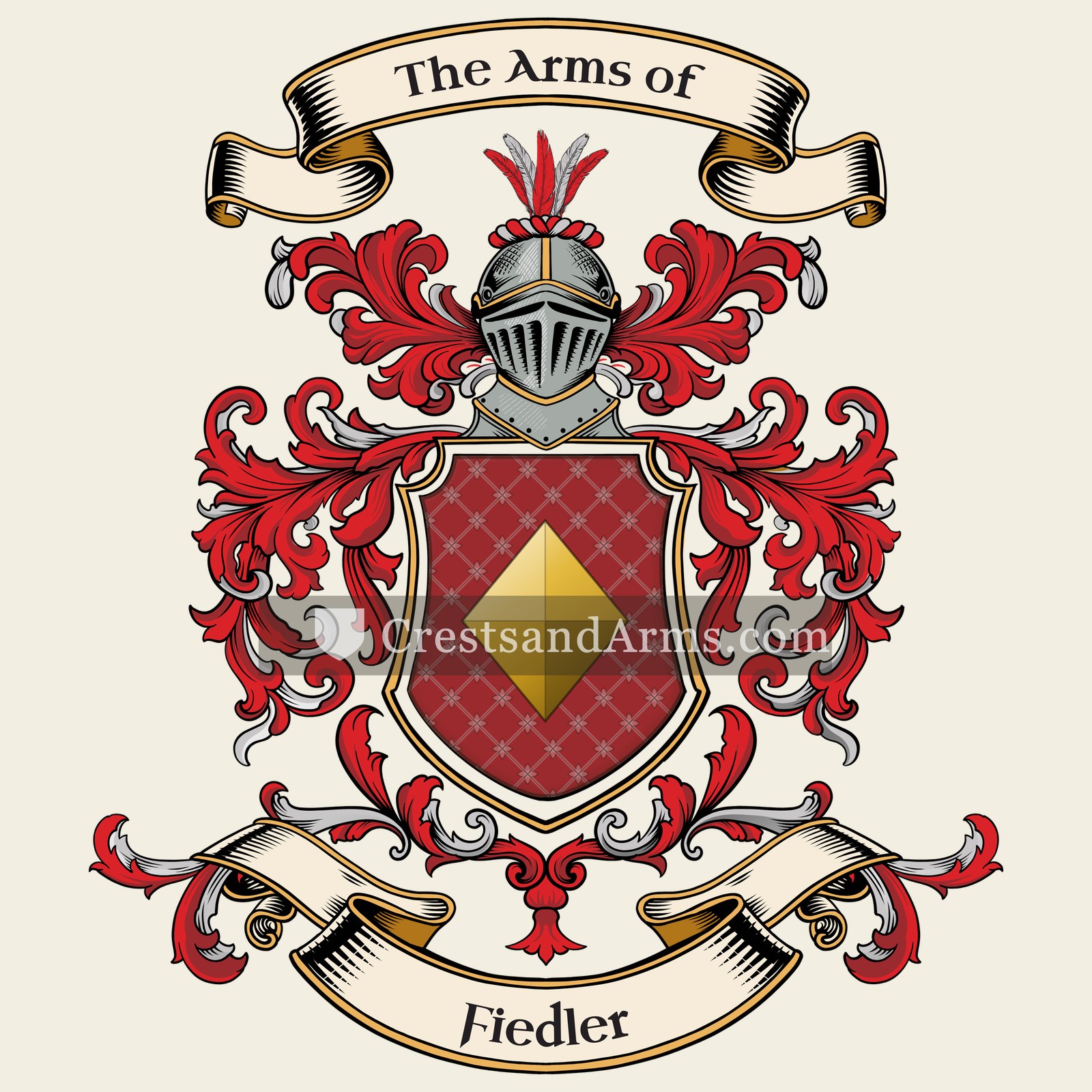
lozengeHonour and nobility, and the arms of a woman
Colours
Red (Gules)Means: Military strength
Gold (Or)Means: Generosity
Historical info
Source
J. B. Rietstap, Armorial Général, Gouda: G. B. van Goor Zonen, 1884–87
Blazon (the actual original written record)
“De gu. à une losange partie d'or et de sa. C.: un vol à l'antique, aux armes de l'écu. L. d'or et de gu.”
GermanyAugsbourg, c. 1765
Digital archive packCoat of arms PNG, gold border print PDF, vector SVG and the certificate of authenticity. Sent to your email in minutes.
Map of Germany showing where the Fiedler arms are recorded
The Fiedler arms were recorded in Augsbourg, c. 1765.
This is where the arms were entered in the register. Families often moved to other parts of the country, so the same name can turn up in more than one region.
The body that granted and recorded arms in Germany in this period.
Francis I, Holy Roman Emperor
Sovereign of the period
Francis I, Holy Roman Emperor
1745–1765
Reigning in Austria when the Fiedler arms are first recorded.
How Arms Worked in Germany
In the Holy Roman Empire, coats of arms were often granted to individuals by the Emperor or his representatives. These arms were then passed down through the generations to all legitimate descendants of the original holder. Younger branches of a family usually kept the same shield design without needing to change it, as the arms belonged to the entire lineage.
Granting authority
The Holy Roman Emperor held the sole power to grant new coats of arms throughout his vast imperial territories.
How they got arms
Families typically obtained their coats of arms through a formal imperial grant or by proving their noble status to the authorities.
Where arms were recorded
These grants were officially recorded in the Imperial Chancery registers, which began keeping formal records of such honors during the Middle Ages.
The family's standing
Recorded among the armigerous families of Germany.
Origin & History of the Fiedler Family in Germany
The surname Fiedler originates from the Middle High German word *videlære*, which translates to a person who plays the fiddle or violin. During the Middle Ages, this name was often given as an occupational descriptor for traveling musicians or entertainers who performed in town squares and at local festivals. By the time members of the family were documented in Augsburg in 1765, the name had transitioned from a simple job title into a formal hereditary surname. Augsburg was a major center for trade and craftsmanship during the eighteenth century, and families like the Fiedlers were often part of the growing urban middle class. As the family established roots in this region, they became part of the social fabric of a city known for its influence in banking, music, and the arts. This transition reflects a broader historical trend in Germany where professional roles eventually became the permanent identifiers for family lineages across generations.
Fiedler Meaning & Related Branches
Root word
Fiedel
A Middle High German term for a stringed musical instrument or fiddle.
This name
FiedlerAn occupational surname for a professional musician or a player of the fiddle.
also spelled
Fiedle
Fied
Feedler
Related arms
Abbassimilar arms
Bethmannsimilar arms
Bethmann-Hollwegsimilar arms
Fidlervariant spelling
Documented Sources
J. B. Rietstap, Armorial Général, Gouda: G. B. van Goor Zonen, 1884–87
Kohlheim, Rosa and Volker Kohlheim, Duden Familiennamen: Herkunft und Bedeutung von 20.000 Nachnamen, 2005
Tiroler Landesarchiv, Standesbücher (Matriken) der Pfarreien in Tirol, 1839
Digital archive packCoat of arms PNG, gold border print PDF, vector SVG and the certificate of authenticity. Sent to your email in minutes.


 mountThe ground held, and steadfastness upon it
 knightChivalry and service in arms
 mulletThe third son, and a divine quality from above
 mountThe ground held, and steadfastness upon it
 knightChivalry and service in arms
 mulletThe third son, and a divine quality from above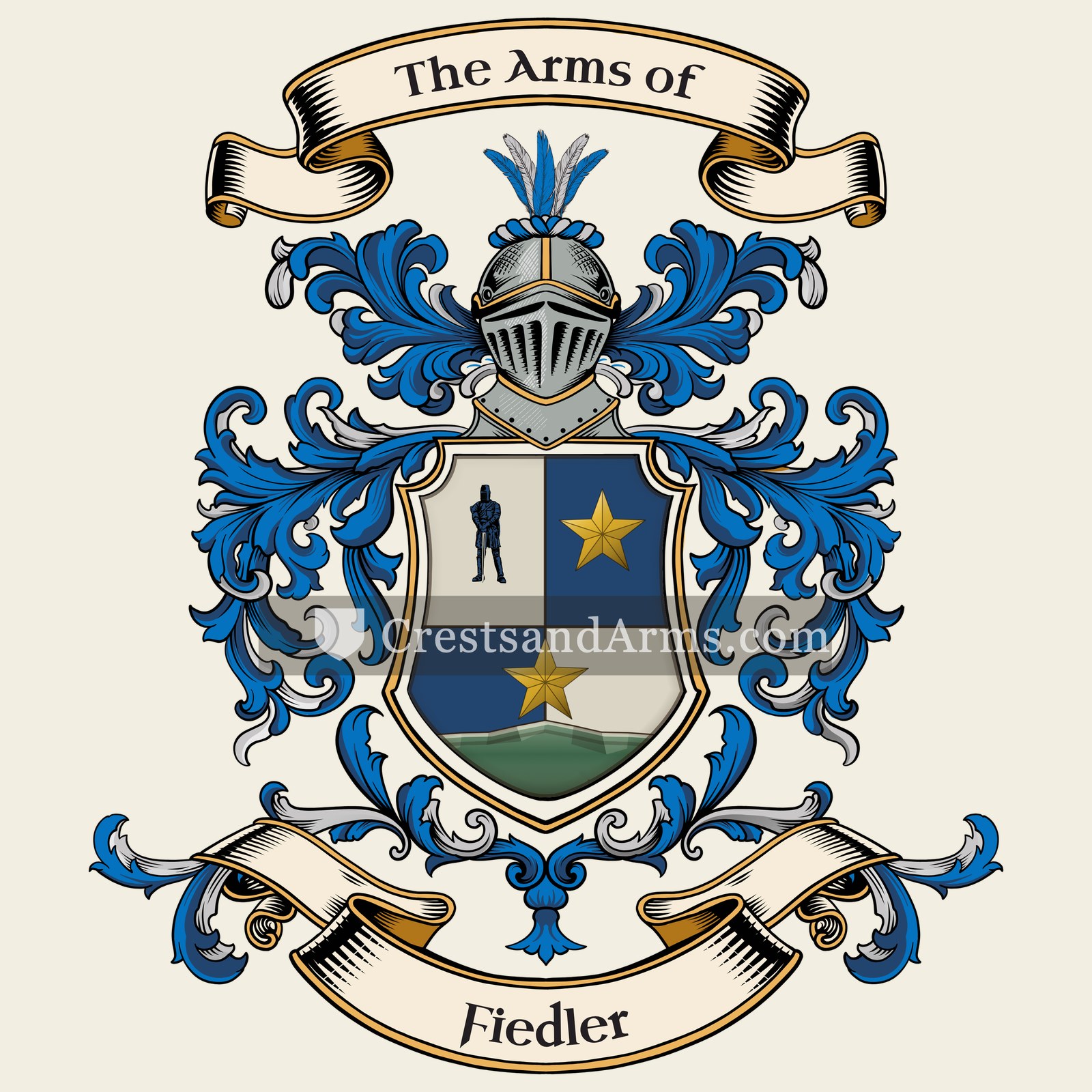


 lozengeHonour and nobility, and the arms of a woman