Map of Italy showing where the Filippo arms are recorded
The Filippo arms were recorded in Italy, c. 1775.
Arms such as these were typically recorded in Venice.
Venice ran on trade, and its great families were merchants before they were anything else. The city kept a formal list of its noble houses, and a name on that list carried arms as a matter of record.
This is where the arms were entered in the register. Families often moved to other parts of the country, so the same name can turn up in more than one region.
The body that granted and recorded arms in Italy in this period.
Alvise Giovanni Mocenigo
Sovereign of the period
Alvise Giovanni Mocenigo
1763–1778
Reigning in Italy when the Filippo arms are first recorded.
How Arms Worked in Italy
In the Italian states, coats of arms were often used by noble families to show their status and history. These symbols were passed down through the generations to all legitimate male descendants. Younger branches of a family usually kept the original design but sometimes added small changes to distinguish their specific line from the main branch.
Granting authority
Various local rulers and city governments controlled the use of coats of arms across the different Italian states.
How they got arms
Families often assumed their own arms or received them as official grants from local lords, popes, or city councils.
Where arms were recorded
Arms were recorded in local city archives or private family books rather than in one single national register.
The family's standing
Recorded among the armigerous families of Italy.
Origin & History of the Filippo Family in Italy
The surname Filippo originates from the Greek name Philippos, which translates to a lover of horses. In Italy, the name gained popularity through the veneration of Saint Philip the Apostle, leading many families to adopt it as a way to honor their faith during the Middle Ages. By the time the family established a documented presence in Venice in 1775, the name had already been woven into the social fabric of the Italian peninsula for centuries. Venice served as a major crossroads for trade and culture, and families living there during the late eighteenth century often participated in the city’s vibrant maritime and merchant economy. As the family navigated life in the Venetian Republic, they were part of a long tradition of individuals carrying a name that bridged ancient linguistic roots with the evolving identity of the Italian people.
Coat of Arms & Family Crest Details
Symbols on this shield
dragonA most valiant defender of treasure
Colours
Red (Gules)Means: Military strength
Blue (Azure)Means: Loyalty and truth
Gold (Or)Means: Generosity
Historical info
Source
J. B. Rietstap, Armorial Général, Gouda: G. B. van Goor Zonen, 1884–87
Blazon (the actual original written record)
“Ec.: aux 1 et 4 de gu. à un dragon à deux pattes d'or, à reflets de sin.; aux 2 et 3 barré d'azur et d'or. Cq. cour. C.: le dragon, iss. L.: à dextre d'or et d'azur, à sen. d'azur et de gu.”
AustriaVienne, c. 1610
Digital archive packCoat of arms PNG, gold border print PDF, vector SVG and the certificate of authenticity. Sent to your email in minutes.
Map of Austria showing where the Filippo arms are recorded
The Filippo arms were recorded in Vienne, c. 1610.
This is where the arms were entered in the register. Families often moved to other parts of the country, so the same name can turn up in more than one region.
Region
Vienne
Town
Vienne
First recorded
1610
Granting Authority for the Filippo Arms
Imperial and Royal chancery
Sodacan · CC BY-SA 3.0
The body that granted and recorded arms in Austria in this period.
Emperor Rudolf II
Sovereign of the period
Emperor Rudolf II
1576–1612
Reigning in Italy when the Filippo arms are first recorded.
How Arms Worked in Austria
Austrian coats of arms were often linked directly to noble titles granted by the Emperor. These symbols belonged to the entire family line rather than just one individual. When a family grew, new branches kept the original design without needing to change it. This system allowed all members of a noble house to share the same identity across many generations.
Granting authority
The Imperial and Royal chancery managed all heraldic matters and controlled the official granting of arms throughout the Austrian lands.
How they got arms
Families typically received their arms through a formal imperial decree that often accompanied the elevation of a person to noble status.
Where arms were recorded
Official records of these grants were kept in the Imperial Register of Nobility which began its formal documentation process in 1453.
The family's standing
Recorded among the armigerous families of Austria.
Origin & History of the Filippo Family in Austria
The family name Filippo carries a rich history that traces back to the vibrant cultural landscape of seventeenth-century Vienna. By 1610, records confirm that members of the family were already established within the city, a time when Vienna served as a primary hub for trade and intellectual exchange under the Habsburg monarchy. As the name suggests an Italian linguistic origin, its presence in Austria likely reflects the long-standing migration patterns of merchants, craftsmen, and artists who traveled north across the Alps to seek opportunities in the imperial capital. These early settlers integrated into the local urban society, contributing to the diverse demographic fabric of the city during a period of significant architectural and social growth. Over time, the family name became a part of the local record, marking the transition of these individuals from newcomers to permanent residents who helped shape the historical identity of the region.
Filippo Meaning & Related Branches
Root word
Philippos
Derived from Greek words meaning friend or lover of horses.
This name
FilippoAn Italian given name and surname signifying one who loves horses.
also spelled
Filippis
Filippo
Phillippi
Filippee
Philippi
Documented Sources
J. B. Rietstap, Armorial Général, Gouda: G. B. van Goor Zonen, 1884–87
De Felice, Emidio. Dizionario dei cognomi italiani. 1978
Fucilla, Joseph G. Our Italian Surnames. 1949
Archivio di Stato di Venezia, Anagrafi di popolazione
Digital archive packCoat of arms PNG, gold border print PDF, vector SVG and the certificate of authenticity. Sent to your email in minutes.


 labelThe eldest son, during his father's life
 dovePeace, love and the Holy Spirit
 labelThe eldest son, during his father's life
 dovePeace, love and the Holy Spirit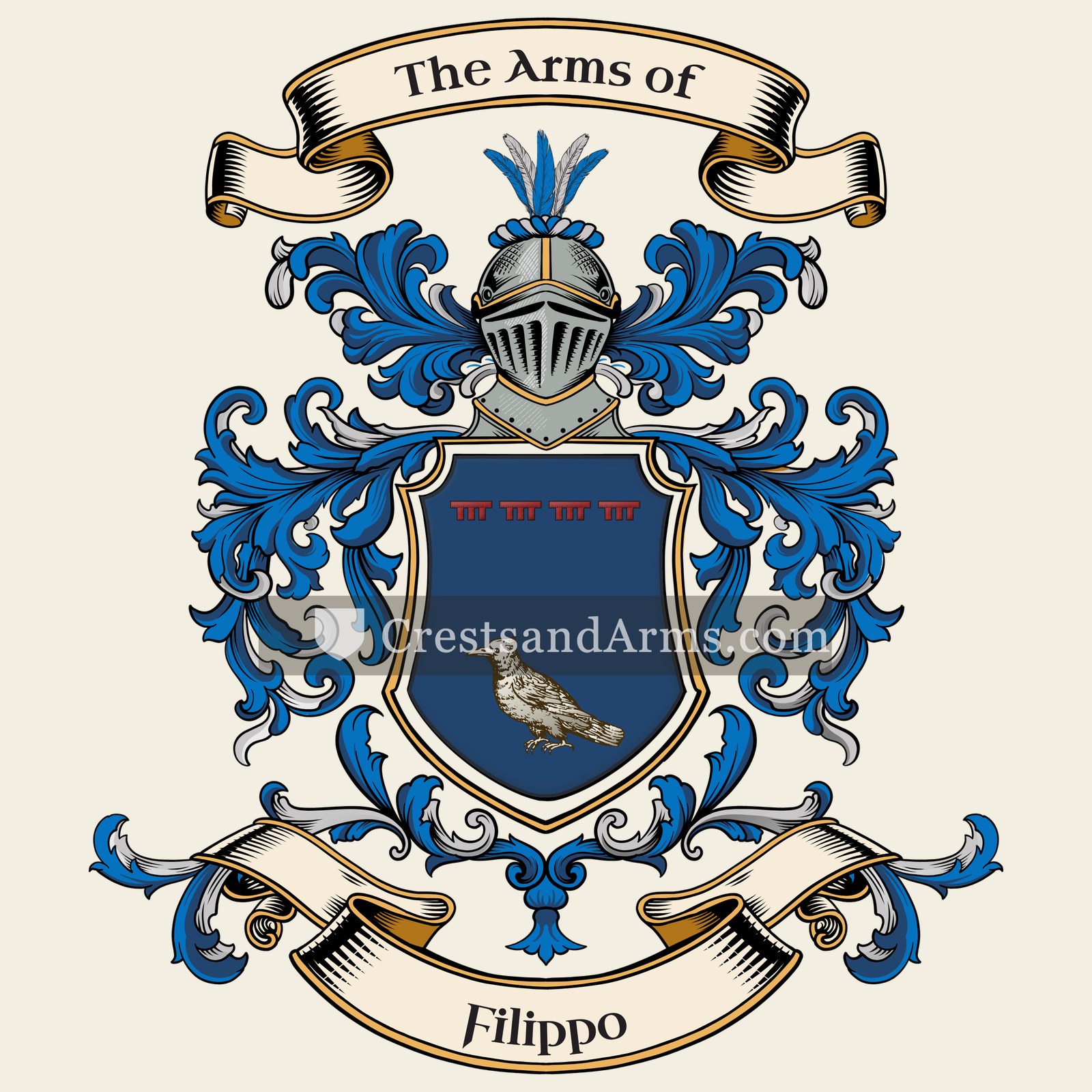


 dragonA most valiant defender of treasure