Map of Austria showing where the Filler arms are recorded
The Filler arms were recorded in Carinthia, c. 1772.
Carinthia was Alpine country in southern Austria with iron and lead in its mountains. Mining and landholding both made money, and families who held either kind of property took arms.
This is where the arms were entered in the register. Families often moved to other parts of the country, so the same name can turn up in more than one region.
Region
Carinthia
First recorded
1772
Granting Authority for the Filler Arms
Imperial and Royal chancery
Sodacan · CC BY-SA 3.0
The body that granted and recorded arms in Austria in this period.
Joseph II, Holy Roman Emperor
Sovereign of the period
Joseph II, Holy Roman Emperor
1765–1790
Reigning in Austria when the Filler arms are first recorded.
How Arms Worked in Austria
Austrian coats of arms were often linked directly to noble titles granted by the Emperor. These symbols belonged to the entire family line rather than just one individual. When a family grew, new branches kept the original design without needing to change it. This system allowed all members of a noble house to share the same identity across many generations.
Granting authority
The Imperial and Royal chancery managed all heraldic matters and controlled the official granting of arms throughout the Austrian lands.
How they got arms
Families typically received their arms through a formal imperial decree that often accompanied the elevation of a person to noble status.
Where arms were recorded
Official records of these grants were kept in the Imperial Register of Nobility which began its formal documentation process in 1453.
The family's standing
Recorded among the armigerous families of Carinthia.
Origin & History of the Filler Family in Austria
The family name Filler has deep roots in the mountainous region of Carinthia, Austria, where records confirm the family was well-established by 1772. The name likely originated as a descriptive occupational surname, as the word "Filler" relates to the German verb "füllen," meaning to fill. In the context of 18th-century alpine life, this often referred to a person who worked in trade or agriculture, specifically someone responsible for filling containers like grain sacks or wine casks. Living in the rugged terrain of southern Austria, these early ancestors were likely part of the local agrarian society that sustained the rural economy of the Habsburg Empire. By the late 1700s, the family had become a stable part of the local community, leaving behind traces in parish registers that document their daily lives, marriages, and contributions to the development of their village.
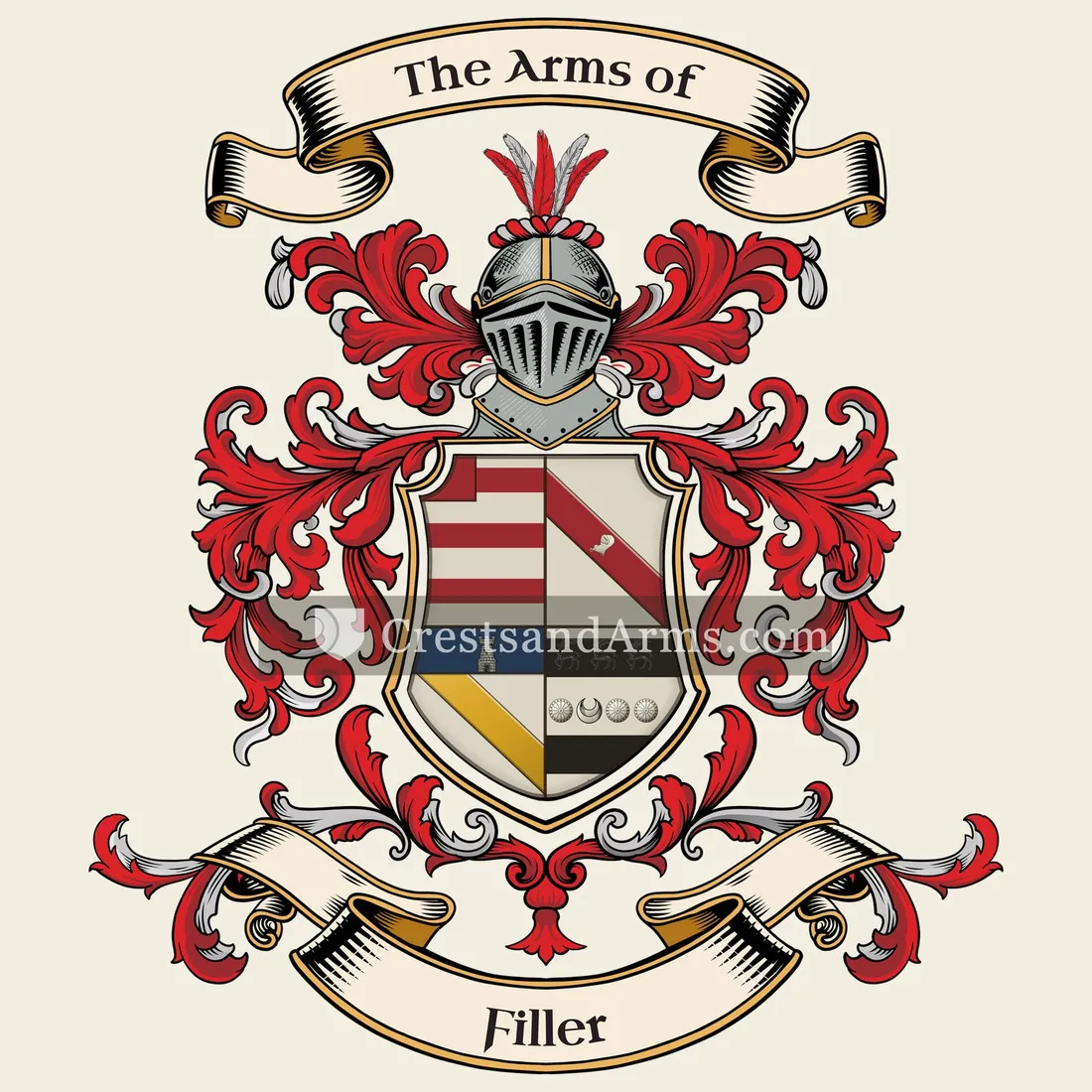
Meaning of the Filler family crest colors & symbols
Symbols on this shield
cantonA mark of honour granted by the sovereign
bendDefence, and the scarf of a commander
chiefAuthority, wisdom and dominion
fessThe military belt, and readiness to serve
helmetWisdom and security in defence
towerGrandeur and solidity, and a stronghold defended
crescentHonour by the sovereign, and the second son
roundelA coin, and one who has been to the crusades
lionCourage, strength and royalty
stagPeace and harmony, and one who will not fight unprovoked
Colours
Silver (Argent)Means: Peace and sincerity
Red (Gules)Means: Military strength
Gold (Or)Means: Generosity
Blue (Azure)Means: Loyalty and truth
Black (Sable)Means: Constancy
Historical info
Source
Sir Bernard Burke, The General Armory of England, Scotland, Ireland and Wales, London: Harrison & Sons, 1884
Blazon (the actual original written record)
“Quarterly, 1st, ar. three bars and a canton gu., for FULLER; 2nd, ar. on a bend gu. a close helmet ppr.; 3rd, gu. on a bend or, a baton of the first on a chief az. the fortress of Gibraltar ar. under it "Plus ultra"; 4th, ar. betw. two bars sa. the upper charged with a crescent betw. two plates, the lower with another plate, a lion pass. of the second, in chief three stags' heads cabossed, also of the second; 5th, az. fretty or, over all a fesse of the second, for PARKER, of Ratton”
SussexAshdown House · Sussex, c. 1620
Digital archive packCoat of arms PNG, gold border print PDF, vector SVG and the certificate of authenticity. Sent to your email in minutes.
Map of England showing where the Filler arms are recorded
The Filler arms were recorded in Sussex, c. 1620.
Sussex had ironworks in its woods and good farmland on its downs. Both made money, and families who made it bought manors, which is what put their names in the heraldic records.
This is where the arms were entered in the register. Families often moved to other parts of the country, so the same name can turn up in more than one region.
The body that granted and recorded arms in England in this period.
James VI and I
Sovereign of the period
James VI and I
1603–1625
Reigning in Austria when the Filler arms are first recorded.
How Arms Worked in England
English heraldry allowed arms to be shared by all legitimate descendants of the original owner. These symbols were treated as personal property that moved through the generations to all children. While the eldest son kept the original design, other family members could use the same shield without needing to change it or register their own unique versions.
Granting authority
The College of Arms in London has regulated the use of coats of arms throughout England and Wales since 1484.
How they got arms
Families typically obtained their coats of arms through a formal grant from the Crown or by proving their ancient right to them.
Where arms were recorded
All official coats of arms are recorded in the registers kept at the College of Arms, which date back to the fifteenth century.
The family's standing
Recorded among the armigerous families of Sussex.
Origin & History of the Filler Family in England
The surname Filler emerged in England as a descriptive occupational name, likely identifying individuals who worked in the textile industry. During the medieval period, a "filler" was often a person tasked with the final stages of cloth production, such as cleaning or thickening wool to improve its quality. By the early 17th century, the family had established a notable presence in the county of Sussex. Historical records confirm that members of the Filler family were living in this region by 1620, where they were integrated into the local agricultural and trade communities. As the family settled into these rural parishes, they contributed to the local economy and social fabric of Southern England, marking the beginning of a long lineage that would eventually spread across the country and beyond.
Filler Meaning & Related Branches
Root word
Füllen
To fill or to stuff.
This name
FillerAn occupational name for a person who stuffed mattresses, pillows, or cushions.
also spelled
Fueller
Fullar
Documented Sources
J. B. Rietstap, Armorial Général, Gouda: G. B. van Goor Zonen, 1884–87


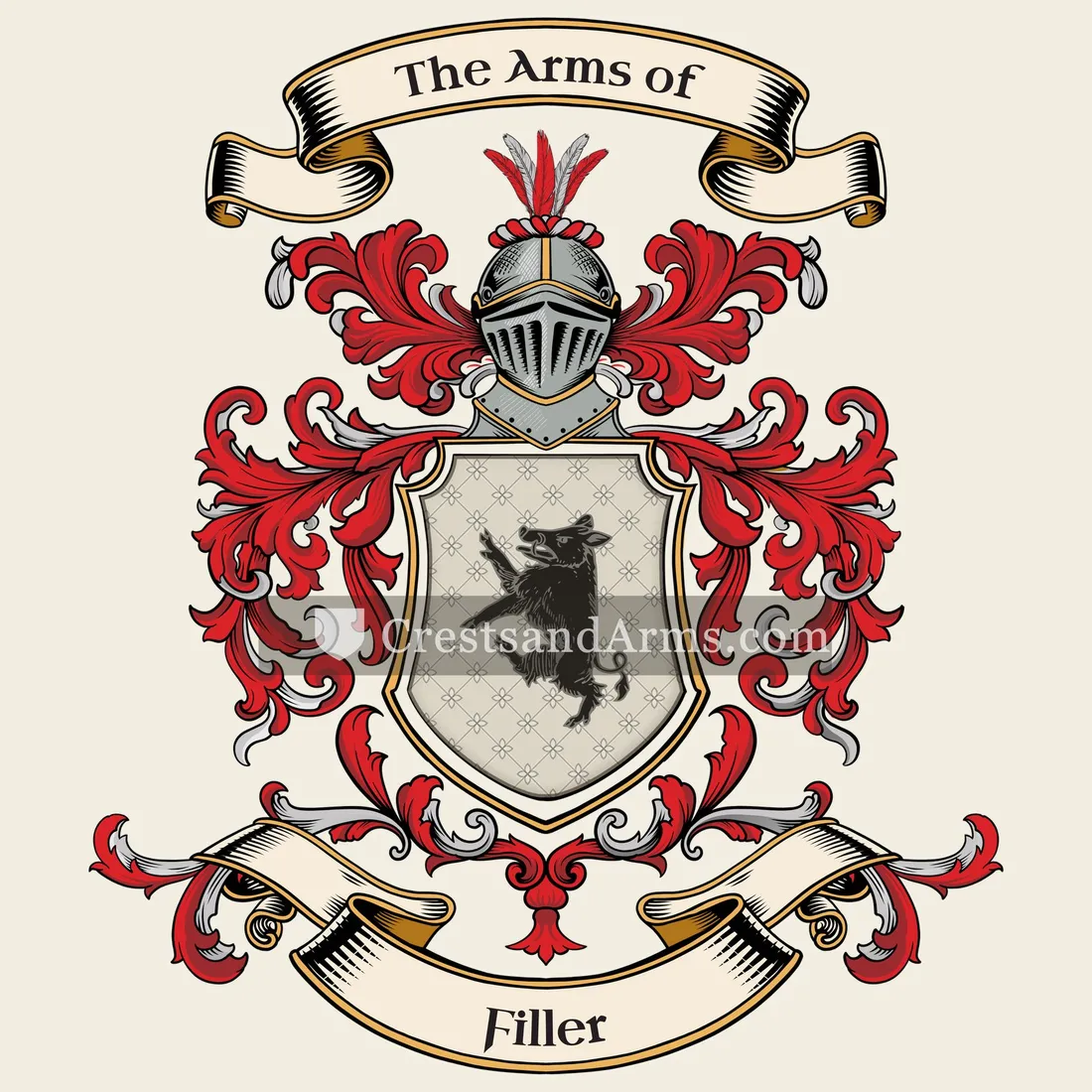
 boarA fierce fighter who battles to the end
 boarA fierce fighter who battles to the end


 cantonA mark of honour granted by the sovereign
 bendDefence, and the scarf of a commander
 chiefAuthority, wisdom and dominion
 fessThe military belt, and readiness to serve
 helmetWisdom and security in defence
 towerGrandeur and solidity, and a stronghold defended
 crescentHonour by the sovereign, and the second son
 roundelA coin, and one who has been to the crusades
 lionCourage, strength and royalty
 stagPeace and harmony, and one who will not fight unprovoked