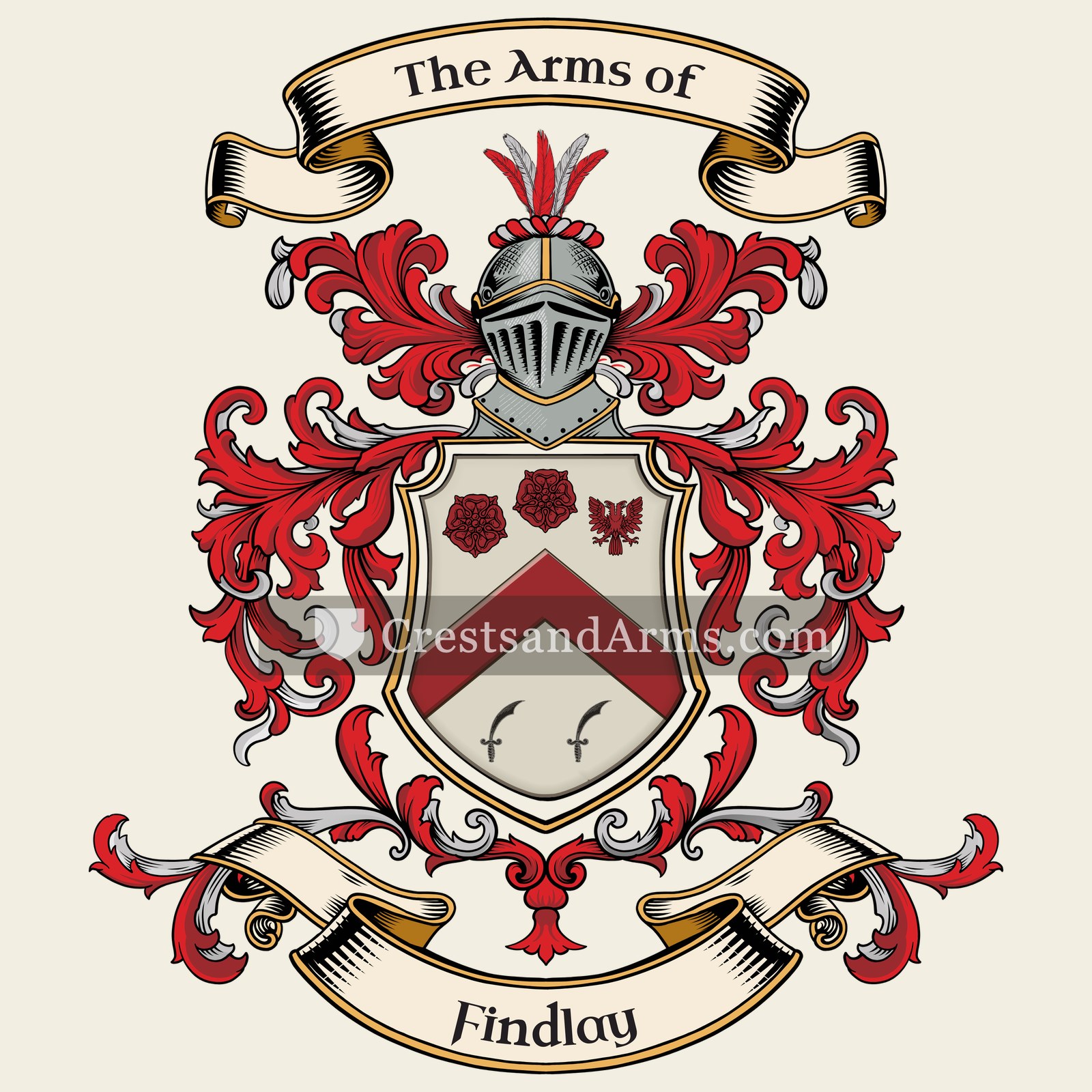
A record of documented arms, meaning and origin, researched for the Findlay family of Scotland.
Reg. 2333 · Scottish, D–F
Coat of Arms & Family Crest Details
Symbols on this shield
chevronProtection, and faithful service completed
roseThe seventh son, and beauty with grace
eagleNobility, strength and a keen mind
swordJustice, and military honour
Colours
Silver (Argent)Means: Peace and sincerity
Red (Gules)Means: Military strength
Historical info
Source
Sir Bernard Burke, The General Armory of England, Scotland, Ireland and Wales, London: Harrison & Sons, 1884
Blazon (the actual original written record)
“Ar. a chev. betw. two roses in chief and a two-headed eagle in base gu. two swords points downwards and conjoined at the pommels of the field, hilted and pommelled or”
LanarkEasterhill · Lanark, c. 1851
Digital archive packCoat of arms PNG, gold border print PDF, vector SVG and the certificate of authenticity. Sent to your email in minutes.
Map of Scotland showing where the Findlay arms are recorded
The Findlay arms were recorded in Lanark, c. 1851.
Lanarkshire ran along the upper Clyde, farming country with coal beneath it. Its landed families were long-established, and long establishment is what brought them into the register.
This is where the arms were entered in the register. Families often moved to other parts of the country, so the same name can turn up in more than one region.
The body that granted and recorded arms in Scotland in this period.
Victoria
Sovereign of the period
Victoria
1837–1901
Reigning in Scotland when the Findlay arms are first recorded.
How Arms Worked in Scotland
Scottish heraldry is unique because it treats a coat of arms as a piece of personal property protected by law. Only one person can own a specific design at any given time. When a family grows, the head keeps the original shield while other relatives must apply for their own distinct version with slight changes to prove their specific identity.
Granting authority
The Court of the Lord Lyon acts as the official body that regulates and controls all heraldic matters throughout Scotland.
How they got arms
Individuals obtain a legal right to their arms through a formal petition process that confirms their identity and family connection.
Where arms were recorded
All valid coats of arms are officially entered into the Public Register of All Arms and Bearings starting from 1672.
The family's standing
Recorded among the armigerous families of Lanark.
Origin & History of the Findlay Family in Scotland
The surname Findlay originates from the Gaelic name Fionnlagh, which translates to fair warrior or white hero. This name was historically popular across Scotland, particularly in the northern Highlands and the central regions. By the mid-nineteenth century, the family had established a notable presence in the town of Lanark. The 1851 census confirms that members of the Findlay family were living and working in this area during a time of significant industrial growth. Many people with this surname were involved in local trades or agriculture, contributing to the development of the community as Lanark transitioned into the Victorian era. Their presence in the region reflects the broader movement of Scottish families who settled in established market towns to build stable lives during the nineteenth century.
Findlay Meaning & Related Branches
Root word
Fionnlagh
Derived from Gaelic elements meaning fair or white warrior.
This name
FindlayA Scottish surname signifying a fair-haired hero or white warrior.
also spelled
Fyndlay
Findley
Fyndley
Documented Sources
Sir Bernard Burke, The General Armory of England, Scotland, Ireland and Wales, London: Harrison & Sons, 1884
Black, George Fraser. The Surnames of Scotland: Their Origin, Meaning, and History. 1946
National Records of Scotland. 1851 Census of Scotland. Reference: Series HO 107
Digital archive packCoat of arms PNG, gold border print PDF, vector SVG and the certificate of authenticity. Sent to your email in minutes.


 chevronProtection, and faithful service completed
 roseThe seventh son, and beauty with grace
 eagleNobility, strength and a keen mind
 swordJustice, and military honour
 chevronProtection, and faithful service completed
 roseThe seventh son, and beauty with grace
 eagleNobility, strength and a keen mind
 swordJustice, and military honour