Map of France showing where the Finlay arms are recorded
The Finlay arms were recorded in Etats-Unis, c. 1725.
Arms such as these were typically recorded in Bretagne.
More families held coats of arms in Bretagne than anywhere else in France. The land was divided into many small estates rather than a few large ones, so far more households counted as gentry, and each needed a shield of its own to be told apart.
This is where the arms were entered in the register. Families often moved to other parts of the country, so the same name can turn up in more than one region.
The body that granted and recorded arms in France in this period.
Louis XV of France
Sovereign of the period
Louis XV of France
1715–1774
Reigning in France when the Finlay arms are first recorded.
How Arms Worked in France
In France, a coat of arms was a mark of honor that passed down through the male line to all legitimate descendants. Families often used the same shield without changes to show their shared heritage. If a branch wanted to stand out, they could add a small mark to their shield to show their specific place in the family tree.
Granting authority
The Juge d'armes de France acted as the official authority that regulated and verified coats of arms across the country.
How they got arms
Families typically inherited their arms from ancestors, though they could also receive them through royal grants or by proving their noble status.
Where arms were recorded
Coats of arms were officially recorded in the Armorial Général de France, which began its main collection in the year 1696.
The family's standing
Recorded among the armigerous families of France.
Origin & History of the Finlay Family in France
The family name Finlay holds a distinct place in the history of the Brittany region of France, where records confirm the presence of family members as early as 1725. While the name is often associated with Gaelic origins, its appearance in the French coastal province suggests a story of migration and integration during the eighteenth century. Families in this region during that period were often deeply connected to the local maritime economy and the specific social structures of the Breton parishes. By settling in Brittany, these early ancestors became part of a unique cultural landscape that blended traditional French provincial life with the distinct linguistic and historical heritage of the area. Their presence in the local archives provides a clear link to a time when families were moving across borders and establishing new roots in the port towns and rural villages of western France.
Coat of Arms & Family Crest Details
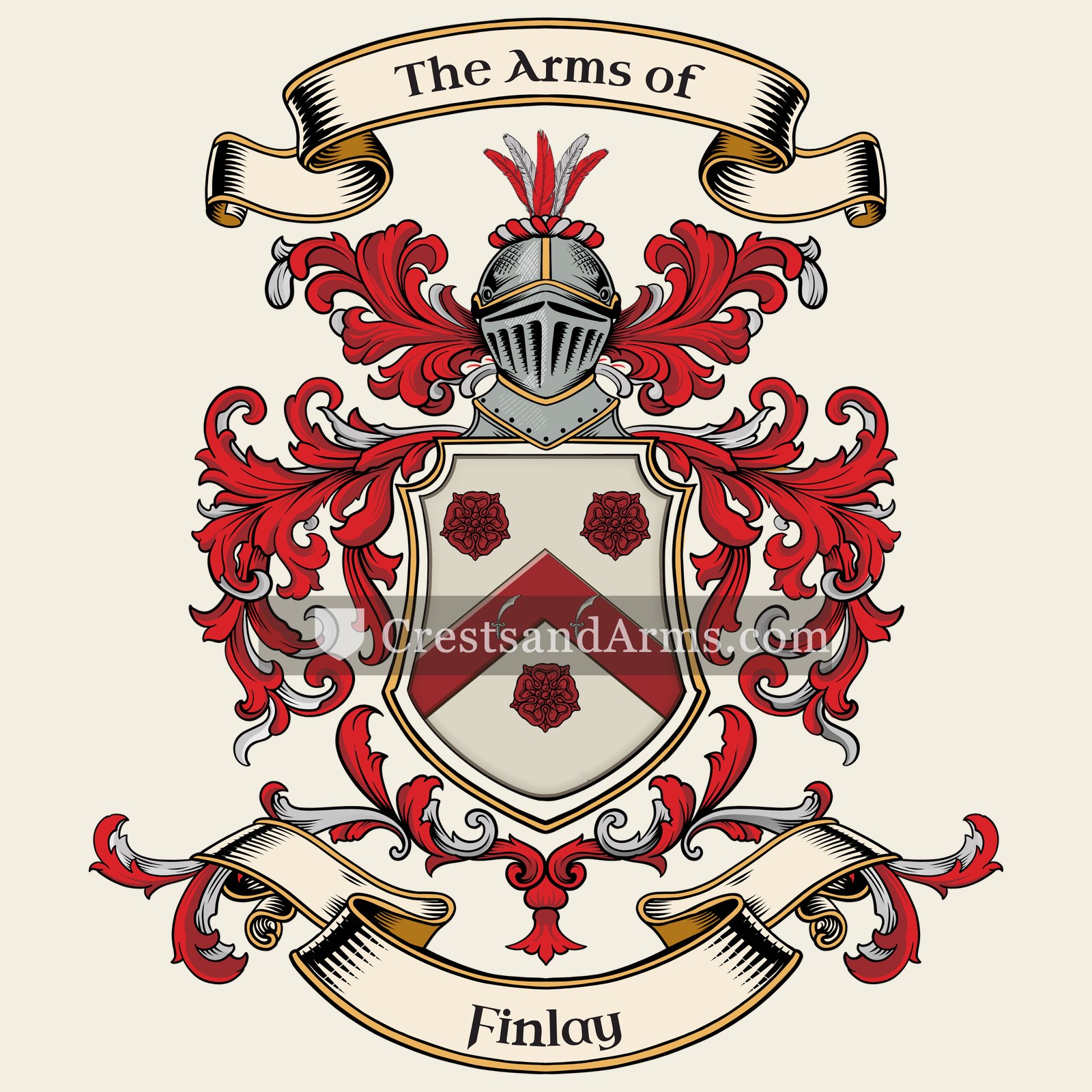
Symbols on this shield
chevronProtection, and faithful service completed
roseThe seventh son, and beauty with grace
swordJustice, and military honour
Colours
Silver (Argent)Means: Peace and sincerity
Red (Gules)Means: Military strength
Historical info
Source
Sir Bernard Burke, The General Armory of England, Scotland, Ireland and Wales, London: Harrison & Sons, 1884
Blazon (the actual original written record)
“Ar. on a chev. betw. three roses gu. two swords points downwards and conjoined at the pommels of the field, hilted and pommelled or”
EdinburghEdinburgh, c. 1672
Digital archive packCoat of arms PNG, gold border print PDF, vector SVG and the certificate of authenticity. Sent to your email in minutes.
Map of Scotland showing where the Finlay arms are recorded
The Finlay arms were recorded in Edinburgh, c. 1672.
Edinburgh was the seat of Scotland's government, its courts and its heralds. Families with business there settled nearby, and being close to where arms were recorded is exactly why so many of them appear.
This is where the arms were entered in the register. Families often moved to other parts of the country, so the same name can turn up in more than one region.
The body that granted and recorded arms in Scotland in this period.
Charles II of England
Sovereign of the period
Charles II of England
1660–1685
Reigning in France when the Finlay arms are first recorded.
How Arms Worked in Scotland
Scottish heraldry is unique because it treats a coat of arms as a piece of personal property protected by law. Only one person can own a specific design at any given time. When a family grows, the head keeps the original shield while other relatives must apply for their own distinct version with slight changes to prove their specific identity.
Granting authority
The Court of the Lord Lyon acts as the official body that regulates and controls all heraldic matters throughout Scotland.
How they got arms
Individuals obtain a legal right to their arms through a formal petition process that confirms their identity and family connection.
Where arms were recorded
All valid coats of arms are officially entered into the Public Register of All Arms and Bearings starting from 1672.
The family's standing
Recorded among the armigerous families of Edinburgh.
Origin & History of the Finlay Family in Scotland
The surname Finlay originates from the Gaelic name Fionnlagh, which translates to fair warrior or white hero. This name was deeply rooted in the culture of the Scottish Highlands and was carried by several early figures of significance, including the Mormaers of Moray. As the name spread across the country, families bearing it became established in various regions, including the capital city of Edinburgh. By the year 1672, official records confirm that members of the Finlay family were active participants in the social and professional life of Edinburgh. During this period, the family name was associated with the growth of urban centers and the shifting structures of Scottish society. These early ancestors helped establish the name as a permanent part of the historical record in Scotland.
Finlay Meaning & Related Branches
Root word
Fionnlagh
Derived from Gaelic elements meaning white or fair warrior.
This name
FinlayA name of Scottish and Irish origin signifying a fair-haired hero or champion.
also spelled
Finley
Finly
Fynlay
Fynley
Related arms
Finleyvariant spelling
Storierecorded with Finlay, same area
Documented Sources
J. B. Rietstap, Armorial Général, Gouda: G. B. van Goor Zonen, 1884–87
Archives départementales du Finistère, Registres paroissiaux et d'état civil
Gautier, Hervé, Histoire de la Bretagne, 1998
Le Goff, Jean, Les migrations en Bretagne au XVIIIe siècle, 2005
Digital archive packCoat of arms PNG, gold border print PDF, vector SVG and the certificate of authenticity. Sent to your email in minutes.


 chevronProtection, and faithful service completed
 cinquefoilHope and joy
 chevronProtection, and faithful service completed
 cinquefoilHope and joy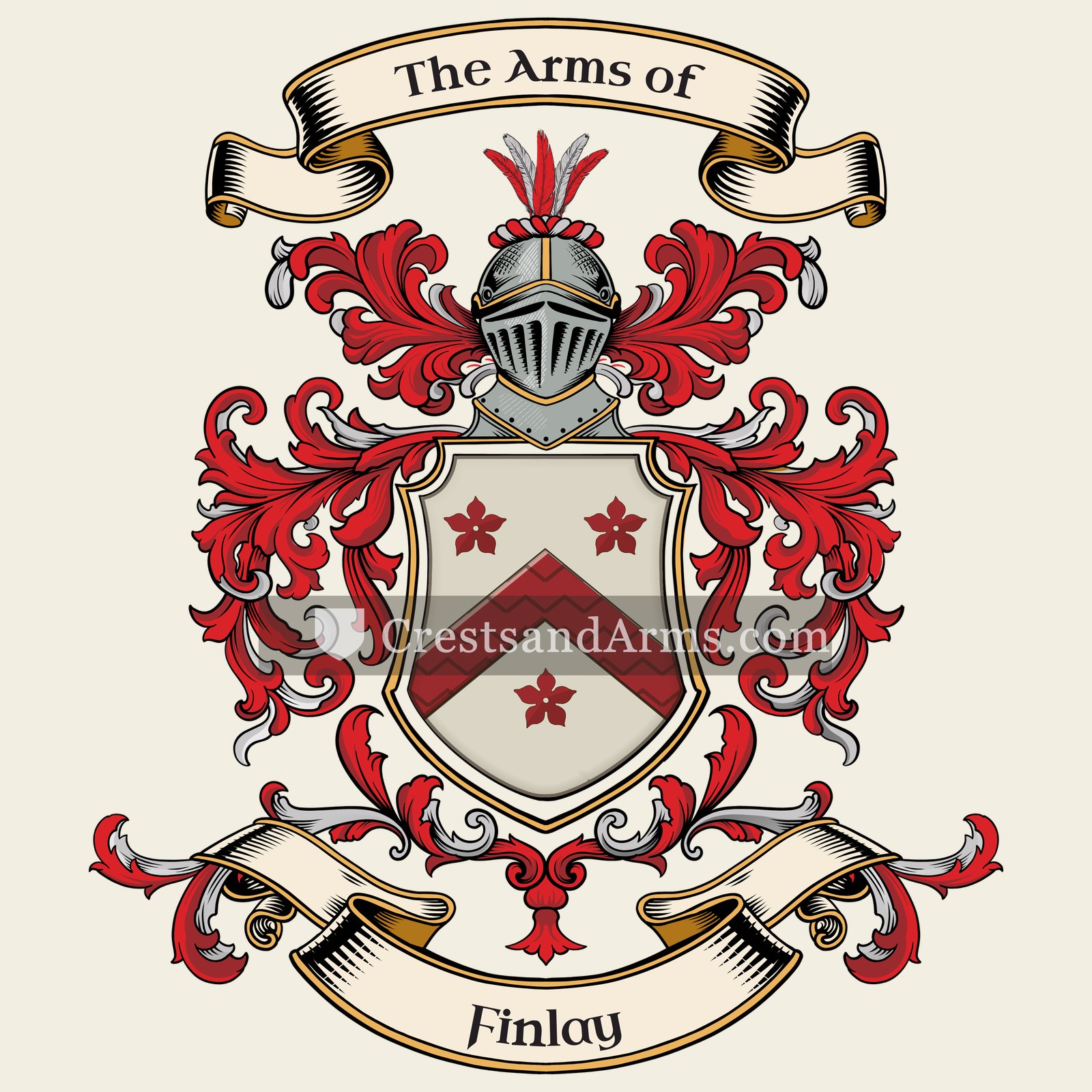


 roseThe seventh son, and beauty with grace
 swordJustice, and military honour