Map of Ireland showing where the Finucane arms are recorded
The Finucane arms were recorded in Clare, c. 1815.
Clare was rocky western Irish country, poor in farmland but held tightly by a few old families. Land there changed hands rarely, and families who stayed put ended up in the records.
This is where the arms were entered in the register. Families often moved to other parts of the country, so the same name can turn up in more than one region.
The body that granted and recorded arms in Ireland in this period.
George III of Great Britain
Sovereign of the period
George III of Great Britain
1801–1820
Reigning in Ireland when the Finucane arms are first recorded.
How Arms Worked in Ireland
The Ulster King of Arms granted coats of arms to individuals who proved their social standing and good character. These symbols were typically inherited by all legitimate descendants of the original holder. If a family branch wanted a unique look, they could apply for a specific change to their design through the office to ensure their identity remained distinct.
Granting authority
The Ulster King of Arms acted as the official body that regulated and issued all coats of arms throughout Ireland.
How they got arms
Families obtained their arms through formal grants issued by the office after proving their eligibility and paying the required fees.
Where arms were recorded
All official grants were recorded in the registers held by the Ulster King of Arms starting from the year 1552.
The family's standing
Recorded among the armigerous families of Clare.
Origin & History of the Finucane Family in Ireland
The family name Finucane is deeply rooted in the history of County Clare, Ireland. The name is an anglicized version of the Gaelic surname Ó Fionnachta, which translates to descendant of the fair or white hero. By the early nineteenth century, the family was well established in the region, particularly around the areas of Ennis and Kilrush. During this period, members of the family were often involved in local agriculture and trade, which were the primary ways of life for many residents of Clare in 1815. While the name is specific to this part of western Ireland, it reflects the broader cultural patterns of families who maintained strong ties to their local communities through generations of farming and commerce. This connection to the land and the local parish records helped the family maintain its identity throughout the turbulent social changes of the nineteenth century.
Finucane Meaning & Related Branches
Root word
Ó Fionnachta
Descendant of the fair or white snow
This name
FinucaneDerived from the Gaelic term for a fair-haired or white-skinned person
also spelled
Finuccan
Finnegan
Documented Sources
Sir Bernard Burke, The General Armory of England, Scotland, Ireland and Wales, London: Harrison & Sons, 1884
MacLysaght, Edward, The Surnames of Ireland, 1985
O'Donovan, John, The Topographical Poems of John O'Dubhagain and Giolla na Naomh O'Huidhrin, 1862
National Archives of Ireland, Tithe Applotment Books, 1823–1837
Digital archive packCoat of arms PNG, gold border print PDF, vector SVG and the certificate of authenticity. Sent to your email in minutes.


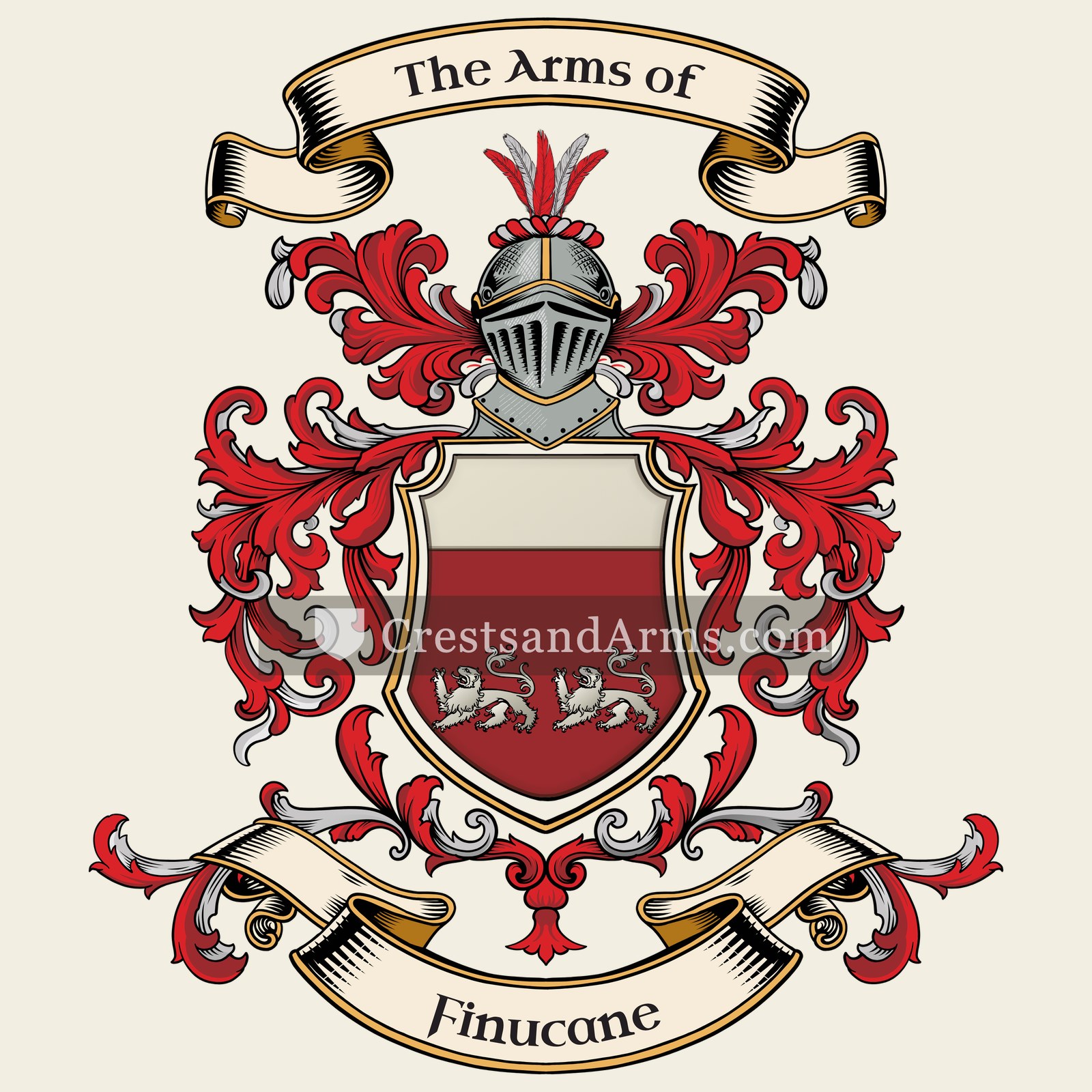
 chiefAuthority, wisdom and dominion
 lionCourage, strength and royalty
 chiefAuthority, wisdom and dominion
 lionCourage, strength and royalty