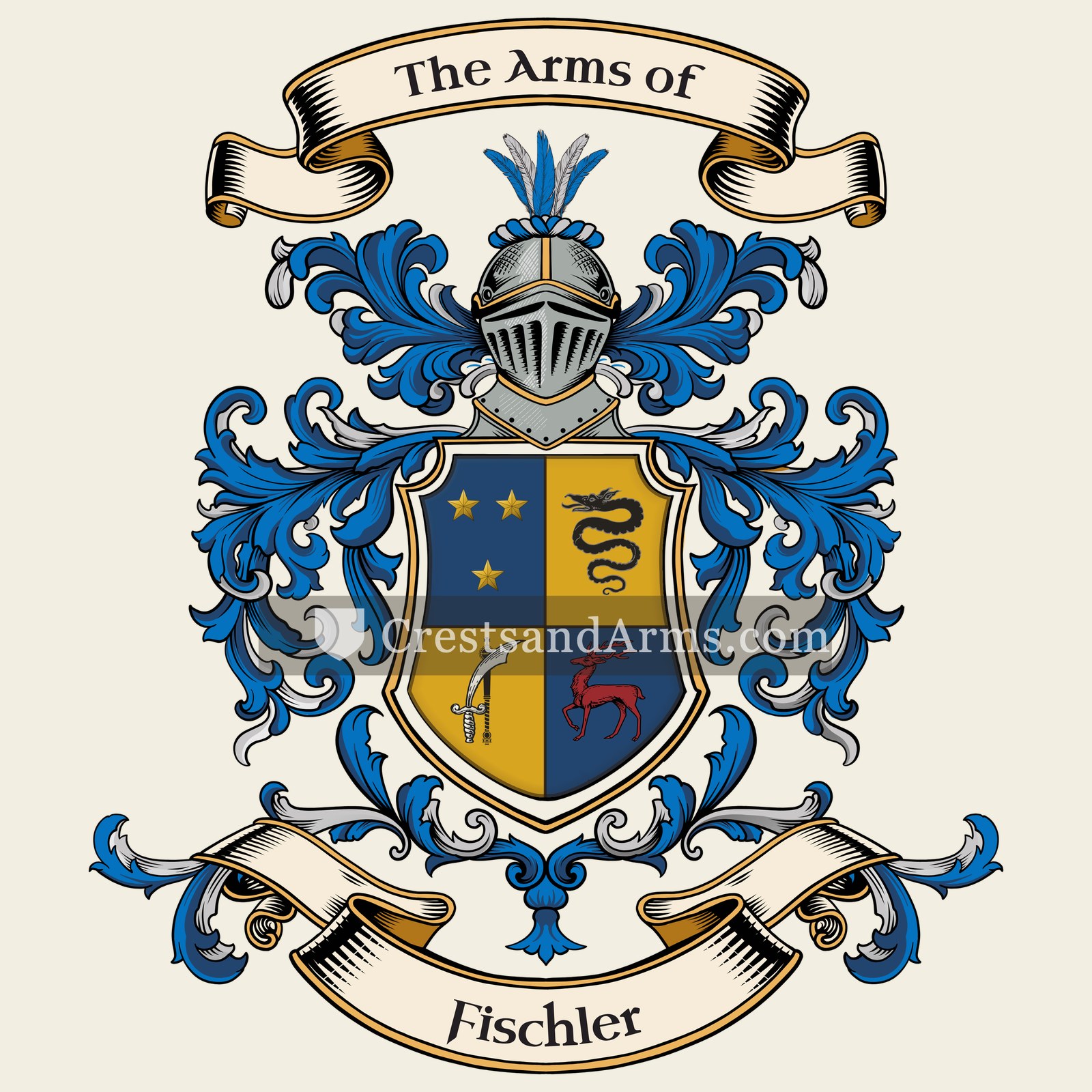
A record of documented arms, meaning and origin, researched for the Fischler family of Germany.
Reg. 5603 · German, D–F
Coat of Arms & Family Crest Details
Symbols on this shield
mulletThe third son, and a divine quality from above
serpentWisdom, healing and prudence
sceptreRoyal authority and justice
swordJustice, and military honour
stagPeace and harmony, and one who will not fight unprovoked
Colours
Blue (Azure)Means: Loyalty and truth
Gold (Or)Means: Generosity
Silver (Argent)Means: Peace and sincerity
Red (Gules)Means: Military strength
Historical info
Source
J. B. Rietstap, Armorial Général, Gouda: G. B. van Goor Zonen, 1884–87
Blazon (the actual original written record)
“Ec.: au 1 parti d'azur et d'or; à trois étoiles de l'un à l'autre, 2 et 1; au 2 d'azur à un serpent d'or, plié en rond; au 3 de gu. à un sceptre d'or, en bande, br. sur une épée d'arg., garnie d'or, en barre; au 4 d'or à une ramure de cerf de gu. Sur le tout un écusson de gu., timbré d'une couronne à neuf perles et ch. d'un château masuré, soutenu d'une colline de sin. et sommé à sen. d'une banderole; au chef d'azur, ch. d'une Foi de carn., alésée. Trois cq. cour. C.: 1º un homme iss., hab. d'un parti de gu. et d'arg., la tête coiffée d'un chapeau panaché; tenant de sa main dextre étendue un poisson d'arg., la sen. appuyée sur sa hanche; L. d'arg. et de gu.; 2º le château du surtout, sur une colline de sin.; L. d'arg. et de sa.; 3º une étoile d'or, entre deux poissons d'azur, les têtes en bas; L. d'or et d'azur.”
SaxonySaxony, c. 1810
Digital archive packCoat of arms PNG, gold border print PDF, vector SVG and the certificate of authenticity. Sent to your email in minutes.
Map of Germany showing where the Fischler arms are recorded
The Fischler arms were recorded in Saxony, c. 1810.
Saxony had mines, trade and old landed families all at once. Silver made some fortunes and land held others, and both sorts of family kept arms, which is why Saxon names appear so often in the registers.
This is where the arms were entered in the register. Families often moved to other parts of the country, so the same name can turn up in more than one region.
The body that granted and recorded arms in Germany in this period.
Frederick William III of Prussia
Sovereign of the period
Frederick William III of Prussia
1797–1840
Reigning in Germany when the Fischler arms are first recorded.
How Arms Worked in Germany
Prussian heraldry was strictly tied to social rank and noble status rather than being a free choice for every citizen. These symbols were treated as permanent family property that moved through the generations to all legitimate heirs. If a family branch wanted to change their design to stand out, they had to apply for official permission to alter their specific version of the shield.
Granting authority
The Prussian Heroldsamt acted as the central state office that managed and strictly controlled all noble titles and coats of arms.
How they got arms
Families usually obtained their arms through formal royal grants or by proving their long-standing noble status to the state authorities.
Where arms were recorded
All official coats of arms were kept in the rolls of the Prussian Heroldsamt, which functioned from 1706 until 1918.
The family's standing
Recorded among the armigerous families of Saxony.
Origin & History of the Fischler Family in Germany
The family name Fischler is an occupational surname that originated in the German-speaking regions of Europe. It is derived from the Middle High German word *vischer*, which translates to fisherman. During the medieval period, surnames were often adopted to describe a person’s trade, and this name likely identified an ancestor who worked in the fishing industry along the rivers or lakes of central Germany. By the early 19th century, records confirm that members of the Fischler family were established in the Kingdom of Saxony. At that time, Saxony was undergoing significant social and economic changes following the Napoleonic Wars. Families like the Fischlers were often deeply connected to their local communities, living in villages where they maintained their traditional trades while adapting to the shifting borders and political landscape of the German states.
Fischler Meaning & Related Branches
Root word
Fisch
A Germanic term referring to a fish or aquatic animal.
This name
FischlerAn occupational surname for a fisherman or a fishmonger.
also spelled
Fischler de Treuberge
Fyschler de Treuberg
Fishler de Troyberg
Fischler
Documented Sources
J. B. Rietstap, Armorial Général, Gouda: G. B. van Goor Zonen, 1884–87
Bahlow, Hans, Deutsches Namenlexikon: Familien- und Vornamen nach Ursprung und Sinn erklärt, 1967
Hellfritzsch, Volkmar, Die Ortsnamen des sächsischen Vogtlandes, 1985
Sächsisches Staatsarchiv, Kirchenbücher der evangelisch-lutherischen Landeskirche Sachsens, 1810
Digital archive packCoat of arms PNG, gold border print PDF, vector SVG and the certificate of authenticity. Sent to your email in minutes.


 mulletThe third son, and a divine quality from above
 serpentWisdom, healing and prudence
 sceptreRoyal authority and justice
 swordJustice, and military honour
 stagPeace and harmony, and one who will not fight unprovoked