A record of documented arms, meaning and origin, researched for the Fisher family lines. Documented in 3 countries.
Reg. 2027 · French, D–F
Coat of Arms & Family Crest Details
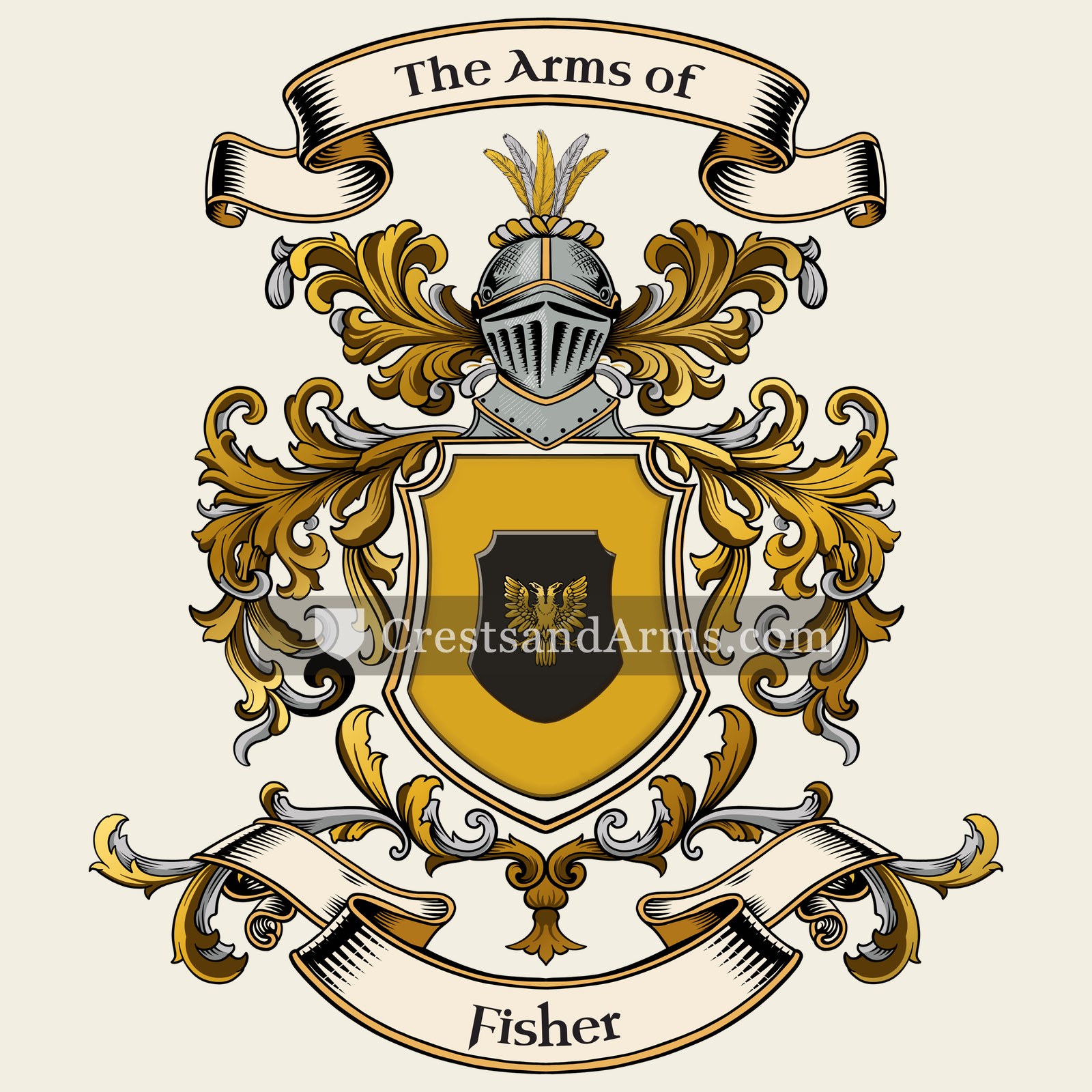
Symbols on this shield
eagleNobility, strength and a keen mind
Colours
Gold (Or)Means: Generosity
Black (Sable)Means: Constancy
Historical info
Source
J. B. Rietstap, Armorial Général, Gouda: G. B. van Goor Zonen, 1884–87
Blazon (the actual original written record)
“d'or. Sur le tout d'or à l'aigle ép. de sa. Cq. cour. C.: une fleur-de-lis d'or, entre deux dauphins d'arg., les têtes en bas et affr. L.: à dextre d'or et de sa., à sen. d'arg. et d'azur.”
Francec. 1725
Digital archive packCoat of arms PNG, gold border print PDF, vector SVG and the certificate of authenticity. Sent to your email in minutes.
Map of France showing where the Fisher arms are recorded
The Fisher arms were recorded in France, c. 1725.
Arms such as these were typically recorded in Bretagne.
More families held coats of arms in Bretagne than anywhere else in France. The land was divided into many small estates rather than a few large ones, so far more households counted as gentry, and each needed a shield of its own to be told apart.
This is where the arms were entered in the register. Families often moved to other parts of the country, so the same name can turn up in more than one region.
The body that granted and recorded arms in France in this period.
Louis XV of France
Sovereign of the period
Louis XV of France
1715–1774
Reigning in France when the Fisher arms are first recorded.
How Arms Worked in France
In France, a coat of arms was a mark of honor that passed down through the male line to all legitimate descendants. Families often used the same shield without changes to show their shared heritage. If a branch wanted to stand out, they could add a small mark to their shield to show their specific place in the family tree.
Granting authority
The Juge d'armes de France acted as the official authority that regulated and verified coats of arms across the country.
How they got arms
Families typically inherited their arms from ancestors, though they could also receive them through royal grants or by proving their noble status.
Where arms were recorded
Coats of arms were officially recorded in the Armorial Général de France, which began its main collection in the year 1696.
The family's standing
Recorded among the armigerous families of France.
Origin & History of the Fisher Family in France
The history of the Fisher name in France is deeply connected to the maritime culture of the Brittany region. While the name is often associated with English or German roots, the presence of the family in Bretagne by 1725 suggests a long-standing integration into the coastal communities of northwestern France. During this period, the name likely served as an occupational identifier for those who made their living from the sea, such as fishermen or merchants involved in the Atlantic trade. Families living in Brittany at this time were often part of a tight-knit society that relied on local parish records to track their lineage and social standing. By settling in this rugged coastal area, these early family members became part of a unique regional identity that blended local traditions with the practical demands of life on the water. Their documented presence in the eighteenth century highlights how a simple occupational name could become a permanent family legacy within the diverse landscape of French provincial history.
Coat of Arms & Family Crest Details
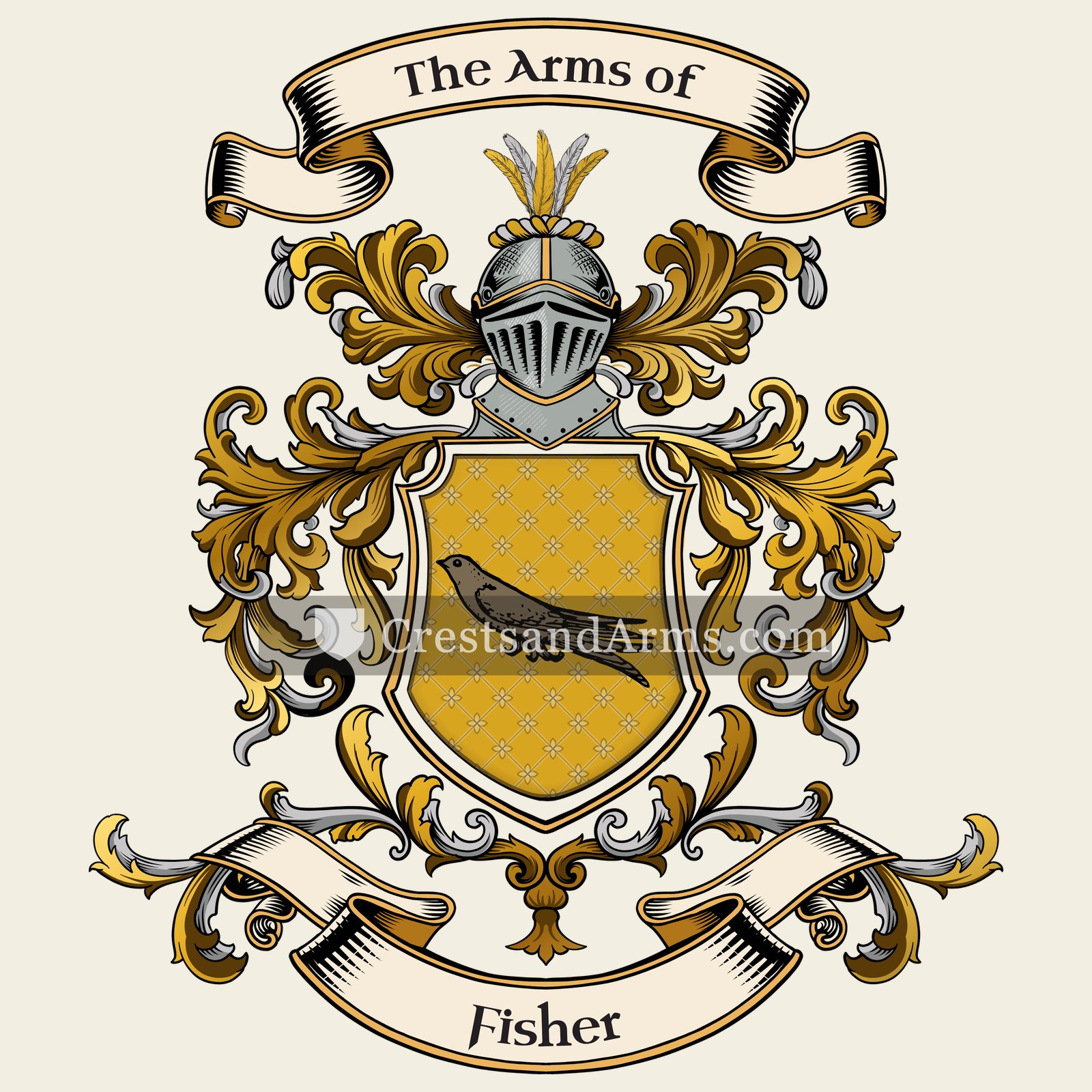
Symbols on this shield
martletA younger son, who must win his own land
Colours
Gold (Or)Means: Generosity
Historical info
Source
Sir Bernard Burke, The General Armory of England, Scotland, Ireland and Wales, London: Harrison & Sons, 1884
Blazon (the actual original written record)
“Or, a kingfisher ppr”
StaffordLondon · Stafford, c. 1607
Digital archive packCoat of arms PNG, gold border print PDF, vector SVG and the certificate of authenticity. Sent to your email in minutes.
Map of England showing where the Fisher arms are recorded
The Fisher arms were recorded in Stafford, c. 1607.
Staffordshire was mixed country of moorland, farmland and early ironworking. Its landed families were spread widely rather than concentrated, and each holding brought its own claim to arms.
This is where the arms were entered in the register. Families often moved to other parts of the country, so the same name can turn up in more than one region.
The body that granted and recorded arms in England in this period.
James VI and I
Sovereign of the period
James VI and I
1603–1625
Reigning in France when the Fisher arms are first recorded.
How Arms Worked in England
English heraldry allowed arms to be shared by all legitimate descendants of the original owner. These symbols were treated as personal property that moved through the generations to all children. While the eldest son kept the original design, other family members could use the same shield without needing to change it or register their own unique versions.
Granting authority
The College of Arms in London has regulated the use of coats of arms throughout England and Wales since 1484.
How they got arms
Families typically obtained their coats of arms through a formal grant from the Crown or by proving their ancient right to them.
Where arms were recorded
All official coats of arms are recorded in the registers kept at the College of Arms, which date back to the fifteenth century.
The family's standing
Recorded among the armigerous families of Stafford.
Origin & History of the Fisher Family in England
The surname Fisher originated in England as a descriptive occupational name during the Middle Ages. It was used to identify individuals who earned their living by catching or selling fish, which was a vital trade in a country surrounded by water. By the early 17th century, the name had become well-established across various English counties, including Staffordshire. Records from 1607 confirm that members of the Fisher family were active residents in the town of Stafford during this period. These early ancestors were likely integrated into the local economy as tradespeople or laborers, contributing to the growth of the community. As the family name spread through different regions, it remained a common identifier for those connected to the fishing industry or those who simply adopted the name to distinguish themselves within their local parishes.
Coat of Arms & Family Crest Details
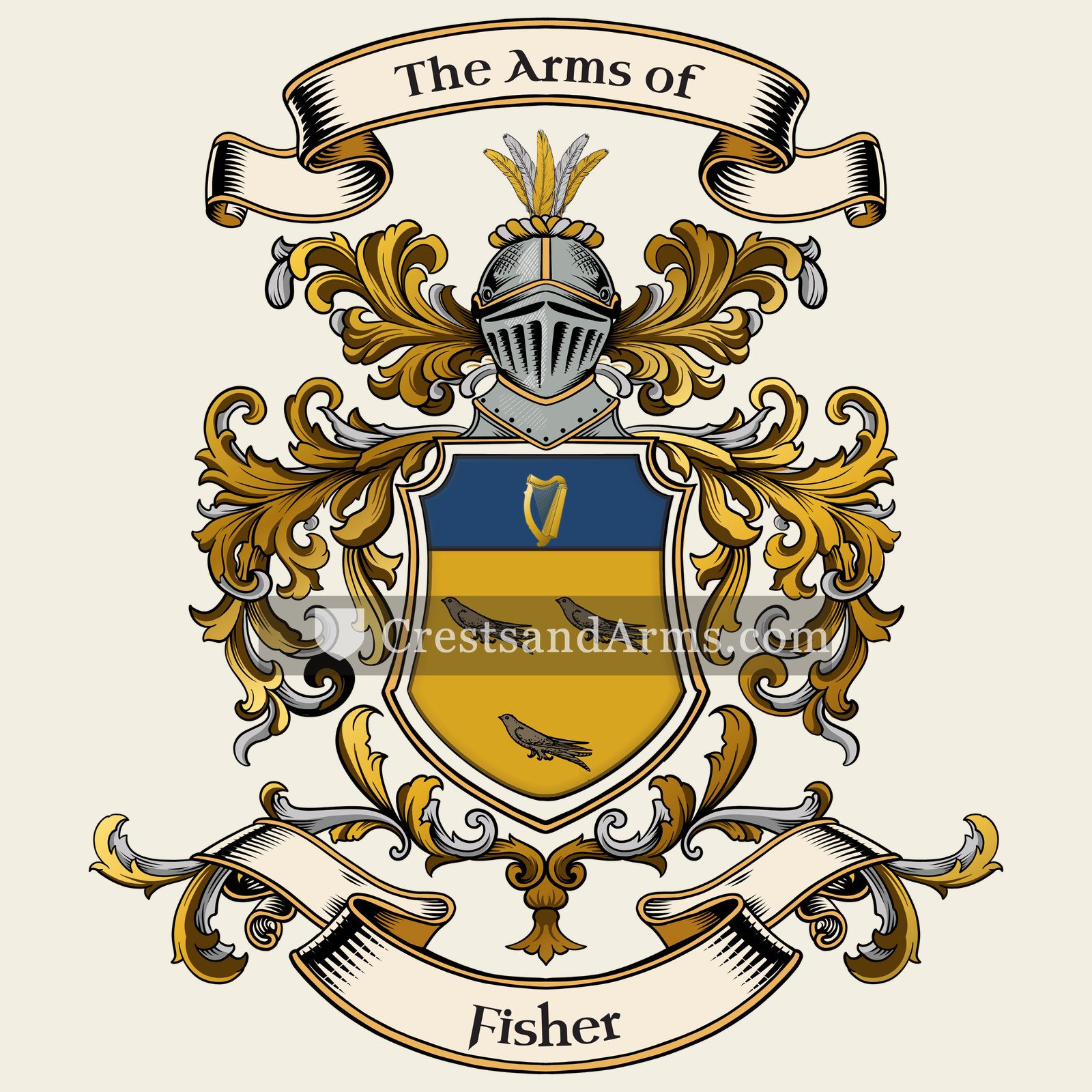
Symbols on this shield
chiefAuthority, wisdom and dominion
martletA younger son, who must win his own land
harpWell-tuned governance and love of music
Colours
Gold (Or)Means: Generosity
Blue (Azure)Means: Loyalty and truth
Historical info
Source
Sir Bernard Burke, The General Armory of England, Scotland, Ireland and Wales, London: Harrison & Sons, 1884
Blazon (the actual original written record)
“Or, three kingfishers ppr. on a chief az. an ancient Irish harp of the field”
CorkKilmoe · Cork, c. 1645
Digital archive packCoat of arms PNG, gold border print PDF, vector SVG and the certificate of authenticity. Sent to your email in minutes.
Map of Ireland showing where the Fisher arms are recorded
The Fisher arms were recorded in Cork, c. 1645.
Cork was the largest county in Ireland, with a great harbour and a wide farming hinterland. Both English settlers and older Irish families held land there, and holding land is what brought a family into the records.
This is where the arms were entered in the register. Families often moved to other parts of the country, so the same name can turn up in more than one region.
The body that granted and recorded arms in Ireland in this period.
Charles I of England
Sovereign of the period
Charles I of England
1625–1649
Reigning in France when the Fisher arms are first recorded.
How Arms Worked in Ireland
The Ulster King of Arms granted coats of arms to individuals who proved their social standing and good character. These symbols were typically inherited by all legitimate descendants of the original holder. If a family branch wanted a unique look, they could apply for a specific change to their design through the office to ensure their identity remained distinct.
Granting authority
The Ulster King of Arms acted as the official body that regulated and issued all coats of arms throughout Ireland.
How they got arms
Families obtained their arms through formal grants issued by the office after proving their eligibility and paying the required fees.
Where arms were recorded
All official grants were recorded in the registers held by the Ulster King of Arms starting from the year 1552.
The family's standing
Recorded among the armigerous families of Cork.
Origin & History of the Fisher Family in Ireland
The surname Fisher arrived in Ireland as a name of occupational origin, identifying individuals who made their living through fishing or the management of fisheries. While the name is often associated with English settlers, records confirm that members of the Fisher family were firmly established in County Cork by 1645. During this period, the family integrated into the local economy of southern Ireland, likely utilizing the rich coastal resources and river systems of the region. As the seventeenth century progressed, these families became part of the shifting social landscape of Munster, moving from their initial roles as tradespeople into various positions within the local community. Their presence in Cork during the mid-1600s highlights how families with common trade names often settled in port cities to take advantage of maritime commerce and established industries.
Fisher Meaning & Related Branches
Root word
Piscator
Latin term for someone who catches fish.
This name
FisherAn occupational surname for a person who earned their living by fishing.
also spelled
Fysher
Fishere
Fysshar
Related arms
Fischervariant spelling
Fishevariant spelling
Fysharvariant spelling
Fyshervariant spelling
Documented Sources
J. B. Rietstap, Armorial Général, Gouda: G. B. van Goor Zonen, 1884–87
Archives départementales du Morbihan, Série B (Archives judiciaires de l'Ancien Régime)
Archives départementales du Finistère, Série E (Registres paroissiaux et d'état civil)
Dauzat, Albert, Dictionnaire étymologique des noms et prénoms de France, 1951
Le Moyne de La Borderie, Arthur, Histoire de Bretagne, 1896
Digital archive packCoat of arms PNG, gold border print PDF, vector SVG and the certificate of authenticity. Sent to your email in minutes.


 eagleNobility, strength and a keen mind
 eagleNobility, strength and a keen mind


 martletA younger son, who must win his own land


 chiefAuthority, wisdom and dominion
 harpWell-tuned governance and love of music