A record of documented arms, meaning and origin, researched for the Fitton family lines. Documented in 2 countries.
Reg. 9146 · Britain, D–F
Coat of Arms & Family Crest Details
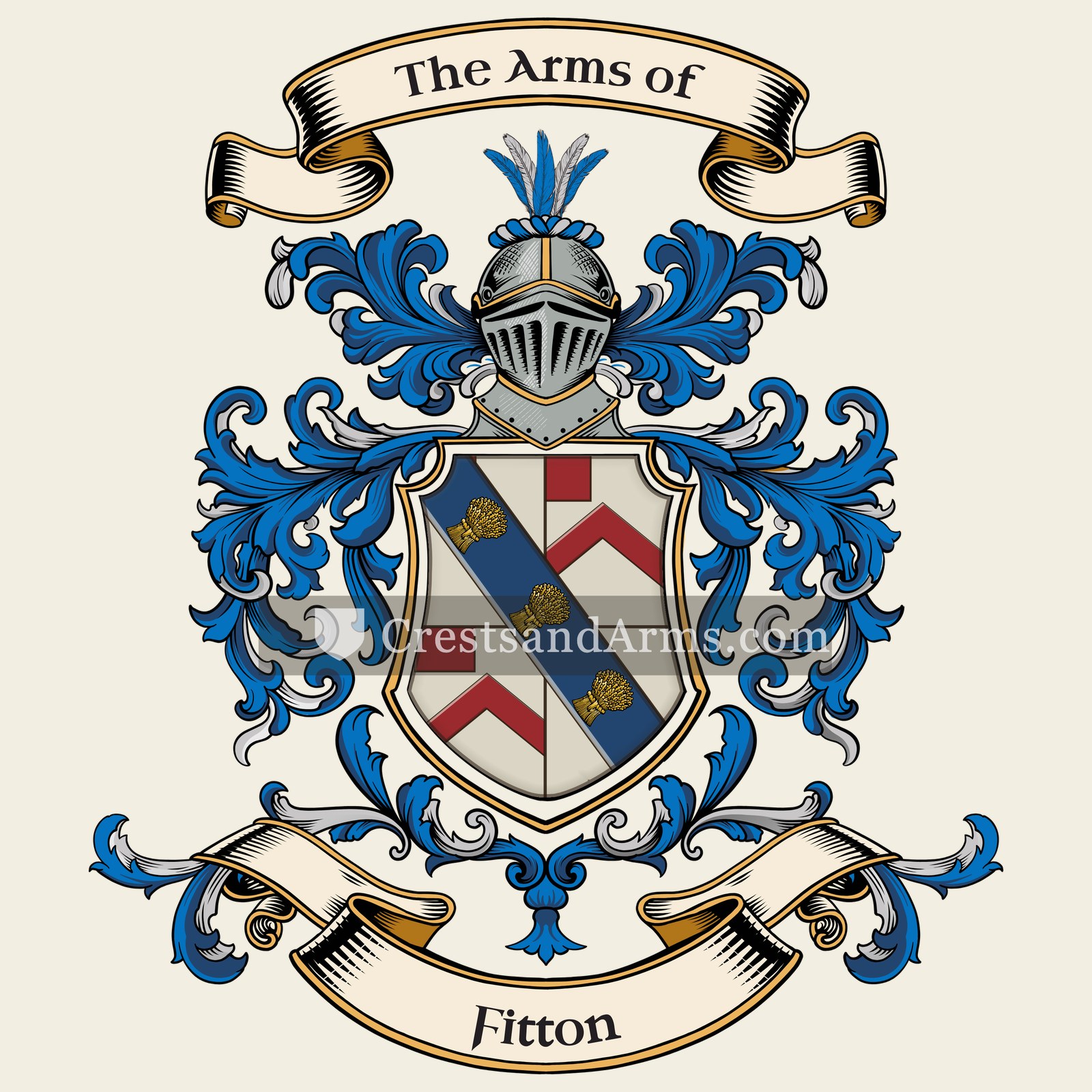
Symbols on this shield
cantonA mark of honour granted by the sovereign
bendDefence, and the scarf of a commander
chevronProtection, and faithful service completed
wheatsheafPlenty, and the harvest of one's own labour
Colours
Silver (Argent)Means: Peace and sincerity
Blue (Azure)Means: Loyalty and truth
Red (Gules)Means: Military strength
Gold (Or)Means: Generosity
Historical info
Source
J. B. Rietstap, Armorial Général, Gouda: G. B. van Goor Zonen, 1884–87
Blazon (the actual original written record)
“Ec.: aux 1 et 4 d'arg. à un canton de gu.; et une bande d'azur, br. sur le tout, ch. de trois gerbes d'or, posées dans le sens de la bande; aux 2 et 3 d'arg. à deux chev. de gu. et un canton du même. C.: une pensée au nat., soutenue d'un chapeau de tournoi de gu., retr. d'herm. S.: deux cerfs d'arg., semés de gouttes de gu. D.: VAE DUPLICI CORDI.”
Britainc. 1700
Digital archive packCoat of arms PNG, gold border print PDF, vector SVG and the certificate of authenticity. Sent to your email in minutes.
Map of Britain showing where the Fitton arms are recorded
The Fitton arms were recorded in Britain, c. 1700.
Arms such as these were typically recorded in Kent.
Kent sits between London and the short crossing to Europe, and the trade passing through made it wealthy. Merchant families bought land with that money, and it was landowners who took coats of arms.
This is where the arms were entered in the register. Families often moved to other parts of the country, so the same name can turn up in more than one region.
The body that granted and recorded arms in Britain in this period.
William III of England
Sovereign of the period
William III of England
1694–1702
Reigning in Britain when the Fitton arms are first recorded.
How Arms Worked in Britain
English heraldry allowed arms to be shared by all legitimate descendants of the original owner. These symbols were treated as personal property that moved through the generations to all children. While the eldest son kept the original design, other family members could use the same shield without needing to change it or register their own unique versions.
Granting authority
The College of Arms in London has regulated the use of coats of arms throughout England and Wales since 1484.
How they got arms
Families typically obtained their coats of arms through a formal grant from the Crown or by proving their ancient right to them.
Where arms were recorded
All official coats of arms are recorded in the registers kept at the College of Arms, which date back to the fifteenth century.
The family's standing
Recorded among the armigerous families of Britain.
Origin & History of the Fitton Family in Britain
The Fitton name has deep roots in the English landscape, with its origins tracing back to the period following the Norman Conquest. While the family established a notable presence in Kent by the year 1700, the name itself likely emerged from the linguistic shifts occurring in medieval Britain. Etymologists often link the surname to Old French or Middle English terms that described a person’s character or physical traits, suggesting that the first individuals to carry the name were identified by their neighbors based on these personal qualities. As the family moved across different regions, they integrated into local communities, shifting from their early medieval origins into the documented roles they held as landowners and tradespeople in the southeastern counties. By the time the family became prominent in Kent, they were part of a long tradition of families who helped shape the social and economic fabric of the English countryside through their participation in local governance and agriculture.
Coat of Arms & Family Crest Details
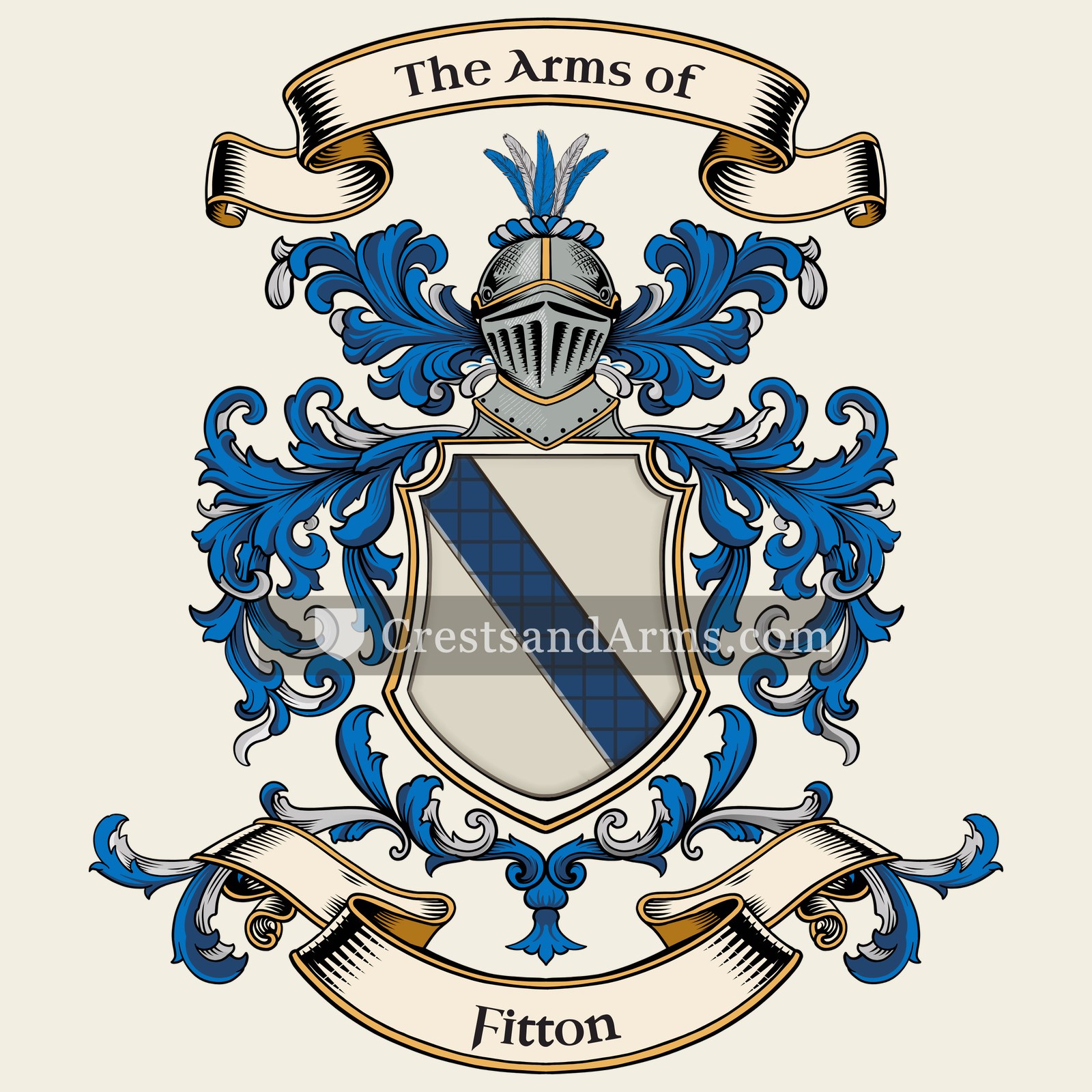
Symbols on this shield
bendDefence, and the scarf of a commander
Colours
Silver (Argent)Means: Peace and sincerity
Blue (Azure)Means: Loyalty and truth
Historical info
Source
Sir Bernard Burke, The General Armory of England, Scotland, Ireland and Wales, London: Harrison & Sons, 1884
Blazon (the actual original written record)
“Ar. on a bend az. three chev. or”
Englandc. 1620
Digital archive packCoat of arms PNG, gold border print PDF, vector SVG and the certificate of authenticity. Sent to your email in minutes.
Map of England showing where the Fitton arms are recorded
The Fitton arms were recorded in England, c. 1620.
Arms such as these were typically recorded in York.
Yorkshire is the largest of the English counties, and it held more gentry families than any other. Land there was split among a great many households rather than a few, so a great many of them carried arms.
This is where the arms were entered in the register. Families often moved to other parts of the country, so the same name can turn up in more than one region.
The body that granted and recorded arms in England in this period.
James VI and I
Sovereign of the period
James VI and I
1603–1625
Reigning in Britain when the Fitton arms are first recorded.
How Arms Worked in England
English heraldry allowed arms to be shared by all legitimate descendants of the original owner. These symbols were treated as personal property that moved through the generations to all children. While the eldest son kept the original design, other family members could use the same shield without needing to change it or register their own unique versions.
Granting authority
The College of Arms in London has regulated the use of coats of arms throughout England and Wales since 1484.
How they got arms
Families typically obtained their coats of arms through a formal grant from the Crown or by proving their ancient right to them.
Where arms were recorded
All official coats of arms are recorded in the registers kept at the College of Arms, which date back to the fifteenth century.
The family's standing
Recorded among the armigerous families of England.
Origin & History of the Fitton Family in England
The Fitton family name is rooted in the social and geographical shifts of medieval England. The name is widely considered to be a locative surname, which means it likely originated from individuals who lived near specific landmarks or within small settlements. By the time the family established a documented presence in York during the early 17th century, the name had already been carried across various English counties for generations. During this era, families often moved toward growing urban centers like York to pursue new economic opportunities in trade and craftsmanship. This migration pattern reflects the broader movement of people away from rural manors and into the bustling markets of northern England. As the Fittons settled into the city in 1620, they became part of a complex network of local citizens who helped shape the administrative and commercial life of the region.
Fitton Meaning & Related Branches
Root word
Fite
An Old French term meaning a fight or a struggle.
This name
FittonA nickname for a pugnacious or combative individual.
also spelled
Fytton
Fittone
Fyton
Related arms
Fytonvariant spelling
Fyttonvariant spelling
Andrewesrecorded with Fitton, same area
Peytonrecorded with Fitton, same area
Documented Sources
J. B. Rietstap, Armorial Général, Gouda: G. B. van Goor Zonen, 1884–87
Reaney, P.H. and Wilson, R.M., A Dictionary of English Surnames, 1991
The National Archives, Records of the Prerogative Court of Canterbury, PROB 11
Kent History and Library Centre, Parish Registers of Kent, P200/1/A1
Digital archive packCoat of arms PNG, gold border print PDF, vector SVG and the certificate of authenticity. Sent to your email in minutes.


 cantonA mark of honour granted by the sovereign
 bendDefence, and the scarf of a commander
 chevronProtection, and faithful service completed
 wheatsheafPlenty, and the harvest of one's own labour
 cantonA mark of honour granted by the sovereign
 bendDefence, and the scarf of a commander
 chevronProtection, and faithful service completed
 wheatsheafPlenty, and the harvest of one's own labour