Map of France showing where the Fitz-Gerald arms are recorded
The Fitz-Gerald arms were recorded in France, c. 1725.
Arms such as these were typically recorded in Bretagne.
More families held coats of arms in Bretagne than anywhere else in France. The land was divided into many small estates rather than a few large ones, so far more households counted as gentry, and each needed a shield of its own to be told apart.
This is where the arms were entered in the register. Families often moved to other parts of the country, so the same name can turn up in more than one region.
The body that granted and recorded arms in France in this period.
Louis XV of France
Sovereign of the period
Louis XV of France
1715–1774
Reigning in France when the Fitz-Gerald arms are first recorded.
How Arms Worked in France
In France, a coat of arms was a mark of honor that passed down through the male line to all legitimate descendants. Families often used the same shield without changes to show their shared heritage. If a branch wanted to stand out, they could add a small mark to their shield to show their specific place in the family tree.
Granting authority
The Juge d'armes de France acted as the official authority that regulated and verified coats of arms across the country.
How they got arms
Families typically inherited their arms from ancestors, though they could also receive them through royal grants or by proving their noble status.
Where arms were recorded
Coats of arms were officially recorded in the Armorial Général de France, which began its main collection in the year 1696.
The family's standing
Recorded among the armigerous families of France.
Origin & History of the Fitz-Gerald Family in France
The origins of the FitzGerald name are deeply rooted in the complex social structures of medieval Europe, particularly within the regions of Normandy and Brittany. While the name is famously associated with the Norman invasion of Ireland, its presence in France remained a significant part of the family narrative for centuries. By the early 18th century, records confirm that members of the family were well-established in the province of Brittany. During this period, the family functioned as part of the local landed elite, navigating the shifting political landscape of the French kingdom. Their residence in Brittany allowed them to maintain connections to both their continental roots and their broader European heritage. This era highlights the family's ability to integrate into French society while preserving their distinct identity through generations of administrative and social service.
Coat of Arms & Family Crest Details
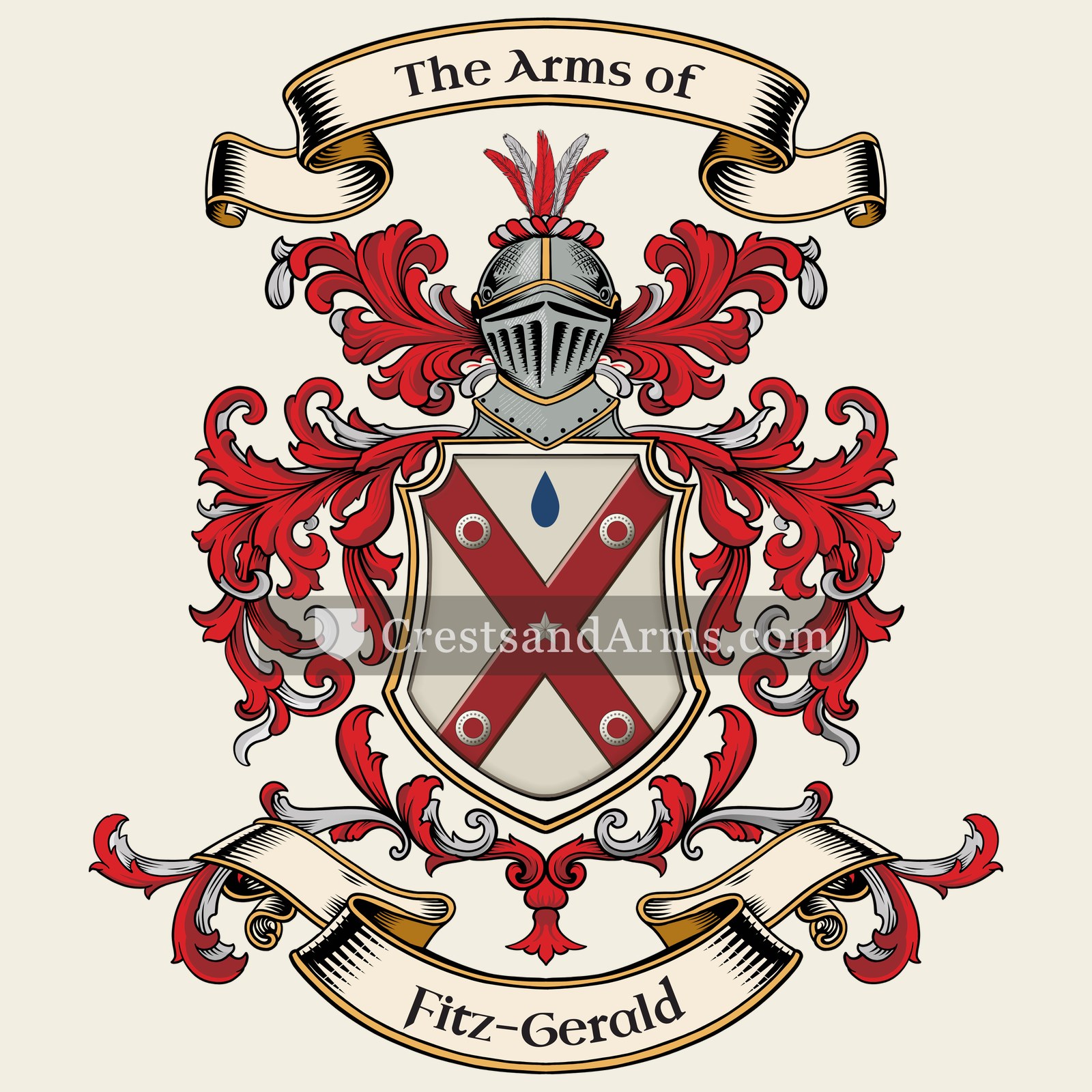
Symbols on this shield
saltireResolution, and St Andrew's cross
mulletThe third son, and a divine quality from above
dropletsTears, and grief borne with patience
ringFidelity, and a promise kept
Colours
Silver (Argent)Means: Peace and sincerity
Red (Gules)Means: Military strength
Blue (Azure)Means: Loyalty and truth
Historical info
Source
Sir Bernard Burke, The General Armory of England, Scotland, Ireland and Wales, London: Harrison & Sons, 1884
Blazon (the actual original written record)
“Ar. guttée de l'armes on a saltire gu. a mullet betw. four annulets of the field”
Irelandc. 1567
Digital archive packCoat of arms PNG, gold border print PDF, vector SVG and the certificate of authenticity. Sent to your email in minutes.
Map of Ireland showing where the Fitz-Gerald arms are recorded
The Fitz-Gerald arms were recorded in Ireland, c. 1567.
Arms such as these were typically recorded in Dublin.
Dublin was the seat of government in Ireland and the place where grants were sought and recorded. Families with business at the castle or the courts settled nearby, and settling there put their arms on record.
This is where the arms were entered in the register. Families often moved to other parts of the country, so the same name can turn up in more than one region.
The body that granted and recorded arms in Ireland in this period.
Elizabeth I of England
Sovereign of the period
Elizabeth I of England
1558–1603
Reigning in France when the Fitz-Gerald arms are first recorded.
How Arms Worked in Ireland
The Ulster King of Arms granted coats of arms to individuals who proved their social standing and good character. These symbols were typically inherited by all legitimate descendants of the original holder. If a family branch wanted a unique look, they could apply for a specific change to their design through the office to ensure their identity remained distinct.
Granting authority
The Ulster King of Arms acted as the official body that regulated and issued all coats of arms throughout Ireland.
How they got arms
Families obtained their arms through formal grants issued by the office after proving their eligibility and paying the required fees.
Where arms were recorded
All official grants were recorded in the registers held by the Ulster King of Arms starting from the year 1552.
The family's standing
Recorded among the armigerous families of Ireland.
Origin & History of the Fitz-Gerald Family in Ireland
The name FitzGerald originated from the Norman-French tradition of using the prefix Fitz, which means son of, followed by the Germanic name Gerald. The family first arrived in Ireland during the Anglo-Norman invasion of the twelfth century. They quickly became one of the most powerful families in the country by securing large estates and forming deep ties with the local population. By the time records place family members in Dublin in 1567, the FitzGeralds had already spent centuries acting as influential political and military leaders. They often balanced their loyalty to the English Crown with their own independent interests in Irish territories. This unique position allowed them to shape the social and political landscape of medieval Ireland for generations.
Fitz-Gerald Meaning & Related Branches
Root word
Gerhard
Derived from Germanic elements meaning spear and hardy or brave.
This name
Fitz-GeraldAn Anglo-Norman patronymic meaning son of Gerald, indicating noble descent from the Gerald line.
also spelled
Geralds
Fitzgerold
Fizgerald
Fitzgerard
Fitzgarrett
Related arms
Fitz-Gibbonsame arms
Fitz-Ercaldvariant spelling
Fitz-Garrettvariant spelling
Fitz-Gerardvariant spelling
Documented Sources
J. B. Rietstap, Armorial Général, Gouda: G. B. van Goor Zonen, 1884–87
Archives départementales d'Ille-et-Vilaine, Série B: Cours et juridictions
Potier de Courcy, Pol, Nobiliaire et armorial de Bretagne, 1890
Digital archive packCoat of arms PNG, gold border print PDF, vector SVG and the certificate of authenticity. Sent to your email in minutes.


 saltireResolution, and St Andrew's cross
 saltireResolution, and St Andrew's cross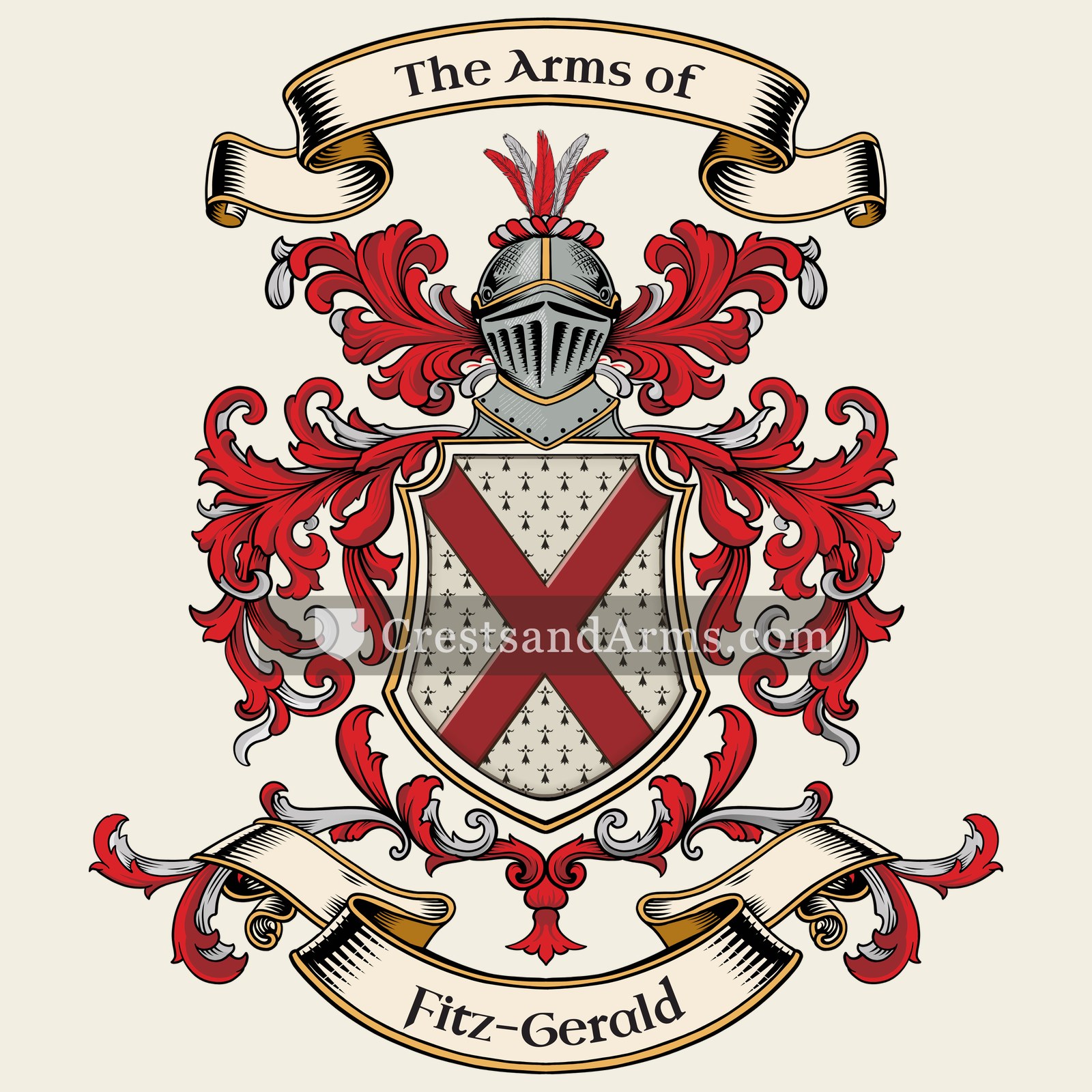


 mulletThe third son, and a divine quality from above
 dropletsTears, and grief borne with patience
 ringFidelity, and a promise kept