A record of documented arms, meaning and origin, researched for the Fitzgibbon family lines. Documented in 2 countries.
Reg. 1267 · French, D–F
Coat of Arms & Family Crest Details
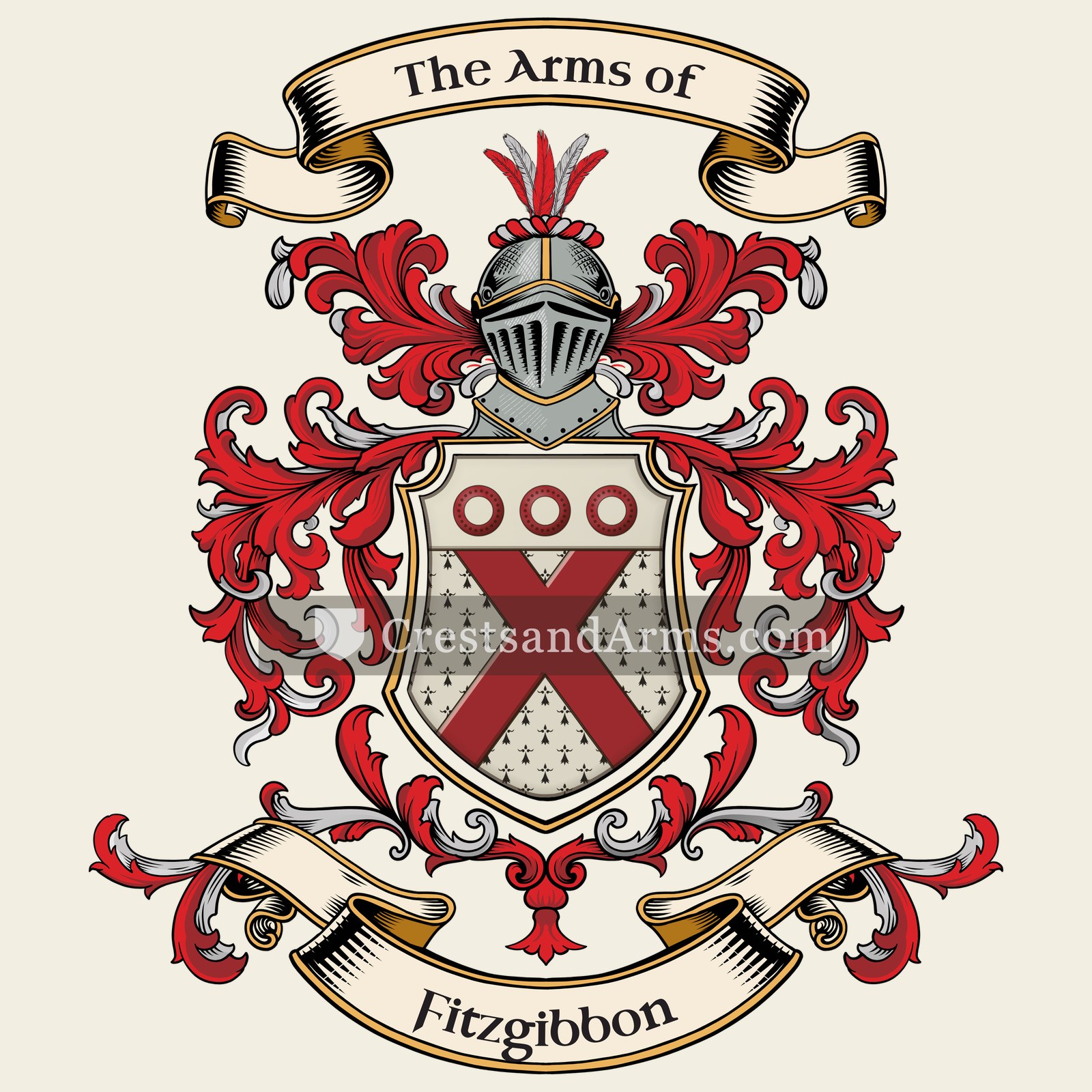
Symbols on this shield
saltireResolution, and St Andrew's cross
ringFidelity, and a promise kept
Colours
Red (Gules)Means: Military strength
Silver (Argent)Means: Peace and sincerity
Gold (Or)Means: Generosity
Historical info
Source
J. B. Rietstap, Armorial Général, Gouda: G. B. van Goor Zonen, 1884–87
Blazon (the actual original written record)
“Ec.: aux 1 et 4 de gu. à trois annelets d'or (Fitzgibbon); aux 2 et 3 d'arg. au saut. de gu. (Fitzgerald). C.: un sanglier pass. de gu., criné d'or, le corps ch. de trois annelets d'or. S.: à dextre un lion de gu., à sen. un griffon d'arg. D.: NIL ADMIRARI.”
Francec. 1725
Digital archive packCoat of arms PNG, gold border print PDF, vector SVG and the certificate of authenticity. Sent to your email in minutes.
Map of France showing where the Fitzgibbon arms are recorded
The Fitzgibbon arms were recorded in France, c. 1725.
Arms such as these were typically recorded in Bretagne.
More families held coats of arms in Bretagne than anywhere else in France. The land was divided into many small estates rather than a few large ones, so far more households counted as gentry, and each needed a shield of its own to be told apart.
This is where the arms were entered in the register. Families often moved to other parts of the country, so the same name can turn up in more than one region.
The body that granted and recorded arms in France in this period.
Louis XV of France
Sovereign of the period
Louis XV of France
1715–1774
Reigning in France when the Fitzgibbon arms are first recorded.
How Arms Worked in France
In France, a coat of arms was a mark of honor that passed down through the male line to all legitimate descendants. Families often used the same shield without changes to show their shared heritage. If a branch wanted to stand out, they could add a small mark to their shield to show their specific place in the family tree.
Granting authority
The Juge d'armes de France acted as the official authority that regulated and verified coats of arms across the country.
How they got arms
Families typically inherited their arms from ancestors, though they could also receive them through royal grants or by proving their noble status.
Where arms were recorded
Coats of arms were officially recorded in the Armorial Général de France, which began its main collection in the year 1696.
The family's standing
Recorded among the armigerous families of France.
Origin & History of the Fitzgibbon Family in France
The Fitzgibbon name carries a unique history that bridges the gap between its Norman-Irish roots and the French landscape. While the family is most famously associated with the medieval history of Ireland, members of the lineage established a notable presence in the Brittany region of France by 1725. During this period, the family integrated into the local social structure of Bretagne, often navigating the complexities of eighteenth-century French society as expatriates or merchants. Their migration to France reflects a broader pattern of movement among families who sought new opportunities in continental Europe following political shifts in the British Isles. By settling in Brittany, these early Fitzgibbons adapted to the local culture while maintaining the distinct identity of their name, which traces back to the Norman practice of using the prefix Fitz to denote a son. This transition into French life highlights the family's ability to thrive in diverse environments while preserving their ancestral heritage across generations.
Coat of Arms & Family Crest Details
Symbols on this shield
saltireResolution, and St Andrew's cross
chiefAuthority, wisdom and dominion
ringFidelity, and a promise kept
Colours
ErmineMeans: Dignity
Red (Gules)Means: Military strength
Silver (Argent)Means: Peace and sincerity
Historical info
Source
Sir Bernard Burke, The General Armory of England, Scotland, Ireland and Wales, London: Harrison & Sons, 1884
Blazon (the actual original written record)
“Erm. a saltire gu. on a chief ar. three annulets of the second”
KerryBallycalling · Kerry, c. 1596
Digital archive packCoat of arms PNG, gold border print PDF, vector SVG and the certificate of authenticity. Sent to your email in minutes.
Map of Ireland showing where the Fitzgibbon arms are recorded
The Fitzgibbon arms were recorded in Kerry, c. 1596.
Kerry was mountain and coast country in the far south-west of Ireland. Its land was poor and held by a few families for a very long time, and long unbroken holding fills a register.
This is where the arms were entered in the register. Families often moved to other parts of the country, so the same name can turn up in more than one region.
The body that granted and recorded arms in Ireland in this period.
Elizabeth I of England
Sovereign of the period
Elizabeth I of England
1558–1603
Reigning in France when the Fitzgibbon arms are first recorded.
How Arms Worked in Ireland
The Ulster King of Arms granted coats of arms to individuals who proved their social standing and good character. These symbols were typically inherited by all legitimate descendants of the original holder. If a family branch wanted a unique look, they could apply for a specific change to their design through the office to ensure their identity remained distinct.
Granting authority
The Ulster King of Arms acted as the official body that regulated and issued all coats of arms throughout Ireland.
How they got arms
Families obtained their arms through formal grants issued by the office after proving their eligibility and paying the required fees.
Where arms were recorded
All official grants were recorded in the registers held by the Ulster King of Arms starting from the year 1552.
The family's standing
Recorded among the armigerous families of Kerry.
Origin & History of the Fitzgibbon Family in Ireland
The Fitzgibbon name emerged in Ireland as a classic example of the Norman influence on Gaelic society. The name itself is a combination of the Norman-French prefix "Fitz," meaning son of, and the Germanic name Gilbert. By the late 16th century, the family had firmly established itself in County Kerry, where they became deeply integrated into the local political and social landscape. They were closely associated with the powerful Geraldine dynasty, often serving as loyal supporters during the turbulent conflicts of the era. By 1596, historical records confirm their presence in Kerry, where they held significant land and influence. Over time, the family transitioned from their Norman roots to become a prominent part of the Irish landed gentry, balancing their unique cultural heritage with the shifting loyalties of the Irish countryside.
Fitzgibbon Meaning & Related Branches
Root word
Filius
Latin term meaning son or male offspring.
This name
FitzgibbonSon of Gilbert, derived from the Germanic name Giselbert meaning bright pledge.
also spelled
Fizgibbon
Phitzgibbon
Fitzgybbon
Fitzgybon
Related arms
Fitz-Geraldsame arms
Documented Sources
J. B. Rietstap, Armorial Général, Gouda: G. B. van Goor Zonen, 1884–87
Archives départementales d'Ille-et-Vilaine, Série B (Fonds de la juridiction de Rennes)
O'Hart, John, Irish Pedigrees; or, The Origin and Stem of the Irish Nation, 1892
Guerin, Jean, Les familles d'origine irlandaise en Bretagne au XVIIIe siècle, 1974
Digital archive packCoat of arms PNG, gold border print PDF, vector SVG and the certificate of authenticity. Sent to your email in minutes.


 saltireResolution, and St Andrew's cross
 ringFidelity, and a promise kept
 saltireResolution, and St Andrew's cross
 ringFidelity, and a promise kept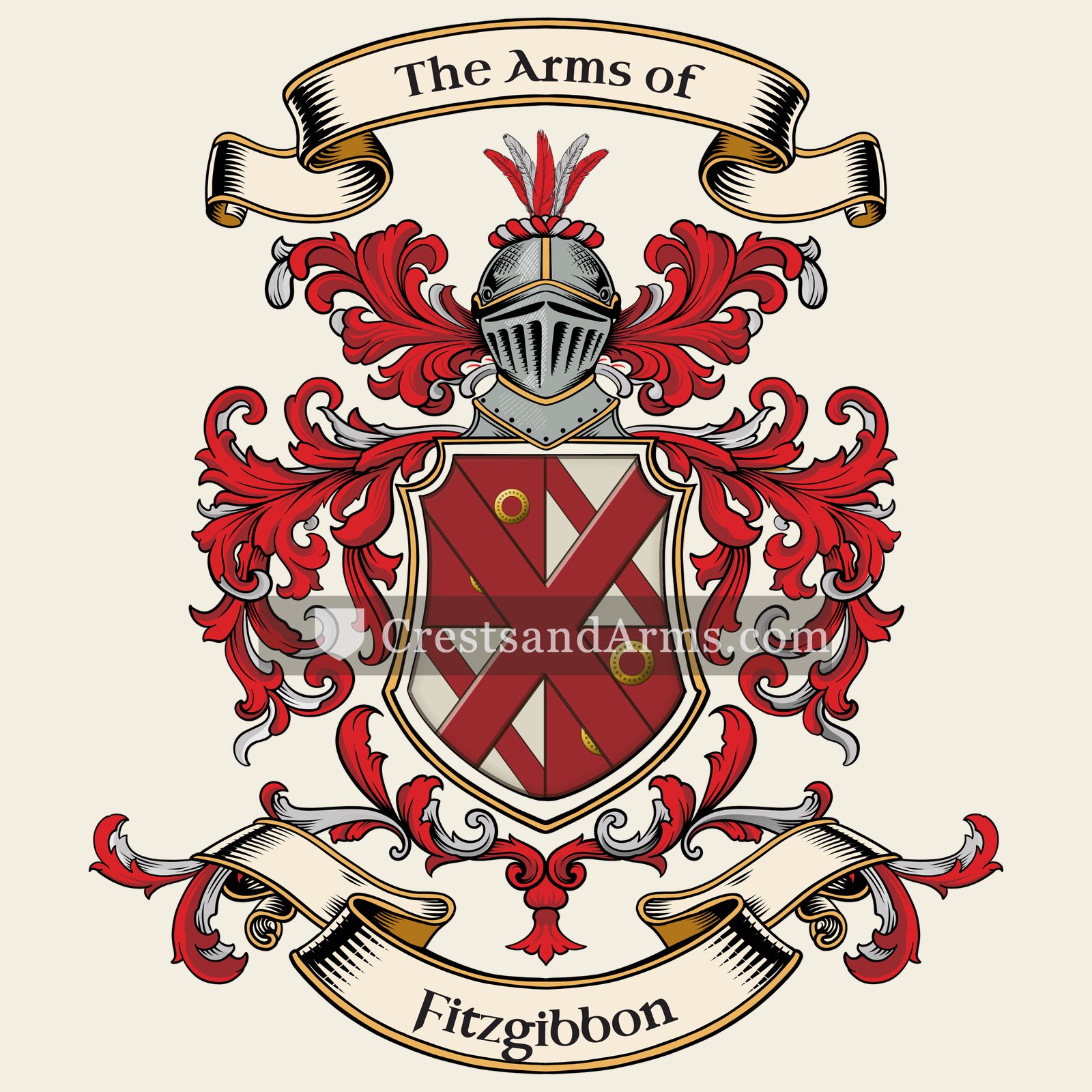


 chiefAuthority, wisdom and dominion