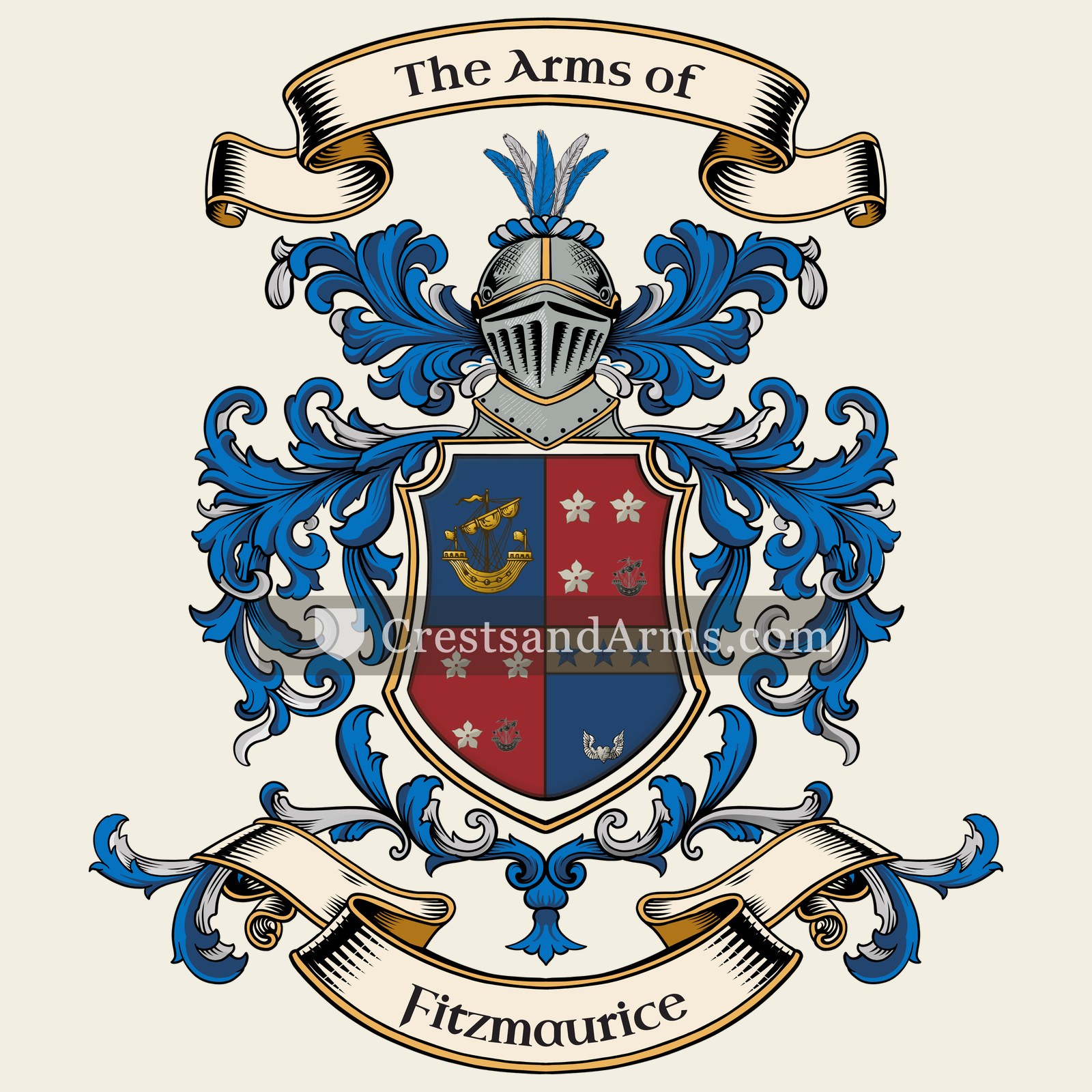
A record of documented arms, meaning and origin, researched for the Fitzmaurice family lines. Documented in 3 countries.
Reg. 7103 · French, D–F
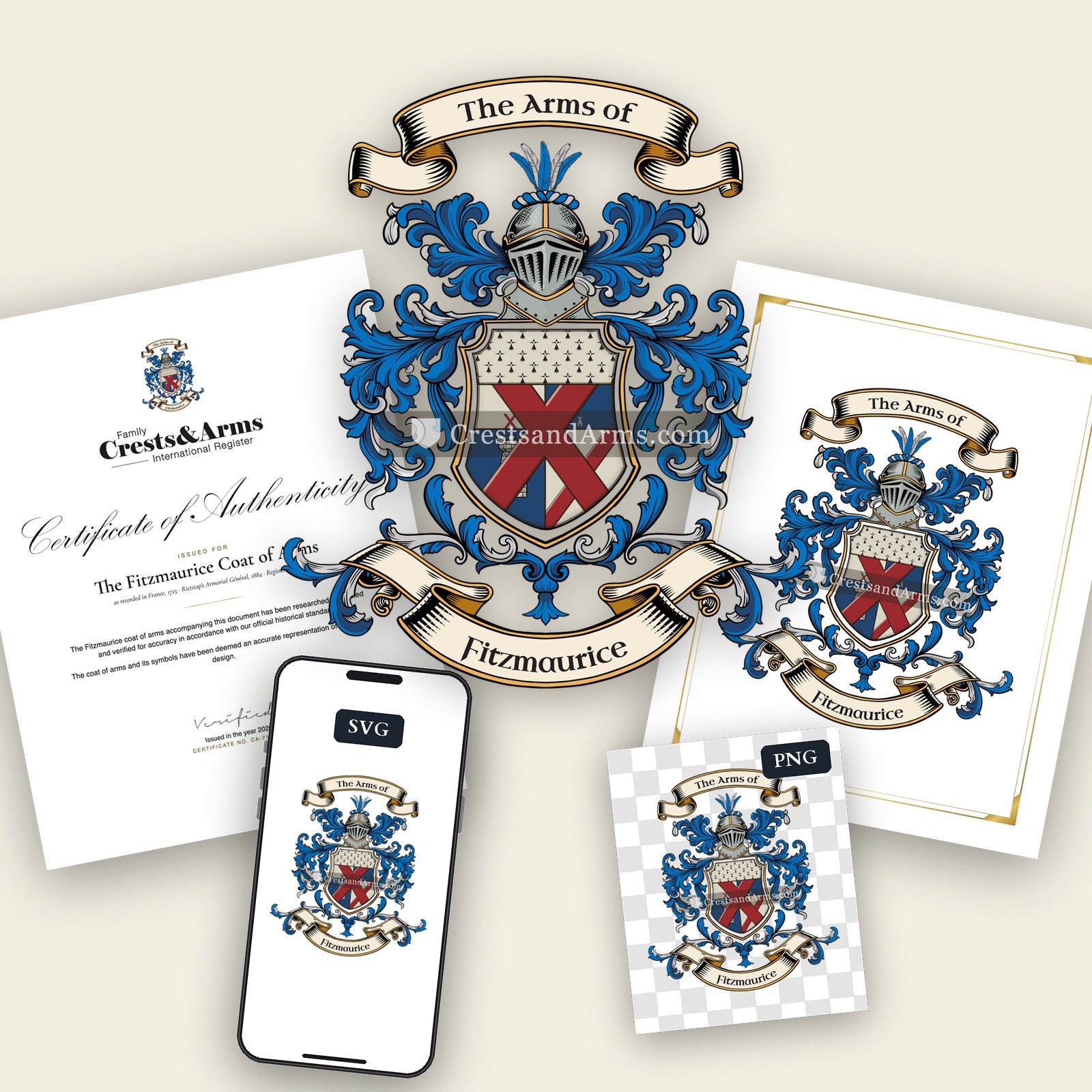
Coat of Arms & Family Crest Details
Symbols on this shield
saltireResolution, and St Andrew's cross
chiefAuthority, wisdom and dominion
towerGrandeur and solidity, and a stronghold defended
Colours
Silver (Argent)Means: Peace and sincerity
Blue (Azure)Means: Loyalty and truth
Red (Gules)Means: Military strength
ErmineMeans: Dignity
Historical info
Source
J. B. Rietstap, Armorial Général, Gouda: G. B. van Goor Zonen, 1884–87
Blazon (the actual original written record)
“Ec.: aux 1 et 4 d'arg. au saut. de gu.; au chef d'herm. (Fitzmaurice); aux 2 et 3 d'azur à une tour d'arg. (Mac Cloade). C.: un centaure-sagittaire, la partie humaine de carn., le reste d'arg. S.: à dextre un lion de gu., à sen. un griffon d'or. D.: VIRTUTE NON VERBIS.”
Francec. 1725
Digital archive packCoat of arms PNG, gold border print PDF, vector SVG and the certificate of authenticity. Sent to your email in minutes.
Map of France showing where the Fitzmaurice arms are recorded
The Fitzmaurice arms were recorded in France, c. 1725.
Arms such as these were typically recorded in Bretagne.
More families held coats of arms in Bretagne than anywhere else in France. The land was divided into many small estates rather than a few large ones, so far more households counted as gentry, and each needed a shield of its own to be told apart.
This is where the arms were entered in the register. Families often moved to other parts of the country, so the same name can turn up in more than one region.
The body that granted and recorded arms in France in this period.
Louis XV of France
Sovereign of the period
Louis XV of France
1715–1774
Reigning in France when the Fitzmaurice arms are first recorded.
How Arms Worked in France
In France, a coat of arms was a mark of honor that passed down through the male line to all legitimate descendants. Families often used the same shield without changes to show their shared heritage. If a branch wanted to stand out, they could add a small mark to their shield to show their specific place in the family tree.
Granting authority
The Juge d'armes de France acted as the official authority that regulated and verified coats of arms across the country.
How they got arms
Families typically inherited their arms from ancestors, though they could also receive them through royal grants or by proving their noble status.
Where arms were recorded
Coats of arms were officially recorded in the Armorial Général de France, which began its main collection in the year 1696.
The family's standing
Recorded among the armigerous families of France.
Origin & History of the Fitzmaurice Family in France
The Fitzmaurice name has deep roots that stretch across the English Channel into the region of Brittany, France. While the name is famously associated with the Anglo-Norman expansion into Ireland, members of the family established a significant presence in the French province of Bretagne by the early eighteenth century. By 1725, records indicate that these individuals were integrated into the local social and professional structures of the region. This migration was often driven by the complex political and military alliances of the era, which frequently saw families moving between the British Isles and the continent. Once in France, the family adapted to the local culture while maintaining their distinct identity. Their presence in Brittany highlights the long history of movement and cultural exchange between the coastal regions of France and the neighboring islands.
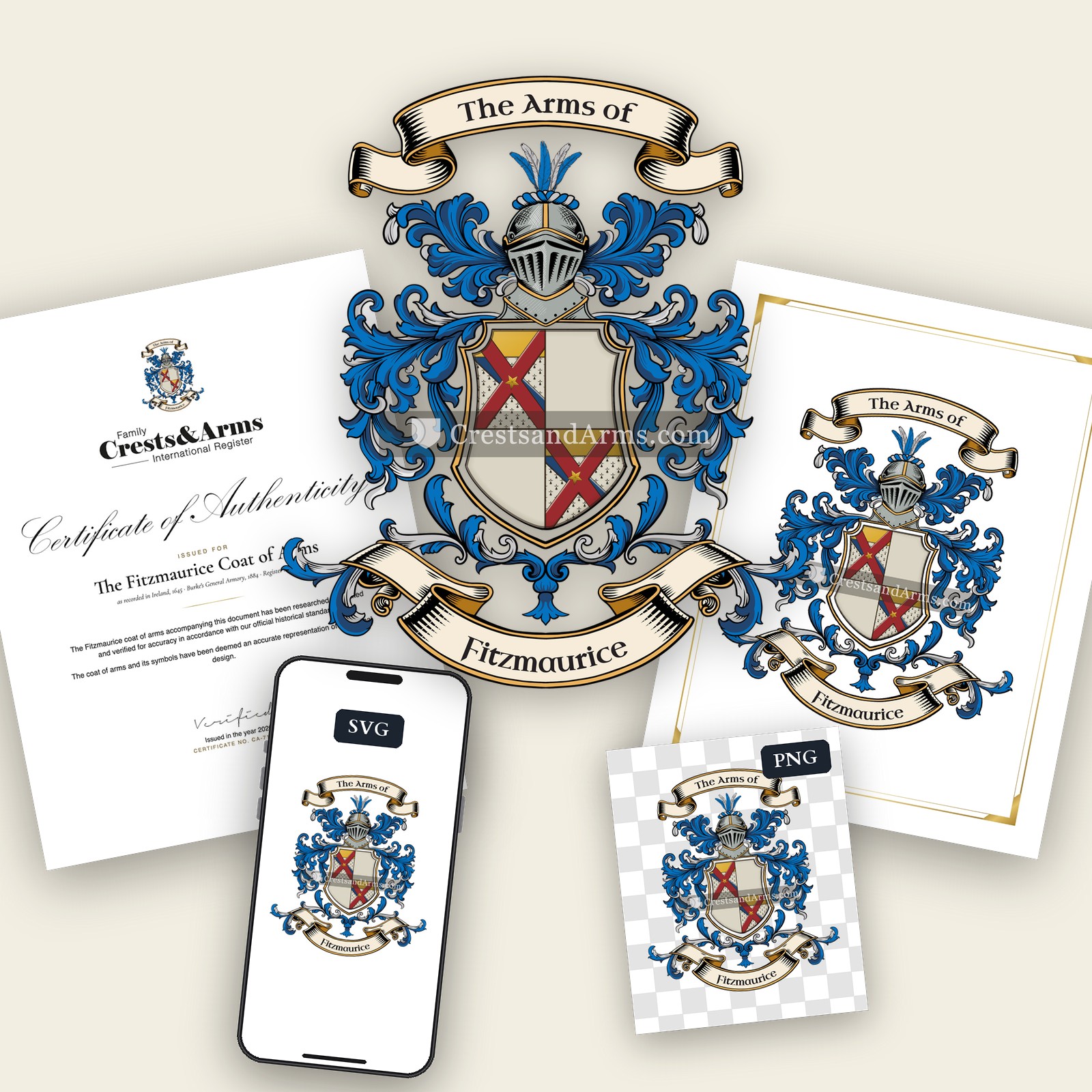
Coat of Arms & Family Crest Details
Symbols on this shield
bendDefence, and the scarf of a commander
saltireResolution, and St Andrew's cross
chiefAuthority, wisdom and dominion
mulletThe third son, and a divine quality from above
Colours
ErmineMeans: Dignity
Silver (Argent)Means: Peace and sincerity
Blue (Azure)Means: Loyalty and truth
Gold (Or)Means: Generosity
Red (Gules)Means: Military strength
Historical info
Source
Sir Bernard Burke, The General Armory of England, Scotland, Ireland and Wales, London: Harrison & Sons, 1884
Blazon (the actual original written record)
“Quarterly, 1st and 4th, erm. on a bend az. a magnetic needle pointing at a polar star or, for PETTY; 2nd and 3rd, ar. a saltire gu. a chief erm., for FITZ-MAURICE”
KerryLansdowne · Kerry, c. 1645
Digital archive packCoat of arms PNG, gold border print PDF, vector SVG and the certificate of authenticity. Sent to your email in minutes.
Map of Ireland showing where the Fitzmaurice arms are recorded
The Fitzmaurice arms were recorded in Kerry, c. 1645.
Kerry was mountain and coast country in the far south-west of Ireland. Its land was poor and held by a few families for a very long time, and long unbroken holding fills a register.
This is where the arms were entered in the register. Families often moved to other parts of the country, so the same name can turn up in more than one region.
The body that granted and recorded arms in Ireland in this period.
Charles I of England
Sovereign of the period
Charles I of England
1625–1649
Reigning in France when the Fitzmaurice arms are first recorded.
How Arms Worked in Ireland
The Ulster King of Arms granted coats of arms to individuals who proved their social standing and good character. These symbols were typically inherited by all legitimate descendants of the original holder. If a family branch wanted a unique look, they could apply for a specific change to their design through the office to ensure their identity remained distinct.
Granting authority
The Ulster King of Arms acted as the official body that regulated and issued all coats of arms throughout Ireland.
How they got arms
Families obtained their arms through formal grants issued by the office after proving their eligibility and paying the required fees.
Where arms were recorded
All official grants were recorded in the registers held by the Ulster King of Arms starting from the year 1552.
The family's standing
Recorded among the armigerous families of Kerry.
Origin & History of the Fitzmaurice Family in Ireland
The Fitzmaurice name has deep roots in Ireland that trace back to the Norman invasion of the twelfth century. The family originated from the Anglo-Norman leader Maurice FitzGerald, whose descendants adopted the surname to signify their status as the sons of Maurice. By the time the family was firmly established in County Kerry in 1645, they had become deeply integrated into the local landscape and political structure of the region. They held significant lands and influence, often acting as powerful lords who navigated the complex shifts in Irish power between the native Gaelic chieftains and the incoming English administration. Over several centuries, the family transitioned from being seen as foreign settlers to becoming a central part of the history and culture of Kerry. Their presence in the seventeenth century reflects a long period of adaptation where they balanced their Norman heritage with the traditions of the Irish people among whom they lived.
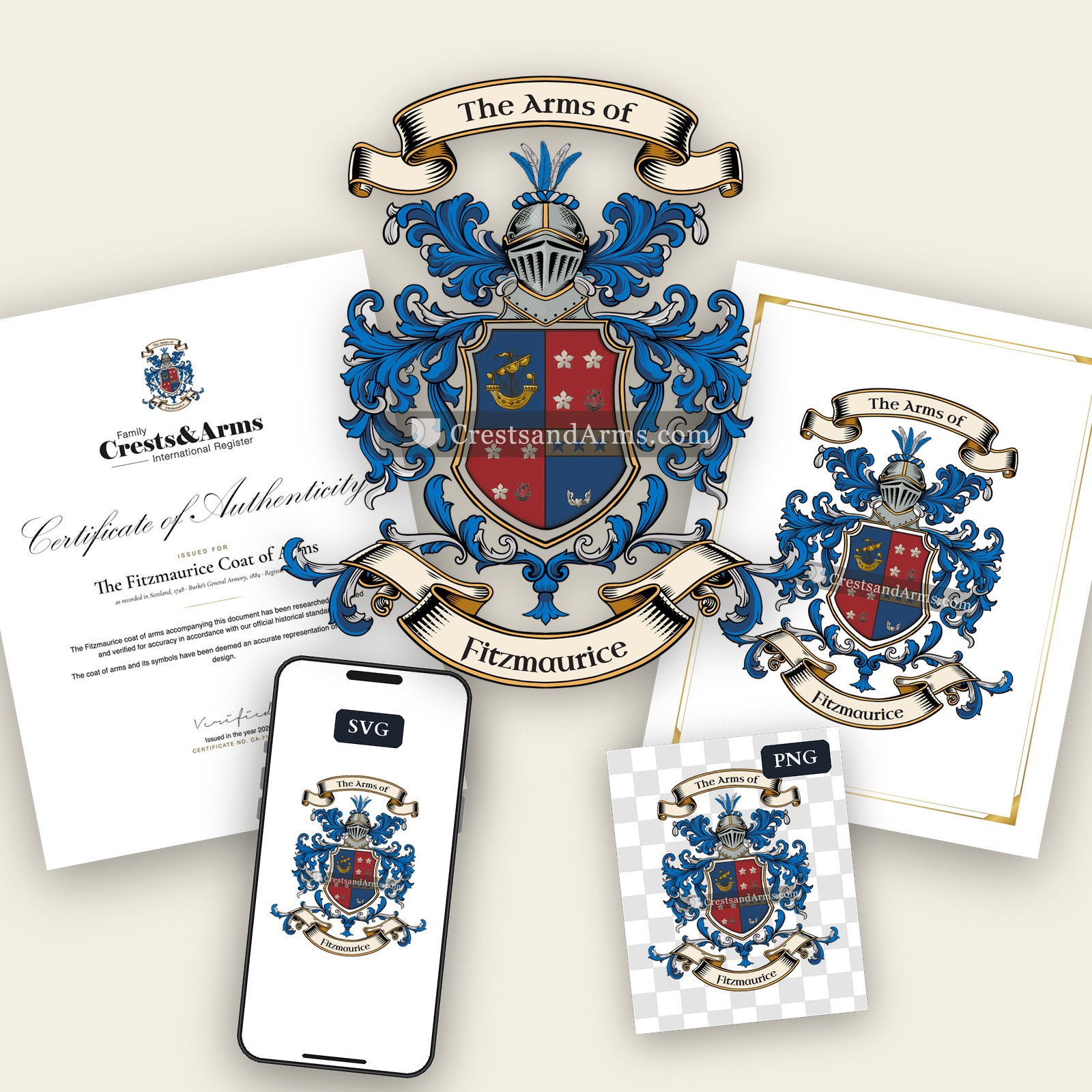
Coat of Arms & Family Crest Details
Symbols on this shield
chiefAuthority, wisdom and dominion
shipEnterprise, and a great voyage undertaken
cinquefoilHope and joy
heartSincerity, charity and true affection
mulletThe third son, and a divine quality from above
Colours
Blue (Azure)Means: Loyalty and truth
Red (Gules)Means: Military strength
Gold (Or)Means: Generosity
ErmineMeans: Dignity
Black (Sable)Means: Constancy
Historical info
Source
Sir Bernard Burke, The General Armory of England, Scotland, Ireland and Wales, London: Harrison & Sons, 1884
Blazon (the actual original written record)
“Quarterly, 1st, az. a ship at anchor, oars crossed in saltire, within a double-tressure flory counterflory or, for ORKNEY; 2nd, quarterly, 1st and 4th, gu. three cinquefoils erm., for HAMILTON, 2nd and 3rd, ar. a ship sails furled sa., for ARRAN; 4th, ar. a human heart imperially crowned ppr. on a chief az. three mullets of the field, for DOUGLAS”
OrkneyOrkney, c. 1748
Digital archive packCoat of arms PNG, gold border print PDF, vector SVG and the certificate of authenticity. Sent to your email in minutes.
Map of Scotland showing where the Fitzmaurice arms are recorded
The Fitzmaurice arms were recorded in Orkney, c. 1748.
Orkney was Norse country until it came to Scotland in 1468, and its landholders kept Norse customs after. Families held their own ground outright, and outright holding brought arms.
This is where the arms were entered in the register. Families often moved to other parts of the country, so the same name can turn up in more than one region.
The body that granted and recorded arms in Scotland in this period.
George II of Great Britain
Sovereign of the period
George II of Great Britain
1727–1760
Reigning in France when the Fitzmaurice arms are first recorded.
How Arms Worked in Scotland
Scottish heraldry is unique because it treats a coat of arms as a piece of personal property protected by law. Only one person can own a specific design at any given time. When a family grows, the head keeps the original shield while other relatives must apply for their own distinct version with slight changes to prove their specific identity.
Granting authority
The Court of the Lord Lyon acts as the official body that regulates and controls all heraldic matters throughout Scotland.
How they got arms
Individuals obtain a legal right to their arms through a formal petition process that confirms their identity and family connection.
Where arms were recorded
All valid coats of arms are officially entered into the Public Register of All Arms and Bearings starting from 1672.
The family's standing
Recorded among the armigerous families of Orkney.
Origin & History of the Fitzmaurice Family in Scotland
The name Fitzmaurice is primarily associated with the Anglo-Norman influence in Ireland, but its presence in Scotland reveals a distinct chapter of movement and settlement. The prefix Fitz indicates a son of Maurice, a name that became prominent across the British Isles after the arrival of the Normans. By the mid-eighteenth century, historical records confirm that members of the Fitzmaurice family were established in the Orkney Islands. This northern archipelago served as a crossroads for maritime trade and cultural exchange between Scotland and Scandinavia. Families residing in Orkney during this period often navigated the complex social structures of island life, which were shaped by both Scottish law and long-standing Norse traditions. The arrival of the family in this remote region suggests a history of migration that likely followed the paths of trade or military service common to the era. While their roots trace back to broader European lineages, the Fitzmaurices in Orkney became part of the unique social fabric of the northern isles during the eighteenth century.
Fitzmaurice Meaning & Related Branches
Root word
Mauritius
Derived from the Latin word for a person from Mauretania or dark-skinned.
This name
FitzmauriceAn Anglo-Norman surname meaning son of Maurice, representing a descendant of the dark-skinned one.
also spelled
Fizmaurice
Phitzmaurice
Fitzmorys
Fitzmauris
Fitzmaurise
Related arms
Mac Sweeneyrecorded with Fitzmaurice, same area
Documented Sources
J. B. Rietstap, Armorial Général, Gouda: G. B. van Goor Zonen, 1884–87
Archives départementales d'Ille-et-Vilaine, Registres paroissiaux et d'état civil, 1725
Archives départementales du Morbihan, Série E, État civil et registres paroissiaux, 1725
Butler, W. F. T., Gleanings from Irish History, 1925
Digital archive packCoat of arms PNG, gold border print PDF, vector SVG and the certificate of authenticity. Sent to your email in minutes.


 saltireResolution, and St Andrew's cross
 chiefAuthority, wisdom and dominion
 towerGrandeur and solidity, and a stronghold defended
 saltireResolution, and St Andrew's cross
 chiefAuthority, wisdom and dominion
 towerGrandeur and solidity, and a stronghold defended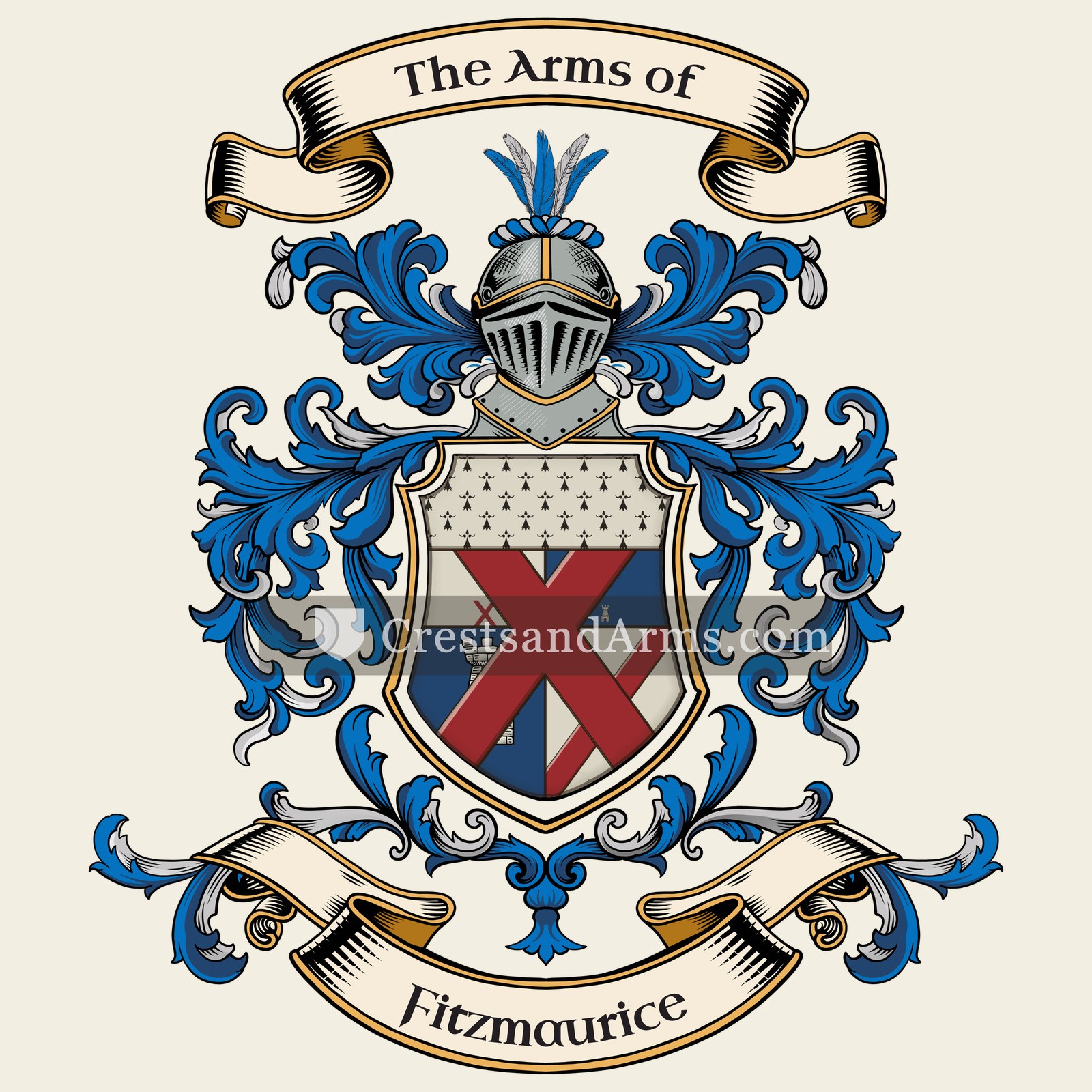


 bendDefence, and the scarf of a commander
 mulletThe third son, and a divine quality from above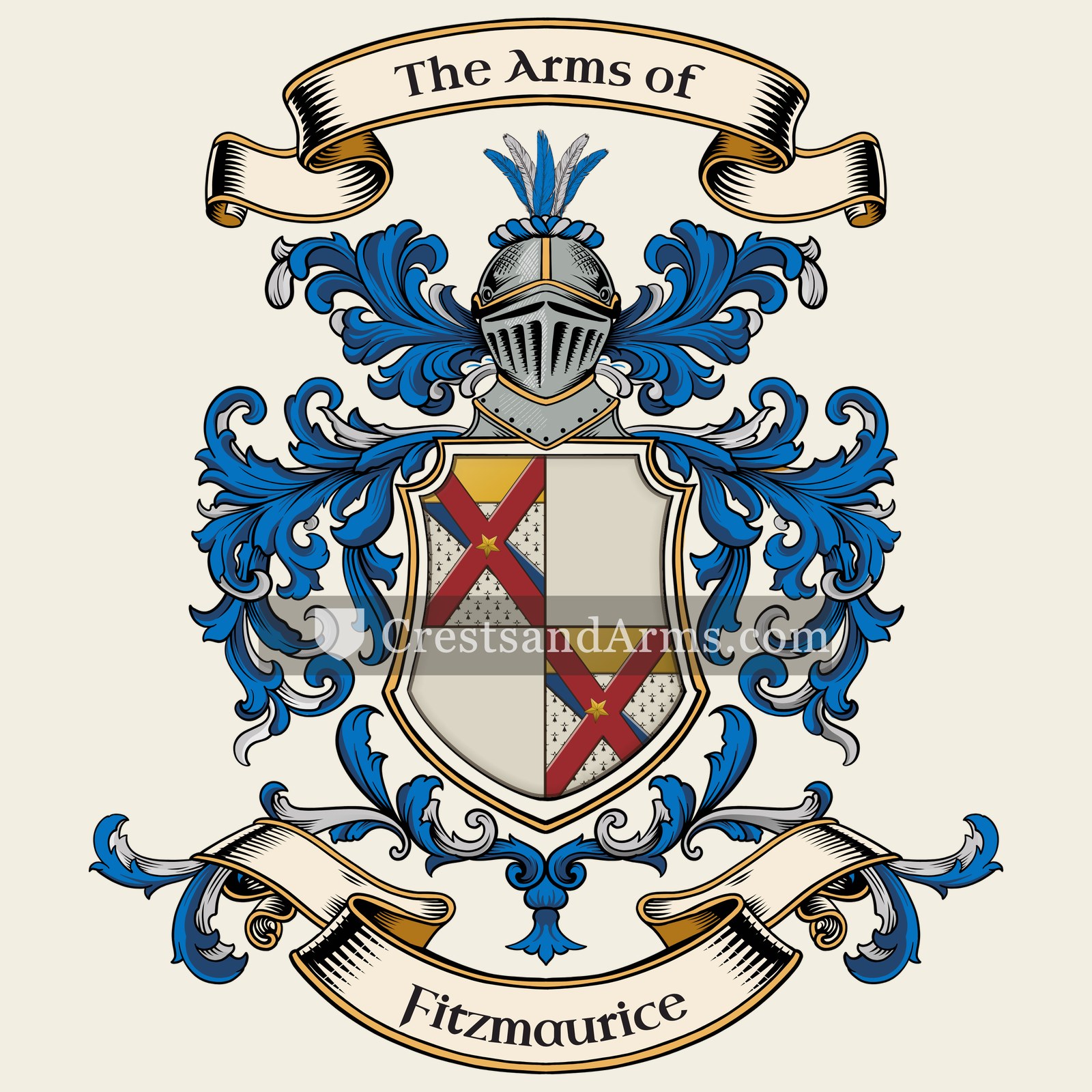


 shipEnterprise, and a great voyage undertaken
 cinquefoilHope and joy
 heartSincerity, charity and true affection