A record of documented arms, meaning and origin, researched for the Flade family lines. Documented in 2 countries.
Reg. 9766 · German, D–F
Meaning of the Flade family crest colors & symbols
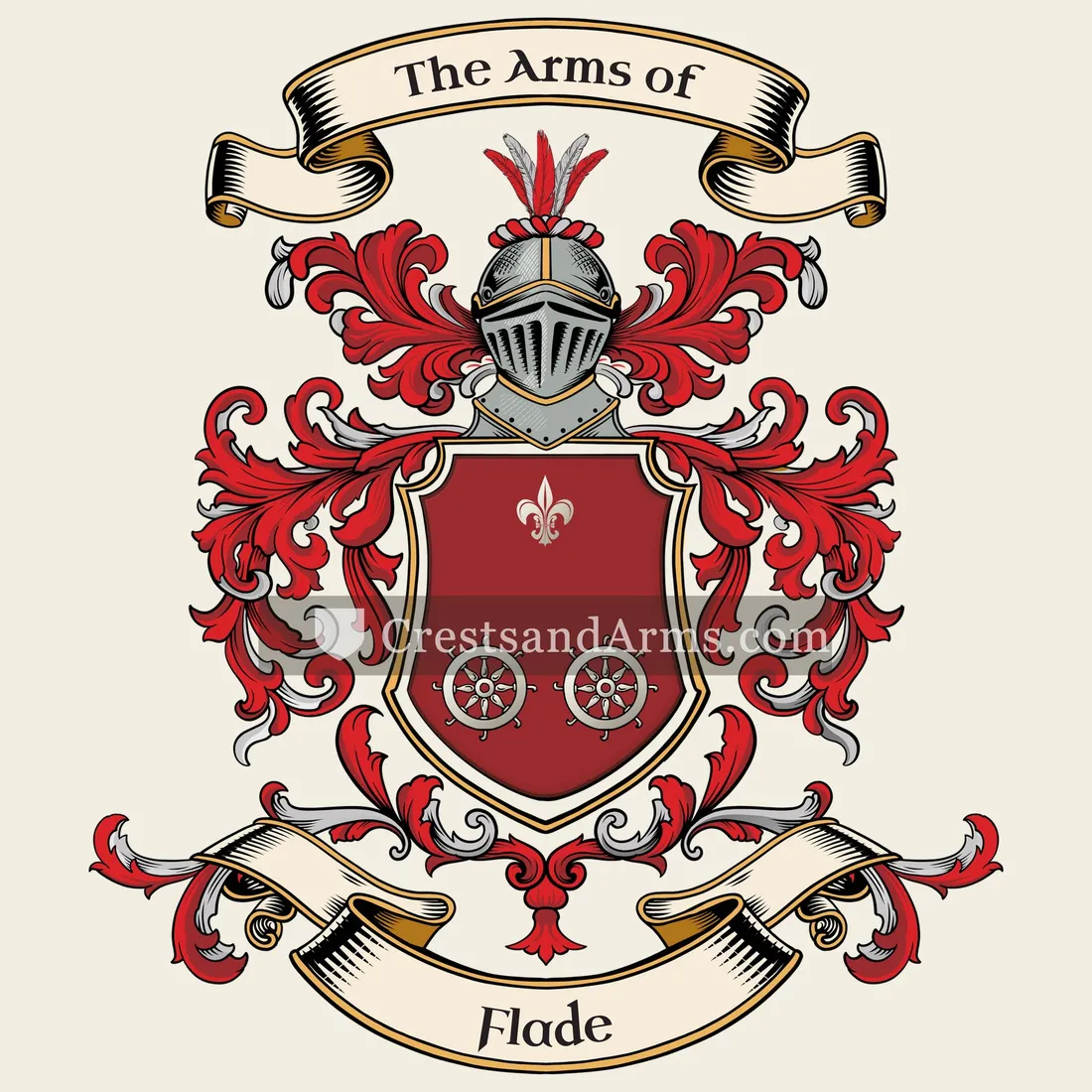
Symbols on this shield
wheelFortune's turning, and the carter's trade
fleur de lisPurity, light, and the sixth son
Colours
Red (Gules)Means: Military strength
Silver (Argent)Means: Peace and sincerity
Historical info
Source
J. B. Rietstap, Armorial Général, Gouda: G. B. van Goor Zonen, 1884–87
Blazon (the actual original written record)
“De gu. à deux demi-roues adossées d'arg., acc. en chef d'une fleur-de-lis du même. Cq. cour. C.: une fleur-de-lis d'arg.; entre un vol de gu., l'aile dextre ch. de la moitié sen. et l'aile sen. de la moitié dextre d'une roue d'arg.”
Germanyc. 1765
Digital archive packCoat of arms PNG, gold border print PDF, vector SVG and the certificate of authenticity. Sent to your email in minutes.
Map of Germany showing where the Flade arms are recorded
The Flade arms were recorded in Germany, c. 1765.
Arms such as these were typically recorded in Bavaria.
Bavaria was a country of old landed families and walled market towns. Estates passed down the same line for centuries, and both the landowners and the leading townsmen kept arms, which is why so many Bavarian names sit in the registers.
This is where the arms were entered in the register. Families often moved to other parts of the country, so the same name can turn up in more than one region.
The body that granted and recorded arms in Germany in this period.
Francis I, Holy Roman Emperor
Sovereign of the period
Francis I, Holy Roman Emperor
1745–1765
Reigning in Germany when the Flade arms are first recorded.
How Arms Worked in Germany
In the Holy Roman Empire, coats of arms were often granted to individuals by the Emperor or his representatives. These arms were then passed down through the generations to all legitimate descendants of the original holder. Younger branches of a family usually kept the same shield design without needing to change it, as the arms belonged to the entire lineage.
Granting authority
The Holy Roman Emperor held the sole power to grant new coats of arms throughout his vast imperial territories.
How they got arms
Families typically obtained their coats of arms through a formal imperial grant or by proving their noble status to the authorities.
Where arms were recorded
These grants were officially recorded in the Imperial Chancery registers, which began keeping formal records of such honors during the Middle Ages.
The family's standing
Recorded among the armigerous families of Germany.
Origin & History of the Flade Family in Germany
The surname Flade has deep roots in the southern German region of Bavaria, where the family was well-established by the middle of the eighteenth century. The name itself is likely derived from the Middle High German word "vlade," which referred to a flat cake or a type of bread. In medieval times, names often described a person’s occupation or a specific physical trait, suggesting that the earliest ancestors to carry this name may have been bakers or people known for making these traditional flatbreads. By 1765, records confirm that the Flade family was integrated into the local community, living through a period of significant agricultural and social change in the Bavarian countryside. As the family grew, they became part of the fabric of village life, participating in the local traditions and economic activities that defined the region during the late Holy Roman Empire.
Meaning of the Flade family crest colors & symbols
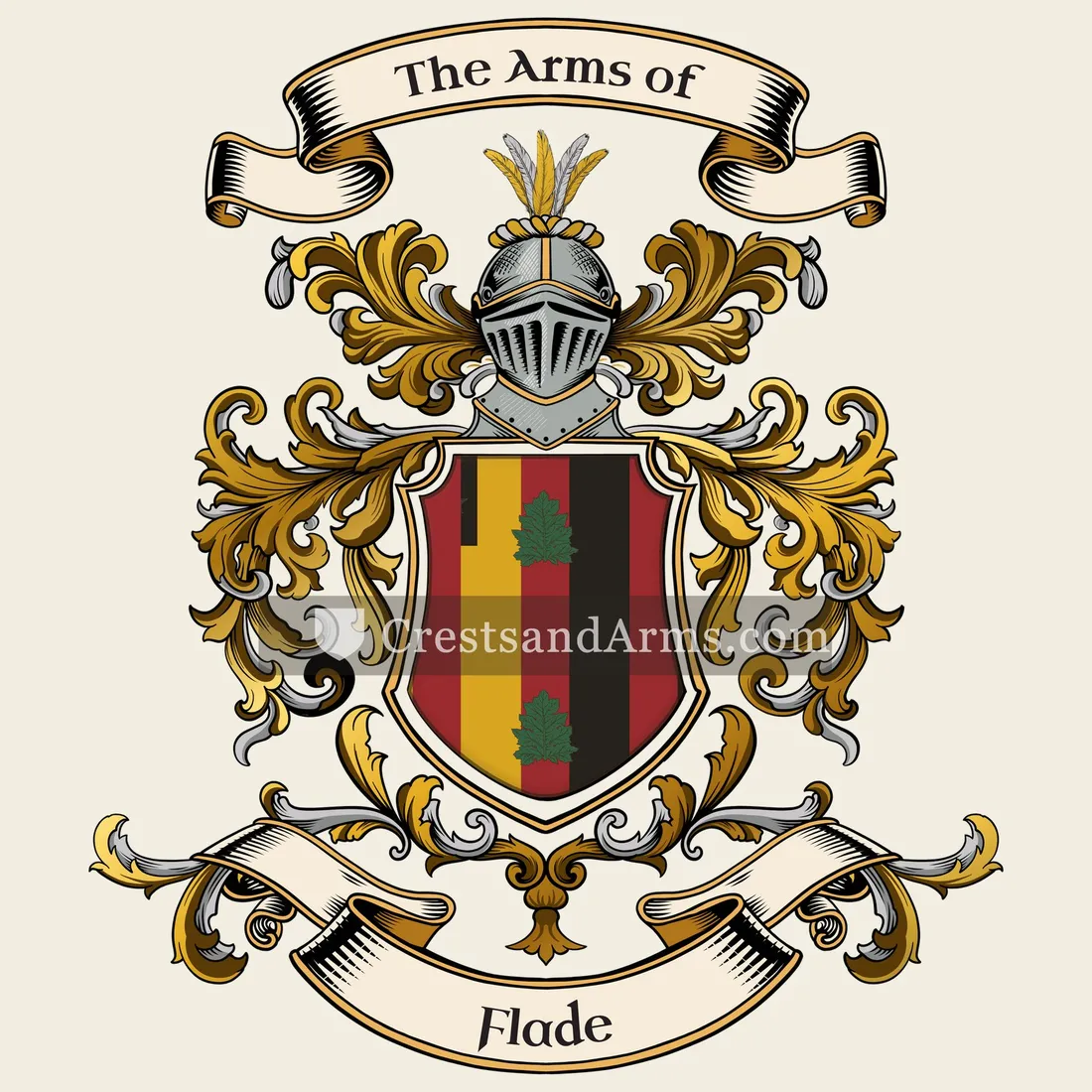
Symbols on this shield
paleMilitary strength, and a fortified defence
cantonA mark of honour granted by the sovereign
leafHappiness and abundance
mulletThe third son, and a divine quality from above
Colours
Gold (Or)Means: Generosity
Black (Sable)Means: Constancy
Red (Gules)Means: Military strength
Green (Vert)Means: Hope
Historical info
Source
J. B. Rietstap, Armorial Général, Gouda: G. B. van Goor Zonen, 1884–87
Blazon (the actual original written record)
“Parti: au 1 d'or à trois pals de gu.; au canton sen. de sa., ch. d'une étoile du champ; au 2 de sa. à la bande ondée d'arg. Sur le tout de gu. à deux feuilles de nénuphar de sin. mouv. d'une seule tige, passée dans un anneau d'or. C.: 1° un écusson aux armes du 1, entre un vol coupé de gu. sur or; 2° un homme iss., hab. de gu., tenant de chaque main une feuille de nénuphar de sin.; 3° un écusson aux armes du 2, entre deux prob. coupées de sa. sur arg. L.: à dextre d'arg. et de sa., à sen. d'or et de gu.”
BavariaBavaria, c. 1663
Digital archive packCoat of arms PNG, gold border print PDF, vector SVG and the certificate of authenticity. Sent to your email in minutes.
Map of France showing where the Flade arms are recorded
The Flade arms were recorded in Bavaria, c. 1663.
Bavaria was a country of old landed families and walled market towns. Estates passed down the same line for centuries, and both the landowners and the leading townsmen kept arms, which is why so many Bavarian names sit in the registers.
This is where the arms were entered in the register. Families often moved to other parts of the country, so the same name can turn up in more than one region.
The body that granted and recorded arms in France in this period.
Louis XIV of France
Sovereign of the period
Louis XIV of France
1643–1715
Reigning in Germany when the Flade arms are first recorded.
How Arms Worked in France
In France, a coat of arms was a mark of honor that passed down through the male line to all legitimate descendants. Families often used the same shield without changes to show their shared heritage. If a branch wanted to stand out, they could add a small mark to their shield to show their specific place in the family tree.
Granting authority
The Juge d'armes de France acted as the official authority that regulated and verified coats of arms across the country.
How they got arms
Families typically inherited their arms from ancestors, though they could also receive them through royal grants or by proving their noble status.
Where arms were recorded
Coats of arms were officially recorded in the Armorial Général de France, which began its main collection in the year 1696.
The family's standing
Recorded among the armigerous families of Bavaria.
Origin & History of the Flade Family in France
The surname Flade is deeply rooted in the Germanic regions of Central Europe, with documented evidence placing the family in Bavaria as early as 1663. While the name is primarily associated with German heritage, the movement of people across borders during the seventeenth century suggests that families with this name likely interacted with neighboring cultures, including those in the eastern territories of France. During this period, the borders between the German states and the French provinces of Alsace and Lorraine were fluid, often shifting due to regional conflicts and political treaties. Families like the Flades were frequently part of the mobile population of craftsmen and farmers who moved through these borderlands to find stability or new land. Because the name is derived from terms related to flat surfaces or specific types of bread, it likely began as a descriptive nickname for an ancestor before becoming a permanent family identifier. This history reflects the broader pattern of European families who maintained their cultural identity while adapting to the changing political landscape of the seventeenth-century continent.
Flade Meaning & Related Branches
Root word
Flad
A flat surface or a level piece of land.
This name
FladeA topographic name for someone who lived on a flat or level area of land.
Documented Sources
J. B. Rietstap, Armorial Général, Gouda: G. B. van Goor Zonen, 1884–87
Bahlow, Hans, Deutsches Namenlexikon: Familien- und Vornamen nach Ursprung und Sinn erklärt, 1967
Heintze, Albert, Die deutschen Familiennamen: geschichtlich, geographisch, sprachlich, 1903


 wheelFortune's turning, and the carter's trade
 fleur de lisPurity, light, and the sixth son
 wheelFortune's turning, and the carter's trade
 fleur de lisPurity, light, and the sixth son


 paleMilitary strength, and a fortified defence
 cantonA mark of honour granted by the sovereign
 leafHappiness and abundance
 mulletThe third son, and a divine quality from above