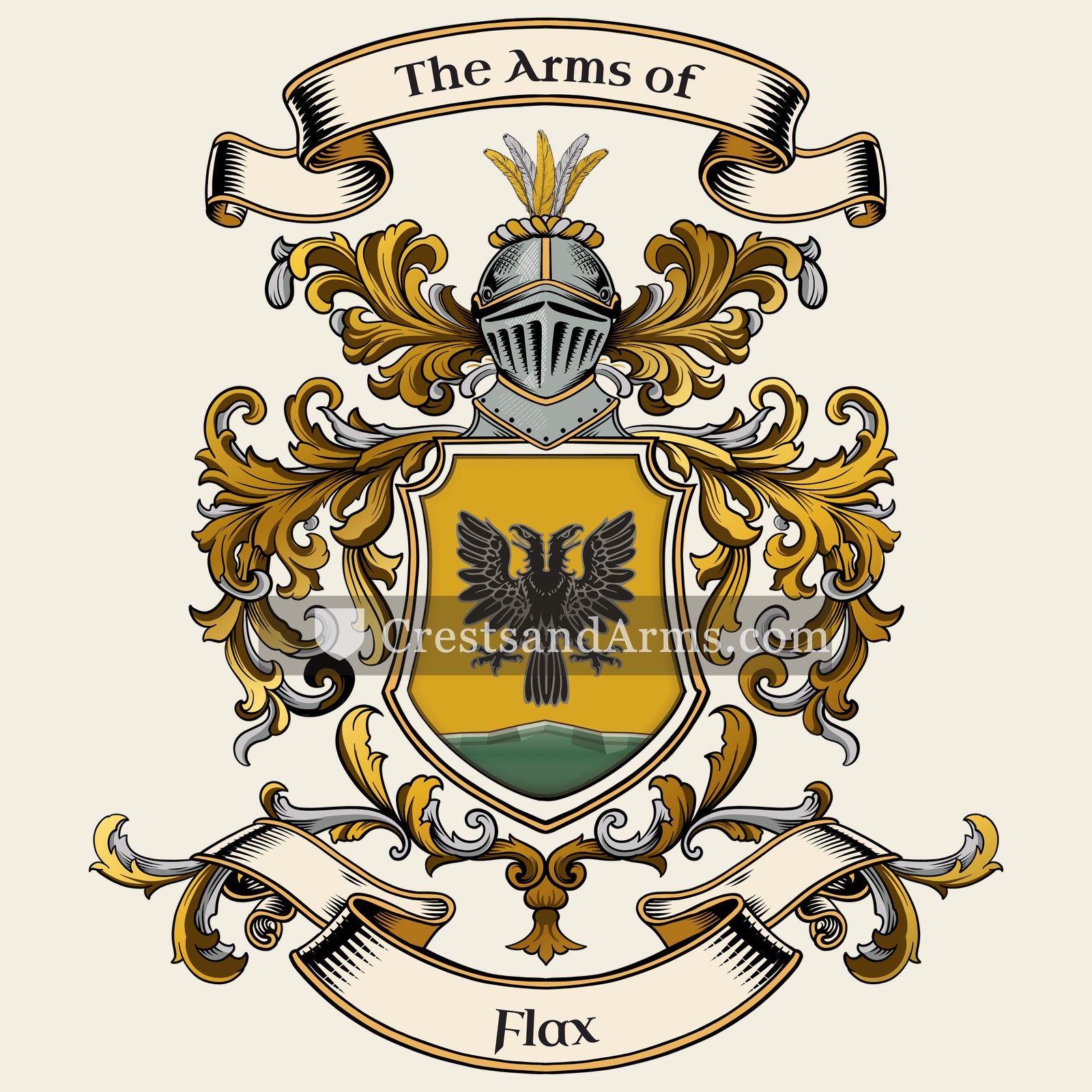
A record of documented arms, meaning and origin, researched for the Flax family of Germany.
Reg. 1588 · German, D–F
Coat of Arms & Family Crest Details
Symbols on this shield
mountThe ground held, and steadfastness upon it
eagleNobility, strength and a keen mind
Colours
Gold (Or)Means: Generosity
Green (Vert)Means: Hope
Black (Sable)Means: Constancy
Historical info
Source
J. B. Rietstap, Armorial Général, Gouda: G. B. van Goor Zonen, 1884–87
Blazon (the actual original written record)
“D'or à une aigle de profil ess. de sa., cour. du champ, tenant en son bec un rameau de sin. et posé sur un tertre du même. Cq. cour. C.: une branche de rosier de sin., fleurie de trois pièces de gu.; entre un vol, coupé alt. de sa. et d'or. L.: à dextre d'or et de sa., à sen. d'or et de gu.”
GermanyNuremberg, c. 1765
Where the Flax Arms Were Recorded
Nuremberg
Map of Germany showing where the Flax arms are recorded
The Flax arms were recorded in Nuremberg, c. 1765.
This is where the arms were entered in the register. Families often moved to other parts of the country, so the same name can turn up in more than one region.
The body that granted and recorded arms in Germany in this period.
Francis I, Holy Roman Emperor
Sovereign of the period
Francis I, Holy Roman Emperor
1745–1765
Reigning in Germany when the Flax arms are first recorded.
How Arms Worked in Germany
In the Holy Roman Empire, coats of arms were often granted to individuals by the Emperor or his representatives. These arms were then passed down through the generations to all legitimate descendants of the original holder. Younger branches of a family usually kept the same shield design without needing to change it, as the arms belonged to the entire lineage.
Granting authority
The Holy Roman Emperor held the sole power to grant new coats of arms throughout his vast imperial territories.
How they got arms
Families typically obtained their coats of arms through a formal imperial grant or by proving their noble status to the authorities.
Where arms were recorded
These grants were officially recorded in the Imperial Chancery registers, which began keeping formal records of such honors during the Middle Ages.
The family's standing
Recorded among the armigerous families of Germany.
Origin & History of the Flax Family in Germany
The surname Flax is rooted in the occupational history of Central Europe, where it likely originated as a descriptive name for individuals involved in the cultivation or processing of the flax plant. During the eighteenth century, the production of linen was a vital industry in the Holy Roman Empire, and families often adopted surnames based on their primary trade. By 1765, records confirm that members of the Flax family were established in Nuremberg, a major center for commerce and skilled craftsmanship at the time. Living in such a bustling city suggests that these early ancestors were likely integrated into the urban guilds or merchant networks that defined the local economy. Over time, the name transitioned from a simple reference to a profession into a permanent family identifier, marking the lineage as part of the industrious middle class that helped sustain the region's economic growth.
Related Branches & Arms
Root word
Flachs
A plant with blue flowers used to make linen fiber.
This name
FlaxAn occupational name for a grower or dealer of flax or linen.
also spelled
Flacks
Flaks
Documented Sources
J. B. Rietstap, Armorial Général, Gouda: G. B. van Goor Zonen, 1884–87


 mountThe ground held, and steadfastness upon it
 eagleNobility, strength and a keen mind
 mountThe ground held, and steadfastness upon it
 eagleNobility, strength and a keen mind