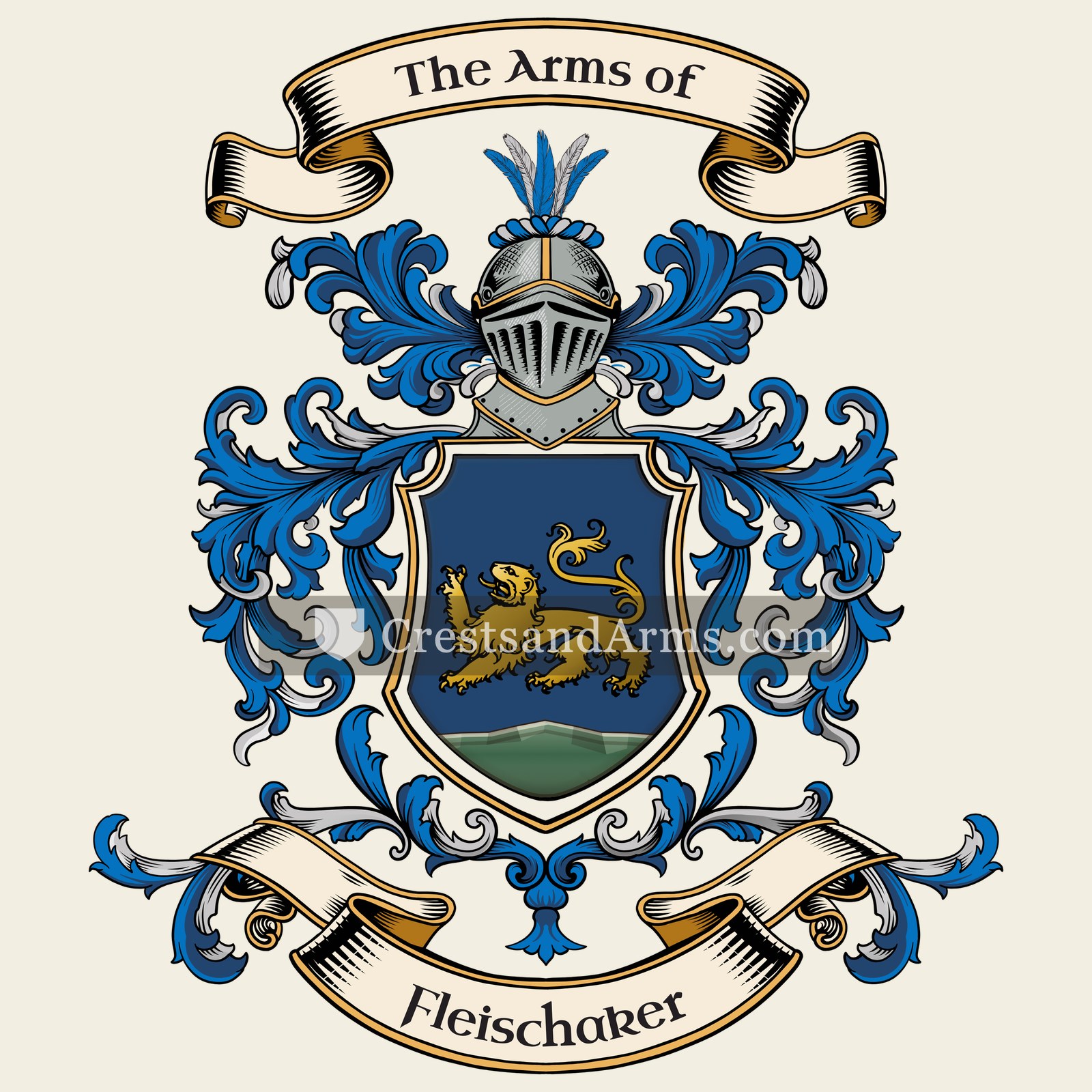
A record of documented arms, meaning and origin, researched for the Fleischaker family of Austria.
Reg. 2750 · Austrian, D–F
Coat of Arms & Family Crest Details
Symbols on this shield
mountThe ground held, and steadfastness upon it
lionCourage, strength and royalty
Colours
Blue (Azure)Means: Loyalty and truth
Green (Vert)Means: Hope
Gold (Or)Means: Generosity
Historical info
Source
J. B. Rietstap, Armorial Général, Gouda: G. B. van Goor Zonen, 1884–87
Blazon (the actual original written record)
“D'azur au lion d'or, cour. du même, soutenu d'un tertre de trois coupeaux de sin., le lion ayant la queue passée entre ses jambes et remontant, tenant de sa patte dextre une épée d'arg., garnie d'or, dirigée vers le canton dextre du chef et de sa sen. un rameau d'olivier de sin., dirigé vers lui-même. Cq. cour. C.: un lion iss. d'or, cour. du même, tenant entre ses pattes un ballot carré d'arg., lié de sa. deux fois sur la longueur et deux fois sur la largeur. L. d'or et d'azur.”
Austriac. 1870
Digital archive packCoat of arms PNG, gold border print PDF, vector SVG and the certificate of authenticity. Sent to your email in minutes.
Map of Austria showing where the Fleischaker arms are recorded
The Fleischaker arms were recorded in Austria, c. 1870.
Arms such as these were typically recorded in Tyrol.
Tyrol was mountain country in western Austria, where the valleys were held by families who had been there a very long time. Old tenure counted for more than money, and old families carried arms.
This is where the arms were entered in the register. Families often moved to other parts of the country, so the same name can turn up in more than one region.
Region
Tyrol
First recorded
1870
Granting Authority for the Fleischaker Arms
Imperial and Royal chancery
Sodacan · CC BY-SA 3.0
The body that granted and recorded arms in Austria in this period.
Franz Joseph I of Austria
Sovereign of the period
Franz Joseph I of Austria
1848–1916
Reigning in Austria when the Fleischaker arms are first recorded.
How Arms Worked in Austria
Austrian coats of arms were often linked directly to noble titles granted by the Emperor. These symbols belonged to the entire family line rather than just one individual. When a family grew, new branches kept the original design without needing to change it. This system allowed all members of a noble house to share the same identity across many generations.
Granting authority
The Imperial and Royal chancery managed all heraldic matters and controlled the official granting of arms throughout the Austrian lands.
How they got arms
Families typically received their arms through a formal imperial decree that often accompanied the elevation of a person to noble status.
Where arms were recorded
Official records of these grants were kept in the Imperial Register of Nobility which began its formal documentation process in 1453.
The family's standing
Recorded among the armigerous families of Austria.
Origin & History of the Fleischaker Family in Austria
The surname Fleischaker is an occupational name that originated in the German-speaking regions of Central Europe. It is derived from the Middle High German word *fleischhackere*, which translates literally to a meat chopper or a butcher. During the medieval period, surnames were often adopted to describe a person’s trade, and this name identified individuals who worked in the local meat markets or slaughterhouses. By the year 1870, records confirm that families bearing this name were well-established in the alpine region of Tyrol. Living in this mountainous area, these early family members likely adapted their trade to the local economy, which relied heavily on livestock farming and the preservation of mountain meats. The name serves as a historical link to the essential role that butchers played in sustaining village life and commerce throughout the nineteenth century.
Related Branches & Arms
Root word
Fleisch
German word for meat or flesh.
This name
FleischakerAn occupational surname for a butcher or someone who sold meat.
also spelled
Flashhaker
Documented Sources
J. B. Rietstap, Armorial Général, Gouda: G. B. van Goor Zonen, 1884–87
Bahlow, Hans, Deutsches Namenlexikon: Familien- und Vornamen nach Ursprung und Sinn erklärt, 1967
Kohlheim, Rosa and Volker Kohlheim, Duden Familiennamen: Herkunft und Bedeutung, 2005
Tiroler Landesarchiv, Standesauskünfte und Zivilstandsregister, 1870
Digital archive packCoat of arms PNG, gold border print PDF, vector SVG and the certificate of authenticity. Sent to your email in minutes.


 mountThe ground held, and steadfastness upon it
 lionCourage, strength and royalty
 mountThe ground held, and steadfastness upon it
 lionCourage, strength and royalty